Published on August 8th, 2026
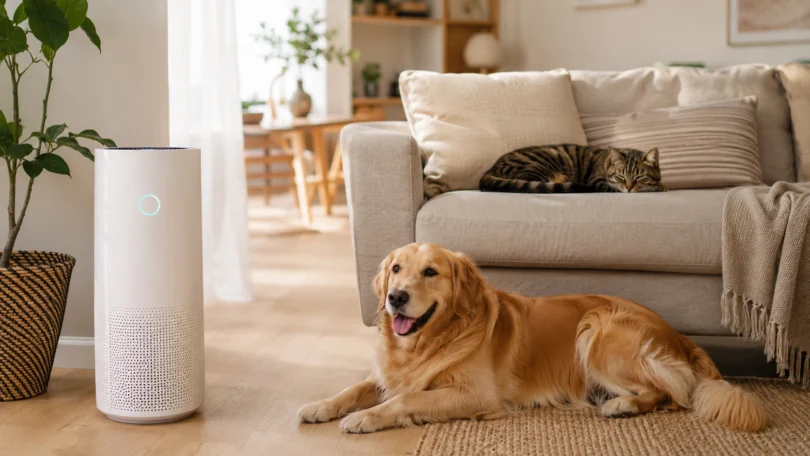
Living with pets is a joy. Cleaning up after them is not.
Cats and dogs shed a steady stream of hair, dander, and odor that settles into carpets, drifts through the air, and clings to furniture. For anyone with allergies, the effect is worse: itchy eyes, a stuffy nose, and restless sleep that no amount of vacuuming seems to fix.
A good air purifier changes the equation. It pulls floating dander and hair out of the air before it lands, traps the fine particles that trigger allergic reactions, and neutralizes the smells that build up in a home shared with animals. The right machine runs quietly in the background and keeps working while life goes on.
The catch is that not every air purifier is built for pet households. Some clog with hair within weeks. Others look impressive on paper but move too little air to matter in a real room. And plenty of models handle dust well yet do nothing for odor.
This guide cuts through the noise. It explains what actually matters when shopping for a pet dander air purifier, reviews six standout models across every budget and room size, and shows how to match a unit to a specific problem, whether that is dog smell in the living room, cat litter box odor down the hall, or allergy relief in the bedroom.
Every pick here is grounded in published specifications and independent testing, chosen for real-world performance rather than marketing claims.
Quick Answer
The best air purifier for pets is one that pairs a true HEPA filter (for dander and allergens) with an activated carbon filter (for odor) and moves enough air to clean the room four to five times per hour.
For most pet owners, the Levoit Vital 200S-P is the strongest all-around choice. Its washable pre-filter and U-shaped intake are engineered specifically to catch pet hair before it clogs the main filter, and it stays quiet during the day.
Quick picks by need:
- Best overall for pets: Levoit Vital 200S-P
- Best value and reliability: Coway Airmega AP-1512HH Mighty
- Best for pet odor: Winix 5510
- Best smart features: Levoit Core 400S
- Best for large rooms and multiple pets: Alen BreatheSmart 75i
- Best budget pick for small rooms: Levoit Core 300S
How Air Purifiers Help Pet Owners
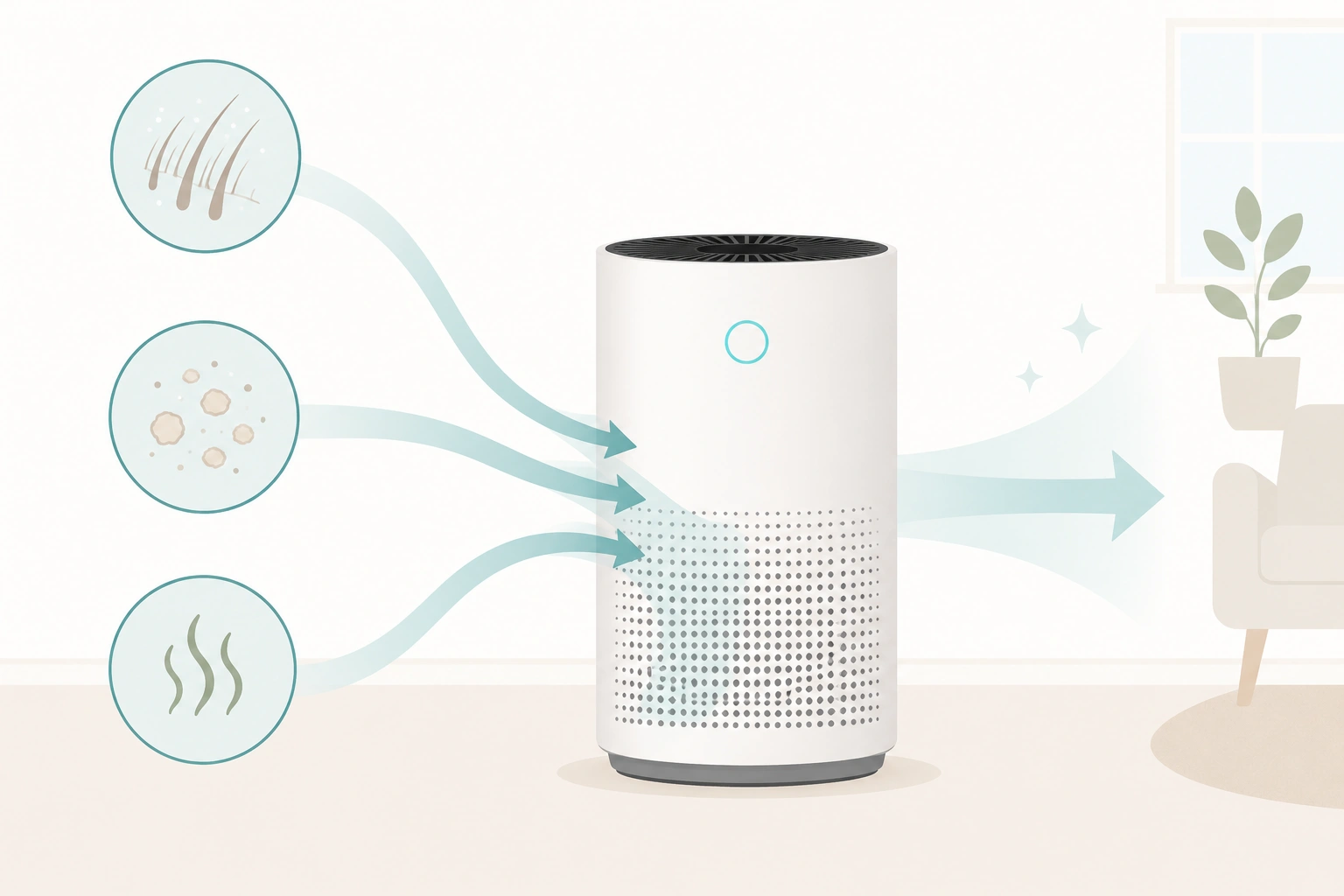
Pet-related air problems come in three forms, and each one behaves differently.
Pet hair and fur are the visible part. Hair is heavy enough to settle on floors and furniture, but the constant movement of a household kicks it back into the air. An air purifier with a strong pre-filter grabs this hair at the intake, which keeps it out of the room and protects the finer filters behind it.
Pet dander is the invisible part, and it is the real trigger for most allergies. Dander is made of tiny flakes of skin, and the particles are light enough to stay airborne for hours. Regular vacuuming does little for dander because it floats above the surfaces a vacuum reaches. This is where a HEPA air purifier for pets earns its keep, capturing microscopic particles that would otherwise circulate and be inhaled.
Pet odor is a gas, not a particle. Dog smell, cat litter box odor, and the general “pet home” scent are molecules that a HEPA filter passes straight through. Only an activated carbon filter can absorb and hold them. This distinction matters more than any other in a pet household, because a purifier without carbon will clean the air of allergens yet leave the smell untouched.
The practical payoff is measurable. Running a purifier continuously reduces the airborne dander that drives allergy symptoms, cuts down on the hair that resettles on surfaces, and keeps odor from building to the point where a home “smells like pets” to visitors. For allergy sufferers in particular, the bedroom is the highest-value place to run one, since that is where the body spends the most uninterrupted hours.
An air purifier does not replace cleaning. Litter boxes still need scooping, and fabrics still need washing. What it does is handle the airborne fraction that cleaning cannot reach, which is exactly the fraction that causes the most discomfort.
Complete Buying Guide
Choosing a pet air purifier comes down to understanding a handful of specifications and knowing which ones matter for a given room. Here is what each term means and how to weigh it.
HEPA Filters
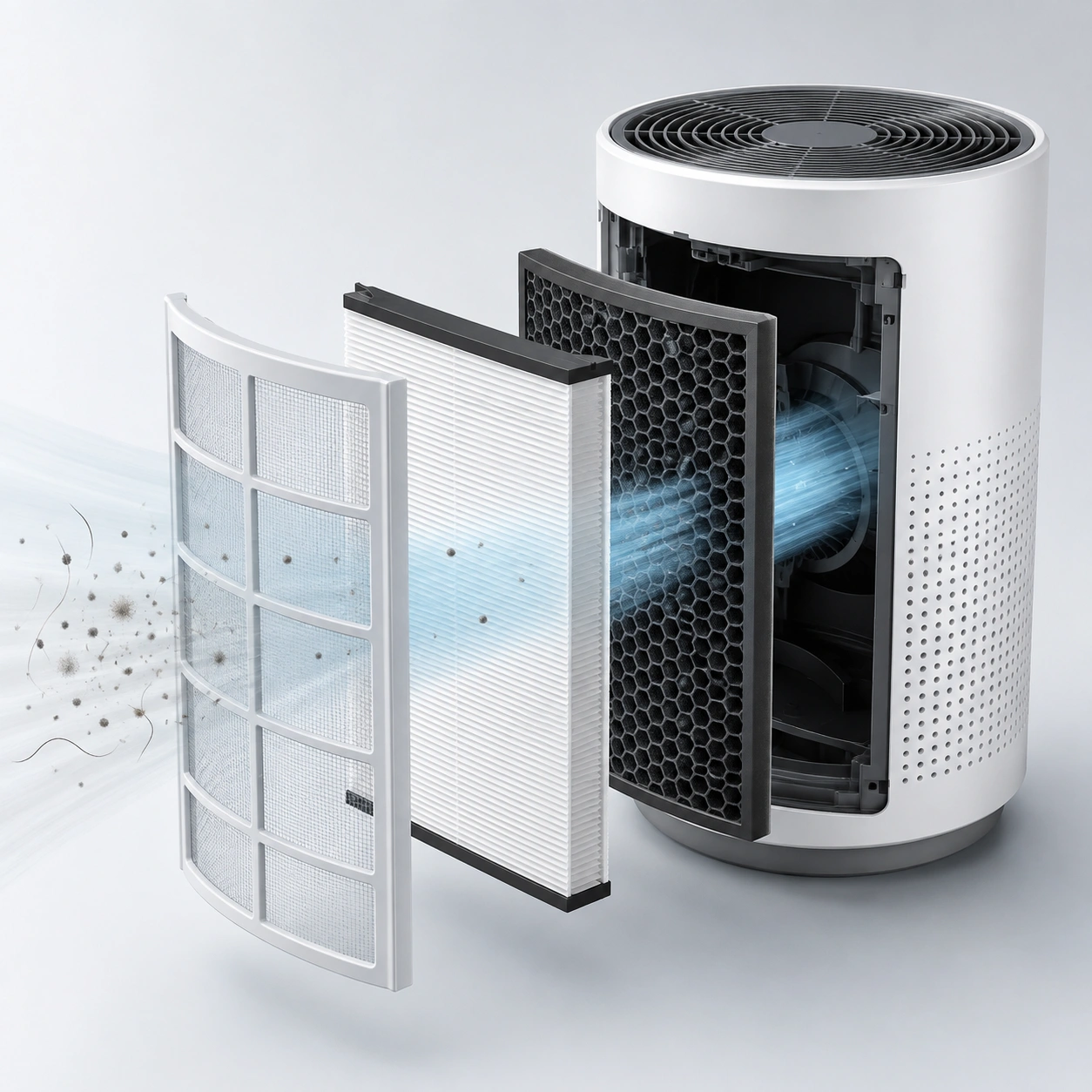
HEPA stands for High-Efficiency Particulate Air. A true HEPA filter captures at least 99.97 percent of particles as small as 0.3 microns, which comfortably covers pet dander, pollen, dust mite debris, and most mold spores.
Watch the wording. “True HEPA” or “H13 HEPA” indicates a genuine high-efficiency filter. Vague phrases like “HEPA-type” or “HEPA-like” often signal a weaker filter that misses the fine particles allergy sufferers care about. For an air purifier for pet allergies, a real HEPA filter is non-negotiable.
Activated Carbon Filters
Carbon is the odor filter. It works by adsorption, trapping gas molecules in a porous surface so they cannot recirculate. For the best air purifier for dog odor or cat litter smell, the amount of carbon is what counts.
Thin carbon-coated sheets fade quickly and do little against strong, persistent smells. Pellet-based or thicker carbon filters hold far more material and neutralize odor for longer. Anyone whose main complaint is smell rather than allergies should prioritize carbon capacity above almost everything else.
CADR
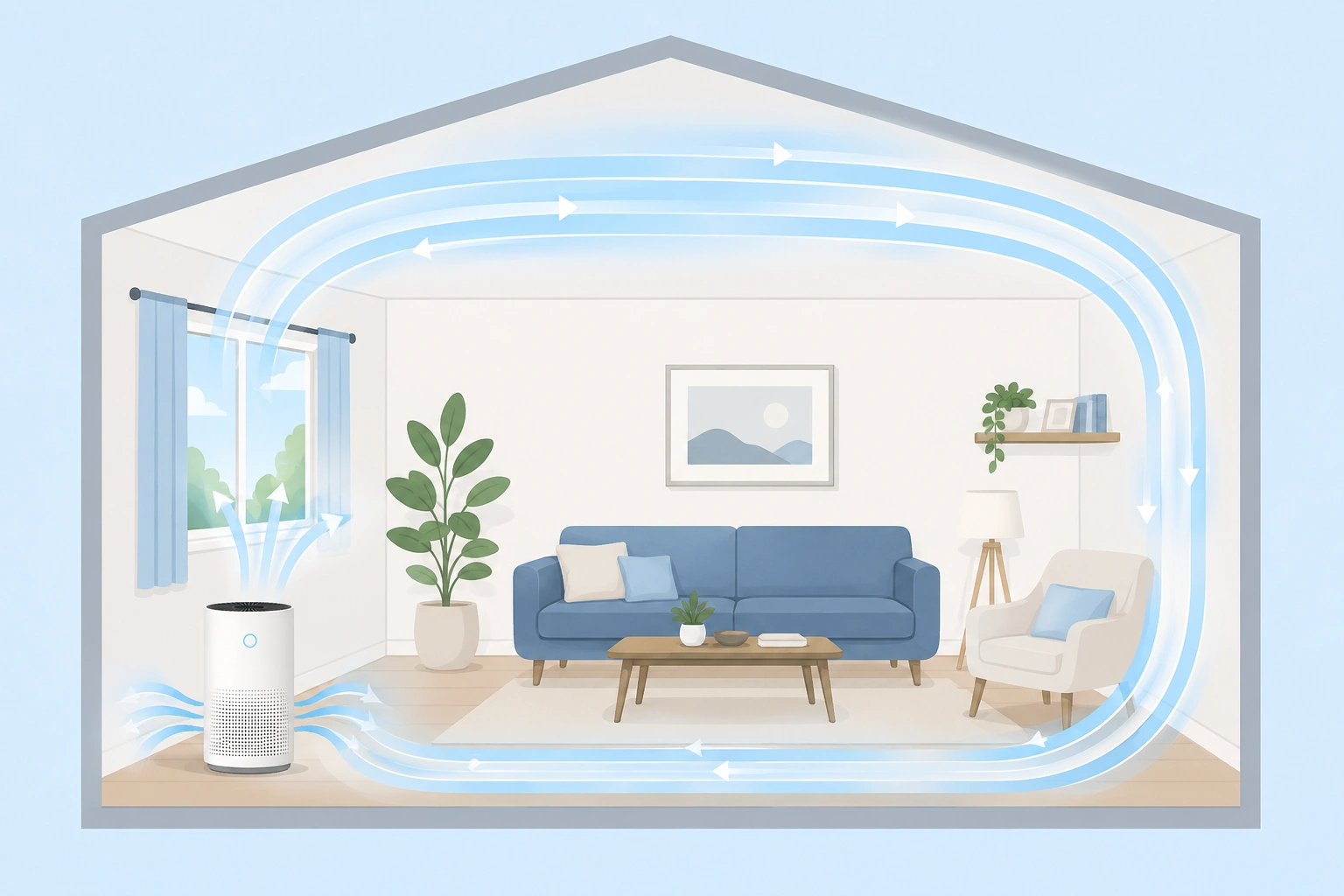
CADR, or Clean Air Delivery Rate, measures how much clean air a purifier produces, expressed in cubic feet per minute (CFM). It is usually listed as three numbers for smoke, dust, and pollen.
Higher is better, and the figure is a reliable way to compare models because AHAM-verified CADR ratings are tested by an independent body rather than the manufacturer. A quick rule of thumb: match the CADR to the room, and for pet households, aim a little higher than the minimum so the unit is not straining at full speed all day.
Room Size and Air Changes per Hour (ACH)
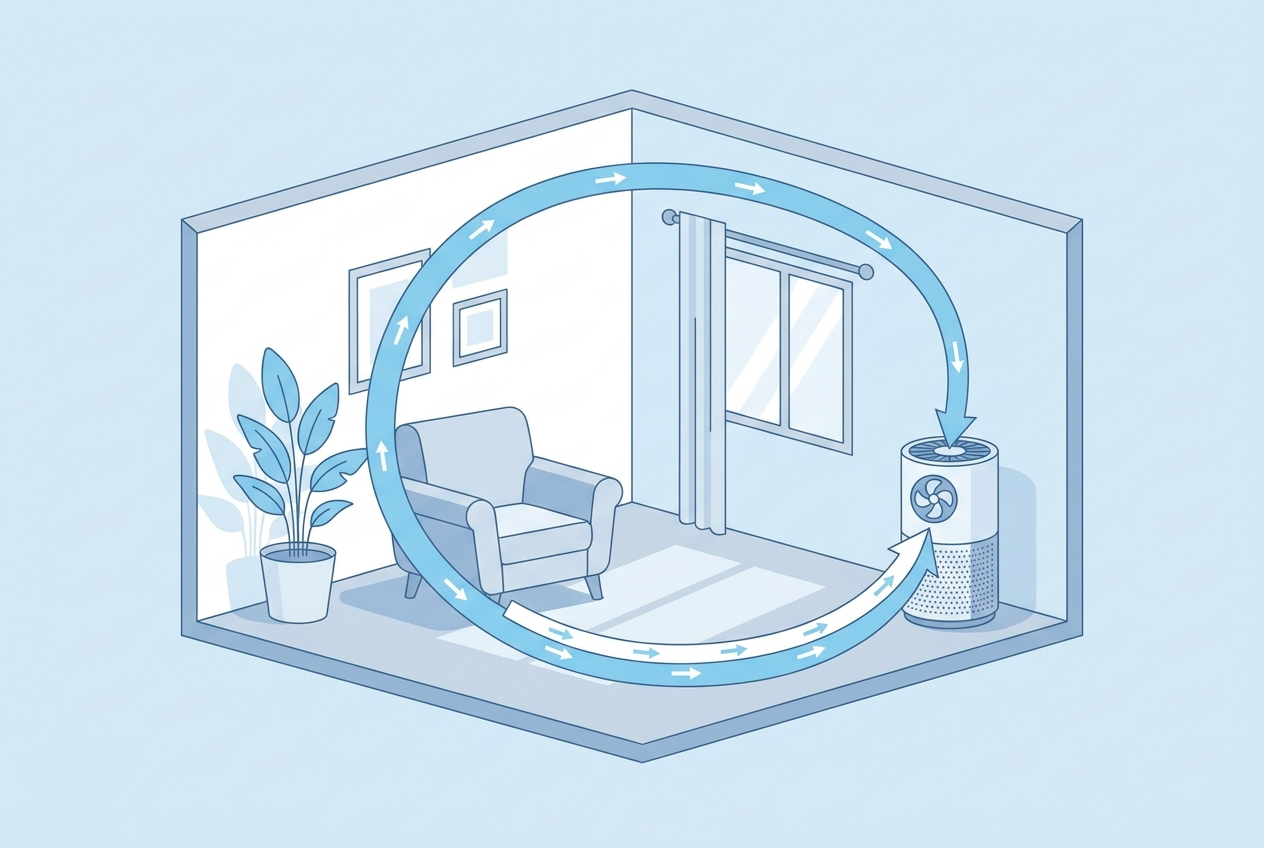
Manufacturers often advertise a large coverage area, but that number is usually based on cleaning the air just once per hour. For pet dander and allergy control, the target is four to five air changes per hour (ACH), meaning the purifier filters all the air in the room four to five times every hour.
At that stricter standard, a unit rated for 1,500 square feet at 1 ACH realistically covers around 350 square feet of genuine allergen-grade cleaning. Always size a purifier to the 4.8 ACH figure, not the headline number, and give it a little margin for a busy pet household.
Noise Level
Noise decides whether a purifier stays on. A unit that is too loud gets switched off, and a purifier that is off cleans nothing.
Noise is measured in decibels (dB). Most quality units run near 24 dB on their lowest setting, quiet enough to sleep beside, and climb to 50 to 65 dB at full speed. The sweet spot is a model that cleans effectively at a mid-range fan speed under about 45 dB, which stays comfortable for daytime living and nighttime use alike.
Energy Efficiency
An air purifier is meant to run continuously, so power draw affects the electricity bill more than with most appliances. Fortunately, modern units are efficient. A well-designed purifier draws roughly 30 to 80 watts, and running one around the clock typically adds only a few dollars a month. Look for Energy Star certification as a simple shortcut to lower running costs.
Filter Replacement Cost
The purchase price is only the start. Filters wear out, and in pet homes they wear out faster because hair and dander load them quickly.
Two things reduce long-term cost. A washable pre-filter that can be rinsed instead of replaced saves money on every cycle. And separate filter layers, where the carbon and HEPA can be swapped independently, mean paying only for the part that is actually saturated. Bonded all-in-one filters are simpler but force a full replacement even when only one layer is spent. Factor in the annual filter cost before deciding a “cheap” unit is truly the affordable one.
Smart Features
Smart features are convenient rather than essential. App control, scheduling, real-time air quality readouts, auto mode that adjusts fan speed to conditions, and voice assistant support all add ease of use.
For pet owners, two features stand out: an auto mode that ramps up when a pet stirs up dander, and a child or pet lock that stops a curious animal from changing settings. Everything else is a nice bonus, not a reason to overspend.
Maintenance
Every purifier needs upkeep, and pet homes need a little more. Pre-filters should be vacuumed or rinsed every two to four weeks to keep airflow strong. HEPA and carbon filters need replacing on schedule, sooner in heavy-shedding households. A filter indicator light helps, but a calendar reminder is more reliable. Low maintenance demands are worth prioritizing for anyone who would rather set the unit and forget it.
Top Product Reviews
Each model below was evaluated on filtration quality, real-world coverage at a genuine cleaning standard, odor handling, noise, running costs, and how well it copes with pet hair specifically. The lineup spans every budget and room size so there is a sensible match for most homes.
1. Levoit Vital 200S-P
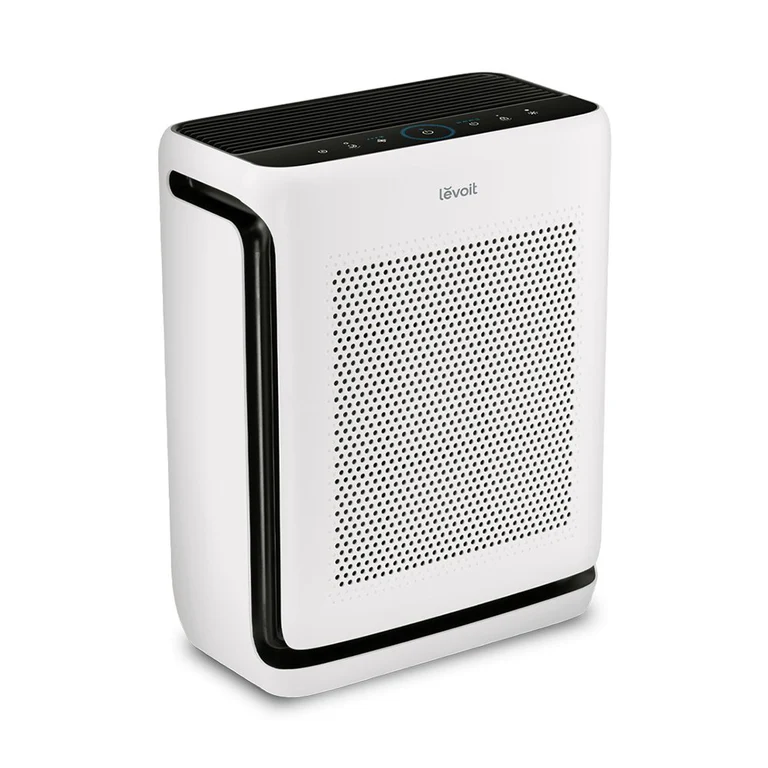
Overview
The Levoit Vital 200S-P is purpose-built for pet households, and it shows. Instead of the cylindrical shape most Levoit units use, it has a rectangular body with a wide U-shaped air intake at the front and bottom, designed to pull in pet hair without choking. That single design choice solves the most common frustration pet owners have with air purifiers: filters clogging with fur within weeks.
It suits medium bedrooms and living rooms, and it fits owners who want smart controls without paying a premium. The main limitation is that its bonded filter combines HEPA and carbon in one unit, so both are replaced together. For a heavy-shedding home that keeps the washable pre-filter clean, though, that filter still lasts a reasonable stretch.
Key Features
- U-shaped air intake engineered to capture pet hair before it reaches the main filter
- Washable, detachable pre-filter that rinses clean instead of needing replacement
- Three-stage filtration: washable pre-filter, HEPA-grade main filter, and activated carbon
- Dedicated Pet Mode that alternates fan speeds to pull in fur and save energy
- VeSync app with scheduling, air quality history, and filter-life tracking
- Works with Amazon Alexa and Google Assistant
Pros
- Handles pet hair better than almost any unit in its class
- Washable pre-filter lowers long-term cost
- Quiet at low and mid speeds
- Strong CADR for the price
Cons
- Bonded HEPA-and-carbon filter must be replaced as a single unit
- Air quality sensor is decent but not the most precise available
- Gets noticeably louder at top fan speed
Technical Specifications
| Specification | Detail |
|---|---|
| Coverage Area | 388 sq ft at 4.8 ACH (1,862 sq ft at 1 ACH) |
| Filter Type | Washable pre-filter + HEPA-grade main filter + activated carbon |
| CADR | 250 CFM |
| Noise Level | 23–54 dB |
| Power Consumption | 50 W |
| Smart Features | Wi-Fi, app control, Pet Mode, auto mode, voice control |
| Warranty | 2 years (limited) |
Why It Stands Out
The U-shaped intake and washable pre-filter turn the biggest pain point of pet ownership, hair clogging the machine, into a non-issue. Few purifiers are engineered around fur this deliberately, and it makes the Vital 200S-P feel purpose-designed rather than adapted.
Bottom Line
For the widest range of pet owners, this is the most sensible starting point. It cleans well, resists hair clogging, and keeps running costs reasonable, all without demanding much attention.
2. Coway Airmega AP-1512HH Mighty
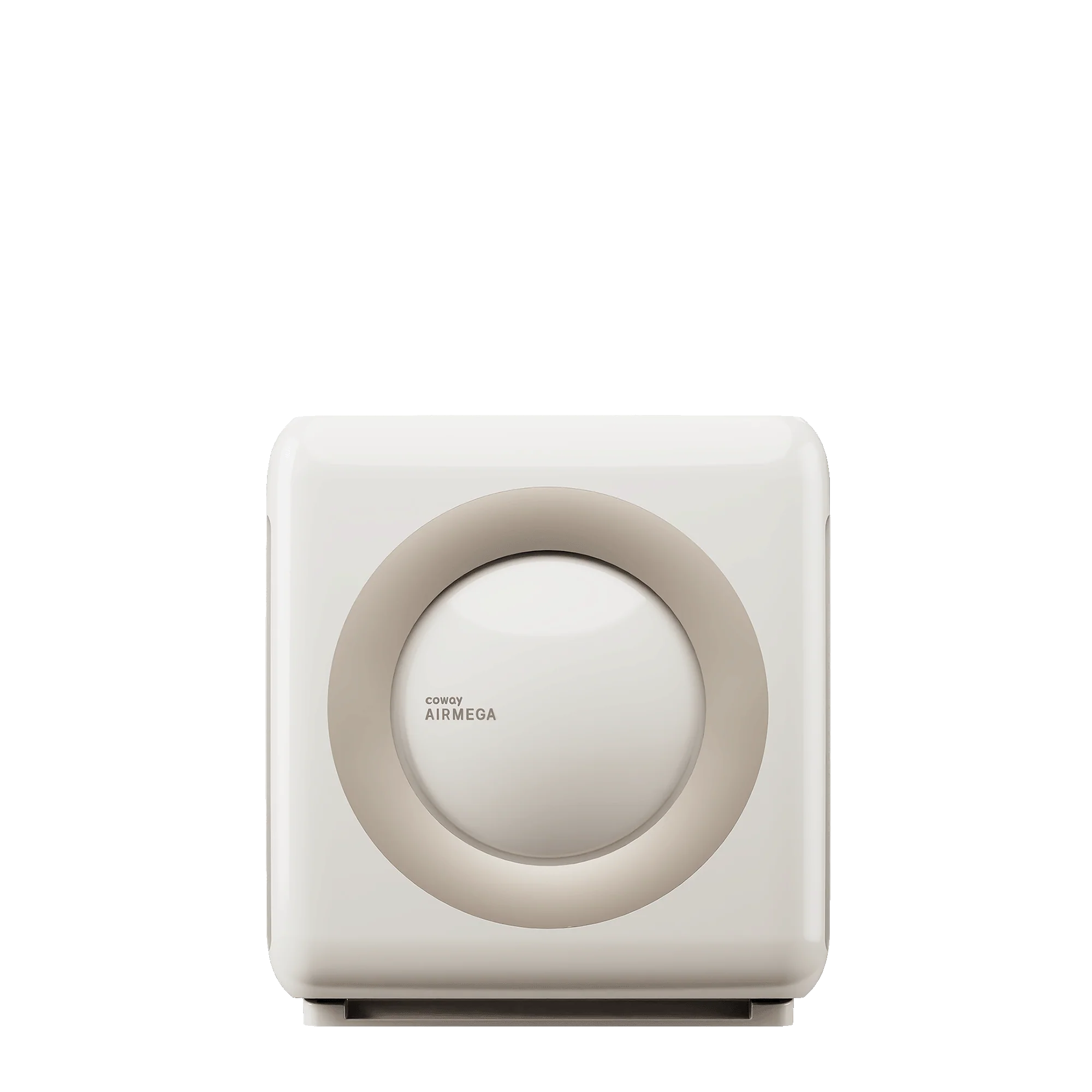
Overview
The Coway Airmega AP-1512HH, often sold simply as the Coway Mighty, has been a benchmark in the mid-range category for years. Its reputation rests on proven, independently verified performance and unusual long-term reliability.
It fits bedrooms, offices, and medium living rooms, and it appeals to buyers who value dependability and simple maintenance over app connectivity. Its four-stage system uses separate filter layers, so the carbon and HEPA can be replaced independently, which saves money over time. The trade-off is that the standard model has no Wi-Fi or app, and it draws more power than some rivals.
Key Features
- Four-stage filtration: washable pre-filter, deodorizing carbon, true HEPA, and an optional ionizer
- Separate filter layers that can be replaced independently to cut cost
- Washable pre-filter that catches pet hair and never needs replacing
- Air quality indicator with real-time color feedback
- Auto mode plus an Eco mode that idles the fan when the air is clean
- AHAM-verified CADR ratings
Pros
- Long track record of reliability
- Independently verified cleaning performance
- Separate filters lower replacement cost
- Compact footprint and quiet at low speeds
Cons
- Standard model has no app or Wi-Fi
- Higher power draw than some competitors
- Carbon layer is thinner than dedicated odor units, so heavy smells need help
Technical Specifications
| Specification | Detail |
|---|---|
| Coverage Area | 361 sq ft at 4.8 ACH (1,748 sq ft at 1 ACH) |
| Filter Type | Washable pre-filter + deodorization (carbon) + True HEPA + bipolar ionizer |
| CADR | 246 dust / 240 pollen / 233 smoke CFM (AHAM verified) |
| Noise Level | 24–53 dB |
| Power Consumption | 77 W |
| Smart Features | Air quality indicator, auto and eco modes (no app on standard model) |
| Warranty | 3 years (per Coway product listings; not stated on the official spec sheet) |
Why It Stands Out
Few purifiers combine verified performance, a three-year warranty, and this level of proven longevity. Owners regularly report years of trouble-free use, which makes the Mighty one of the safest long-term buys in its class.
Bottom Line
A reliable, no-fuss workhorse for pet owners who want performance and peace of mind more than smart-home extras. The separate filter layers make it economical to keep running for the long haul.
3. Winix 5510
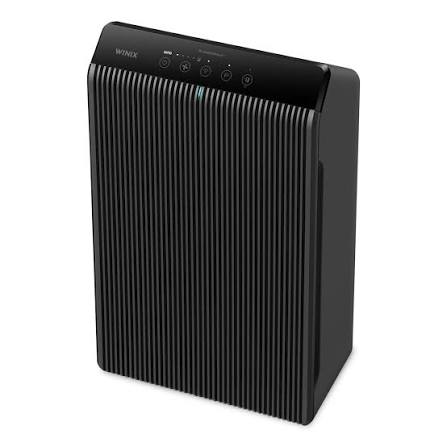
Overview
The Winix 5510 is the odor specialist. It succeeds the long-popular 5500-2 and carries forward that model’s biggest strength: a genuine pellet-based activated carbon filter that holds far more odor-absorbing material than the thin carbon sheets found in many rivals.
It is the pick for homes where smell is the primary complaint, whether that is dog odor in the living room or a cat litter box that makes its presence known. It covers medium rooms well and includes Winix’s PlasmaWave technology, which helps break down odors and can be switched off for those who prefer purely mechanical filtration. The main drawbacks are a loud maximum fan speed and OEM filters that cost a bit more than budget alternatives.
Key Features
- Pellet-based activated carbon filter for strong, lasting odor control
- Washable AOC carbon filter that rinses clean between replacements
- Three-stage system with a true HEPA filter for dander and allergens
- PlasmaWave technology that breaks down odors and VOCs, with an on/off toggle
- Smart sensor with auto and sleep modes
- Wi-Fi with the Winix Smart app and a filter-life indicator
Pros
- Strong odor absorption thanks to pellet carbon
- Washable pre-filter and carbon filter reduce ongoing cost
- Effective, fast particle cleaning
- PlasmaWave can be disabled for those who want mechanical filtration only
Cons
- Loud at maximum fan speed
- OEM replacement filters cost more than some rivals
- No remote included, and the companion app is fairly basic
Technical Specifications
| Specification | Detail |
|---|---|
| Coverage Area | Up to 392 sq ft at 4.8 ACH (AHAM verified) |
| Filter Type | 4-stage: washable pre-filter + pellet activated carbon + True HEPA + PlasmaWave |
| CADR | 253 CFM (AHAM verified) |
| Noise Level | 23.5 dB (lowest, per Winix); ~67 dB at max (independently measured) |
| Power Consumption | Not published by Winix (independently measured ~54–70 W) |
| Smart Features | Wi-Fi, Winix Smart App, smart sensor, auto and sleep modes |
| Warranty | 2 years |
Why It Stands Out
The pellet carbon filter is the difference-maker. Where most purifiers only mask or lightly reduce pet smells, this one absorbs them at volume, making it the clear choice when odor is the problem to solve.
Bottom Line
For a home that smells like pets no matter how often it is cleaned, the Winix 5510’s serious carbon capacity does what lighter filters cannot. Run it at a mid speed to keep the noise comfortable.
4. Levoit Core 400S
Overview
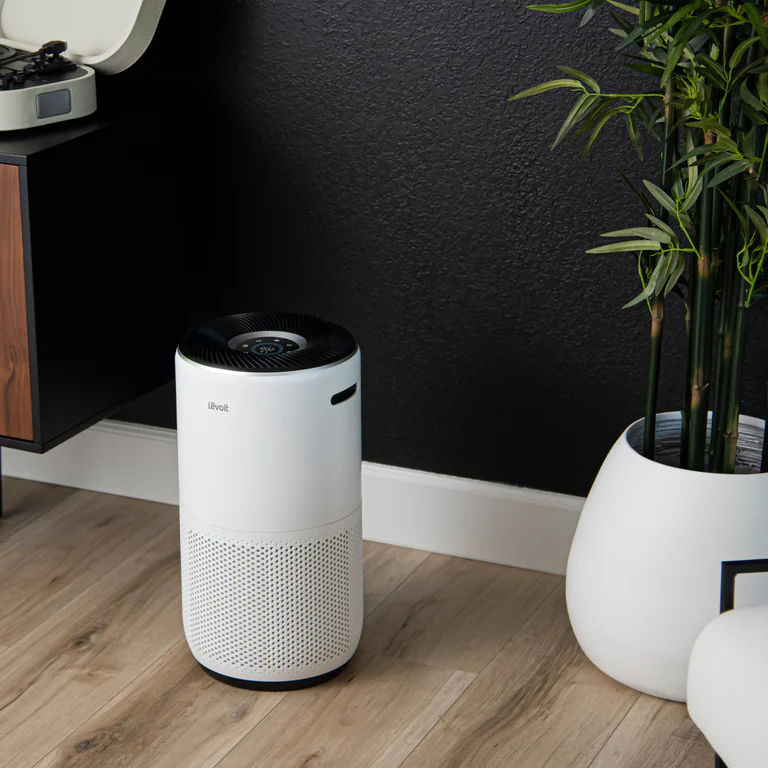
The Levoit Core 400S is the smart-home pick for medium to large rooms. It brings genuine connectivity, a responsive laser particle sensor, and a heavier carbon layer than Levoit’s smaller Core models, all in the brand’s familiar cylindrical tower design.
It suits open living areas, master bedrooms, and anyone who wants their purifier to respond automatically to cooking, dust, or a pet stirring up dander. The auto mode actually reacts to changing conditions rather than just cycling on a timer. Its honeycomb carbon handles odor better than thin sheet filters, though not to the degree of a dedicated pellet-carbon unit. At its highest speed it is not the quietest option, and its replacement filter is among the pricier in the Core line.
Key Features
- Laser PM2.5 sensor with a real-time air quality readout on the display
- Auto mode that responds to cooking, dust, and pet activity
- Three-in-one filter with a honeycomb carbon layer for improved odor control
- VeSync app with scheduling, filter tracking, and remote control
- Works with Amazon Alexa and Google Assistant
- Quiet, dimmable sleep mode for bedrooms
Pros
- Responsive laser air quality sensor
- Effective across medium and large rooms
- Heavier carbon than smaller Core models
- Full smart-home integration
Cons
- Replacement filter is relatively expensive
- Heavier and less portable than compact units
- Louder than the quietest options at top speed
Technical Specifications
| Specification | Detail |
|---|---|
| Coverage Area | 358 sq ft at 4.8 ACH (1,718 sq ft at 1 ACH) |
| Filter Type | Pre-filter + HEPA-grade main filter + activated carbon (ARC Formula) |
| CADR | 231 smoke / 240 dust / 259 pollen CFM (AHAM verified) |
| Noise Level | 22–52 dB |
| Power Consumption | 38 W |
| Smart Features | Wi-Fi, app control, laser sensor, auto mode, voice control |
| Warranty | 2 years (limited) |
Why It Stands Out
The combination of a genuinely responsive laser sensor and low power draw makes this one of the most efficient smart purifiers for larger pet spaces. It cleans a big room quickly while sipping electricity.
Bottom Line
The right choice for a tech-minded pet owner with a larger room who wants automation that actually works. Budget for the pricier filter, and it rewards with hands-off convenience.
5. Alen BreatheSmart 75i
Overview
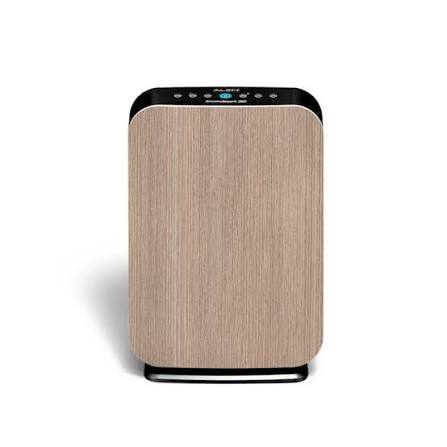
The Alen BreatheSmart 75i is the premium, large-room option, and it is the strongest pick for homes with multiple pets or open-concept spaces. It covers a substantial area with a medical-grade H13 HEPA filter and, crucially, offers interchangeable filter options, including a dedicated pet-and-odor filter tuned for dander and smell.
It fits big living rooms, open floor plans, and households where several animals mean a heavier air-cleaning load. Two features set it apart from cheaper units: a lifetime warranty, unusual in this category, and the ability to choose a filter matched to the specific problem. The cost is the obvious trade-off, both for the unit and for its premium filters, and the strongest odor performance requires selecting the odor-focused filter rather than the standard one.
Key Features
- Covers a large area, suitable for open-plan homes and multiple pets
- Medical-grade H13 HEPA captures particles down to 0.1 microns
- Interchangeable filter options, including a dedicated pet and odor filter
- Laser SmartSensor with auto mode that adjusts to real-time air quality
- Acoustically tuned quiet operation designed to aid sleep
- Customizable front panels in a wide range of finishes
Pros
- Excellent coverage for large rooms and multi-pet homes
- Filter can be matched to a specific concern
- Lifetime warranty is rare at any price
- Quiet for its size
Cons
- High purchase price
- Premium filters cost more than mainstream replacements
- Best odor control requires choosing the odor-specific filter
Technical Specifications
| Specification | Detail |
|---|---|
| Coverage Area | Up to 2,800 sq ft per hour (optimal ~1,400 sq ft) |
| Filter Type | H13 True HEPA with interchangeable options (Ultimate Odor filter for pets) |
| CADR | 375 CFM |
| Noise Level | 25–51 dB |
| Power Consumption | 1.4–55 W |
| Smart Features | Wi-Fi, app control, laser sensor (PM2.5, TVOC, eCO2), auto mode, ionizer |
| Warranty | Lifetime (with registration + active filter subscription) |
Why It Stands Out
The customizable filter system and lifetime guarantee make this a long-term investment rather than a disposable appliance. For a large home with several animals, the ability to target dander and odor with a purpose-made filter is a real advantage.
Bottom Line
The premium answer for big spaces and multiple pets. It costs more upfront and per filter, but the coverage, filter flexibility, and warranty justify the price for the right household.
6. Levoit Core 300S
Overview
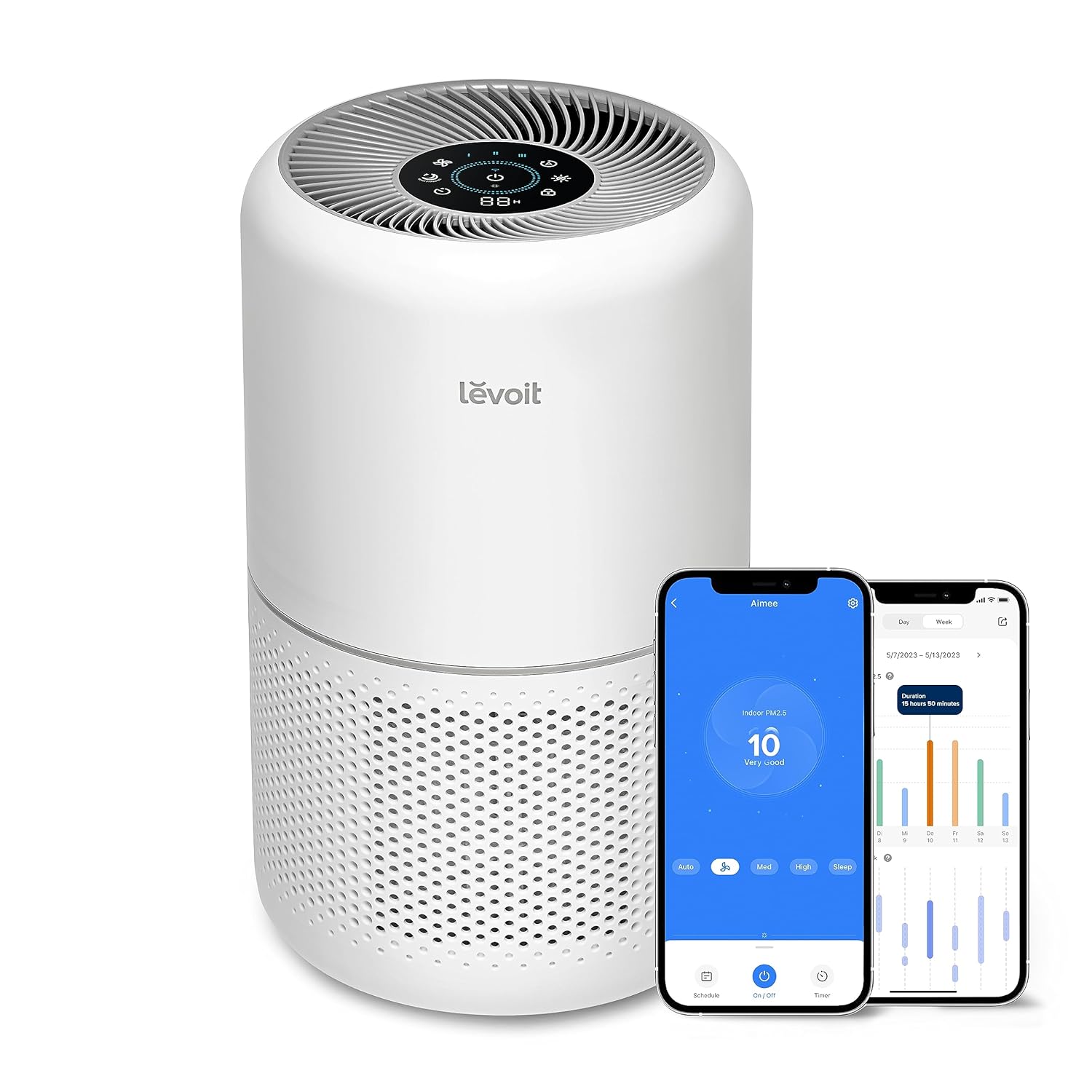
The Levoit Core 300S is the budget-friendly pick for small rooms, and it punches above its price. It is compact, quiet, and smart-enabled, making it ideal for a bedroom, nursery, home office, or a small space where a single pet spends its time.
It suits owners who want HEPA-grade filtration and app control without a large outlay, or anyone needing a second unit for an additional room. Its coverage is genuinely small, so it should not be stretched into a large living area, and its slim carbon layer means it handles light odor rather than heavy, persistent smells. Within its intended room size, though, it delivers clean air efficiently and inexpensively.
Key Features
- Compact design suited to small rooms and tight spaces
- Three-in-one filter: pre-filter, HEPA-grade main filter, and activated carbon
- VeSync app with scheduling, air quality readings, and filter tracking
- Works with Amazon Alexa and Google Assistant
- Very quiet sleep mode with a dimmable display
- Low power draw and affordable replacement filters
Pros
- Low purchase price and cheap filters
- Genuinely quiet, even for a bedroom
- Smart features usually found on pricier units
- Very energy efficient
Cons
- Limited to small rooms
- Thin carbon layer handles only light odor
- Bonded filter replaces all layers at once
Technical Specifications
| Specification | Detail |
|---|---|
| Coverage Area | 219 sq ft at 4.8 ACH (1,051 sq ft at 1 ACH) |
| Filter Type | Pre-filter + HEPA-grade main filter + activated carbon |
| CADR | 141 CFM |
| Noise Level | 22–50 dB |
| Power Consumption | 23 W |
| Smart Features | Wi-Fi, app control, air quality sensor, voice control |
| Warranty | 2 years (limited) |
Why It Stands Out
Smart controls, true HEPA filtration, and near-silent operation at this price make it one of the best value entries for a small pet space. It is also an easy second unit for another room.
Bottom Line
For a bedroom, office, or single-pet corner on a budget, the Core 300S delivers clean air quietly and cheaply. Keep expectations sized to the room and it rarely disappoints.
Product Comparison Table
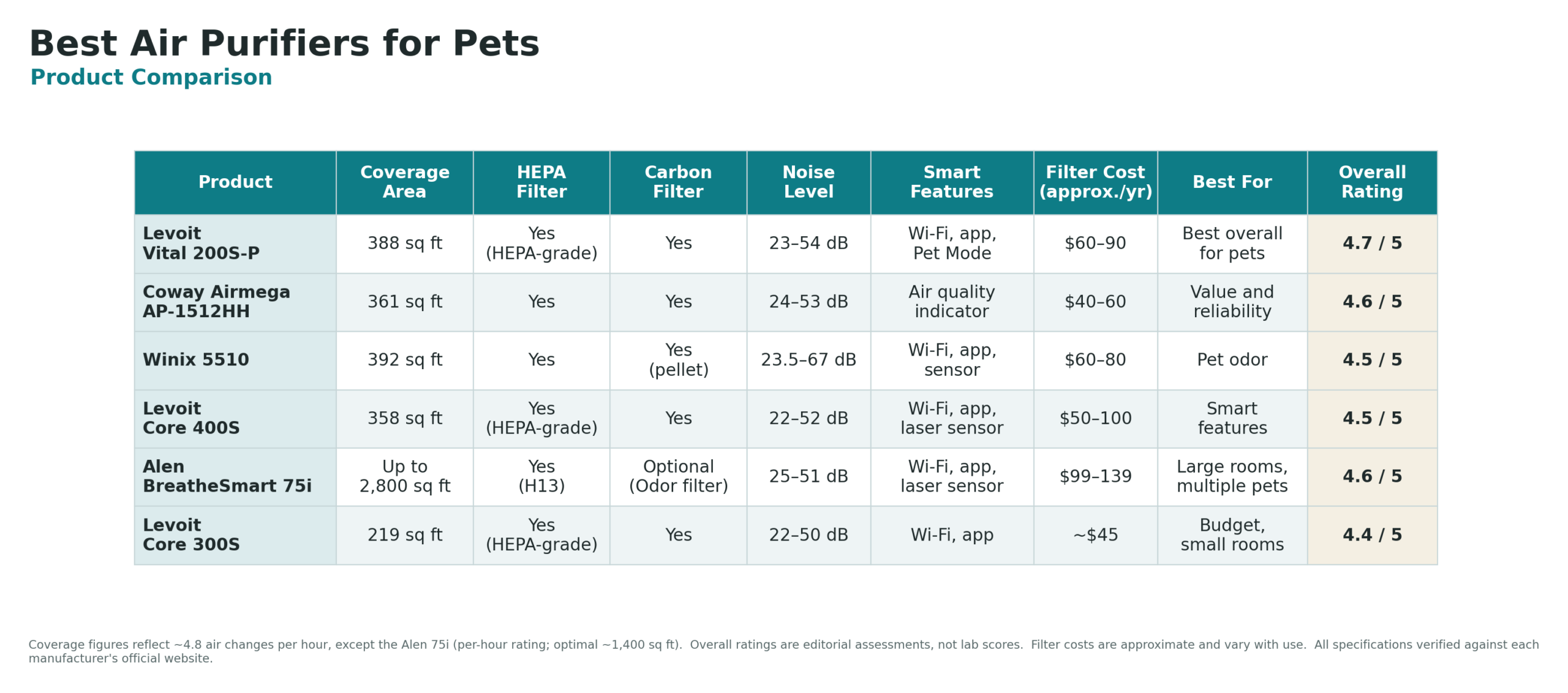
Coverage figures reflect a realistic 4.8 air changes per hour, except the Alen 75i, whose figure is its per-hour (1 ACH) rating; its optimal coverage is about 1,400 sq ft. Overall ratings are editorial assessments, not lab scores. Filter costs are approximate and vary with usage and filter choice. All specifications were verified against each manufacturer’s official website; where a manufacturer does not publish a figure, that is noted in the product’s specification table.
Which Air Purifier Is Best for Different Needs
Different homes have different priorities. Here is how the picks map to specific situations.
For pet hair above all else, the Levoit Vital 200S-P is the standout. Its U-shaped intake and washable pre-filter are built to grab fur before it clogs anything, which is exactly what a heavy-shedding home needs.
For the best air purifier for dog odor, the Winix 5510 wins. Its pellet carbon filter holds enough odor-absorbing material to tackle strong, persistent dog smell that lighter filters simply cannot manage.
For cat litter box smell, the Winix 5510 is again the top choice, for the same reason: litter odor is a gas, and only serious carbon capacity neutralizes it. Placing the unit near the litter area, with good airflow, improves results further.
For pet allergies, any true HEPA unit helps, but the Coway Airmega AP-1512HH and the Levoit Vital 200S-P stand out for verified particle removal and quiet bedroom operation, where allergy sufferers benefit most.
For an air purifier for multiple pets, the Alen BreatheSmart 75i handles the heavier combined load of several animals across a large space, and its dedicated pet filter targets both dander and odor.
For a large room air purifier for pets, the Alen BreatheSmart 75i and the Levoit Core 400S both cover more ground, with the Alen suited to open-plan areas and the Core 400S offering strong value for a single large room.
For a small bedroom or a tight budget, the Levoit Core 300S delivers true HEPA filtration and smart controls without overspending, provided the room stays within its coverage.
Common Buying Mistakes
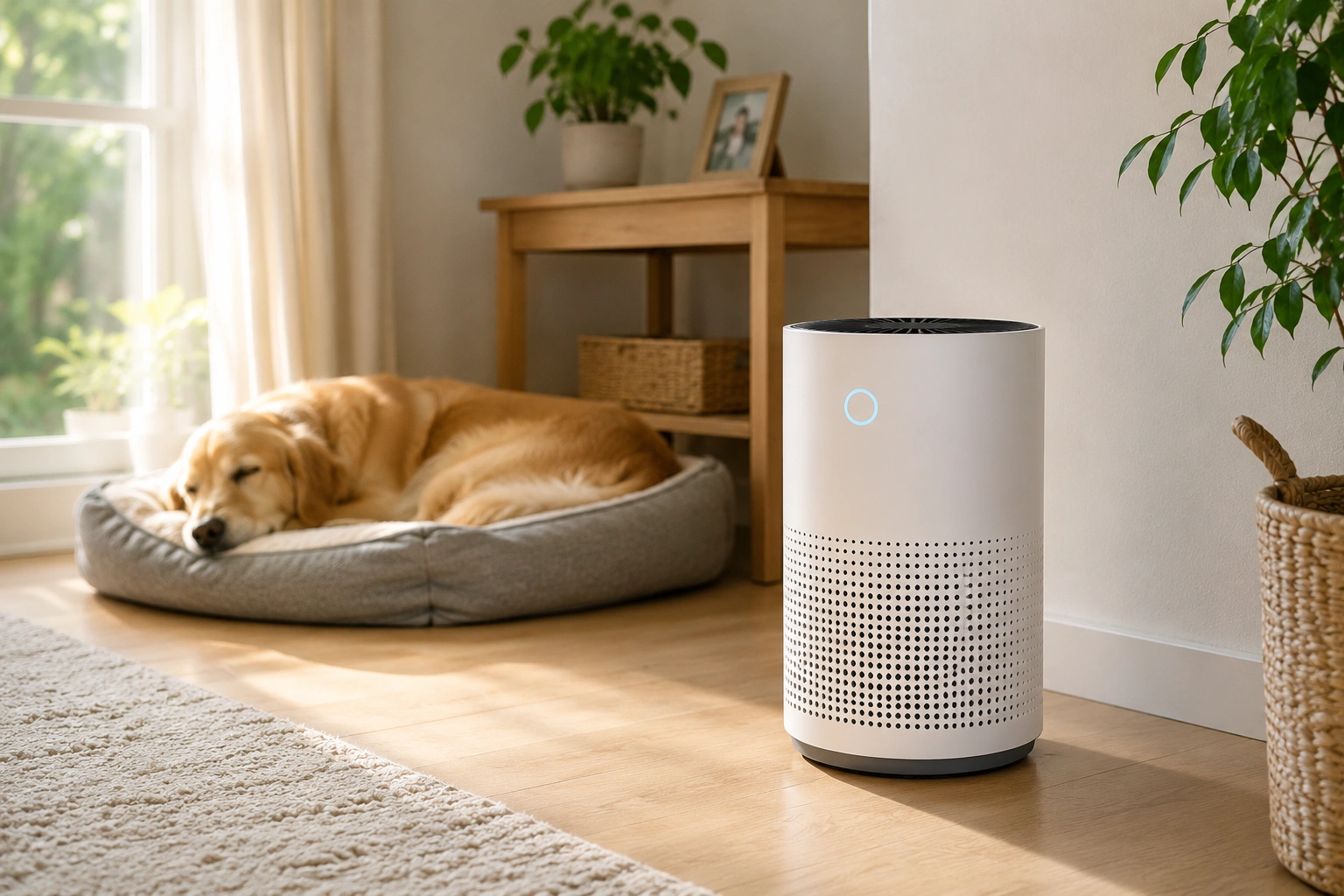
A few predictable errors leave pet owners disappointed. Avoiding them is easy once they are named.
Ignoring the odor problem. Many buyers assume any air purifier removes smell. A HEPA filter does nothing for odor, which is a gas. Without a substantial carbon filter, a purifier will clean the air of allergens yet leave the home smelling the same. Match the carbon to the smell.
Trusting the headline coverage number. Advertised square footage is usually based on a single air change per hour, which is too weak for allergen control. Sizing a unit to that number leaves it underpowered. Size to the 4.8 ACH figure instead, and the real coverage is often a third of the advertised claim.
Overlooking noise. A purifier that is too loud gets turned off, and then it cleans nothing. Check the decibel range and confirm the unit cleans well at a mid speed under about 45 dB, not just at its loudest setting.
Forgetting filter replacement cost. A cheap unit with expensive, frequently replaced filters can cost more over time than a pricier model with a washable pre-filter or separate filter layers. Calculate the running cost before deciding what is affordable.
Choosing “HEPA-type” filters. Vague labels like “HEPA-like” often mean the filter misses the fine dander that triggers allergies. Insist on “true HEPA” or “H13 HEPA.”
Placing the unit poorly. Wedging a purifier into a corner, behind furniture, or tight against a wall chokes its airflow. It needs clearance around the intake and outlet to work as designed.
Buying too small for the space. A compact unit in a large living room will run at full speed constantly and still fall short. When in doubt, size up rather than down, especially in a busy pet household.
Maintenance Tips
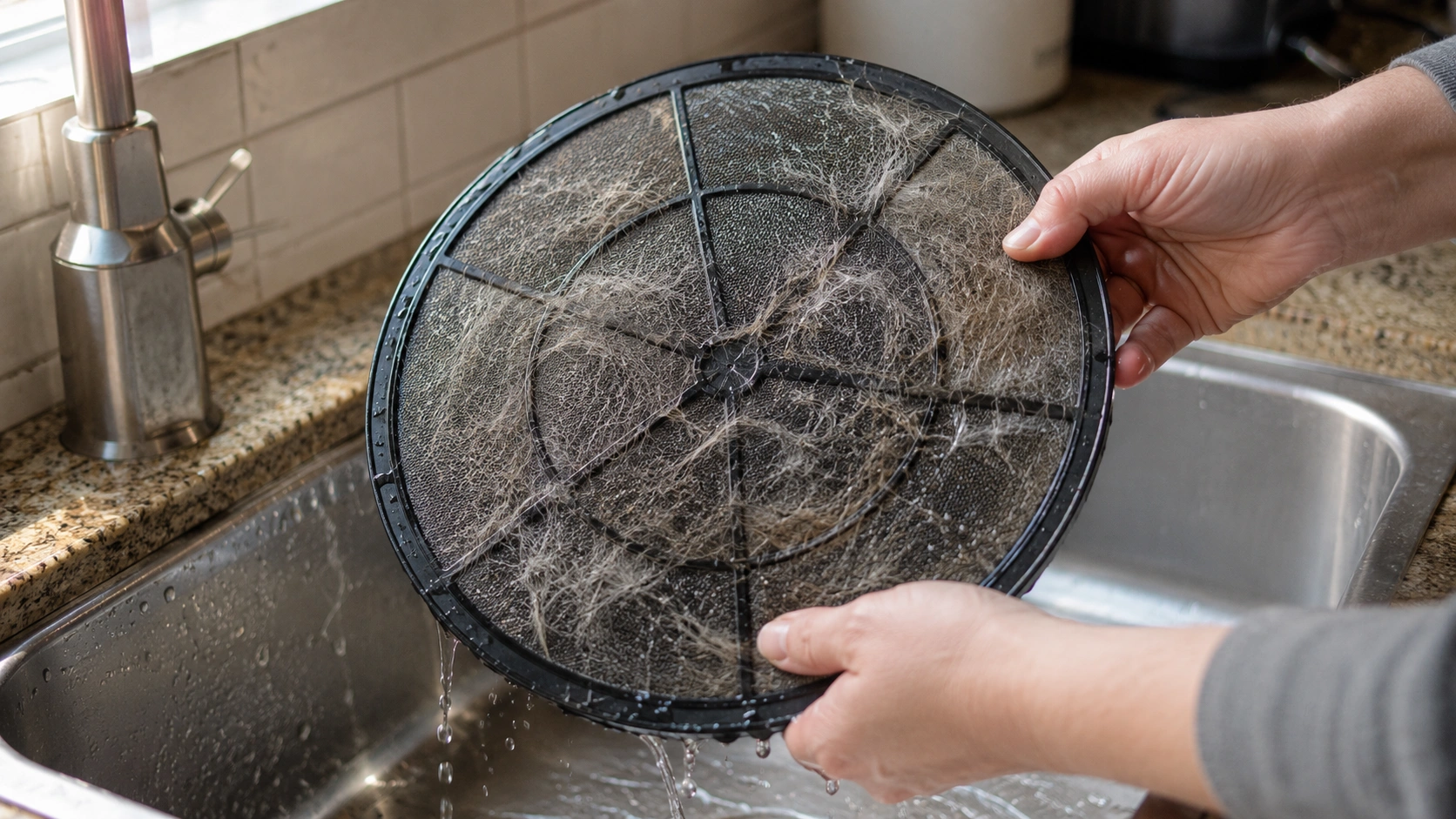
A pet air purifier only performs as well as it is maintained. These habits keep one working at its best.
Clean the pre-filter regularly. In a pet home, hair and dander load the pre-filter fast. Vacuum or rinse it every two to four weeks. A washable pre-filter makes this quick, and it protects the more expensive filters behind it.
Replace HEPA and carbon filters on schedule, and sooner in heavy-shedding homes. Pet households often need replacements every six to eight months rather than the standard nine to twelve. A saturated carbon filter stops absorbing odor, and a clogged HEPA filter restricts airflow, so overdue filters quietly undermine performance.
Keep the sensor clean. Units with an air quality sensor rely on a clear optical path. Dust or dander on the sensor causes false readings and erratic auto-mode behavior. Wipe it gently on the manufacturer’s recommended schedule.
Run the unit continuously. Dander is generated all day, so intermittent use lets it rebuild between sessions. Continuous operation on auto or a low-to-mid speed keeps levels consistently low and costs only a few dollars a month.
Position it near the source. Placing the purifier close to a litter box, pet bed, or favorite lounging spot lets it capture hair, dander, and odor before they spread. Leave several inches of clearance around it for airflow.
Wipe down the exterior and vents. Dust and hair collect on the housing and intake grilles. A periodic wipe keeps air moving freely and the unit looking clean.
Frequently Asked Questions
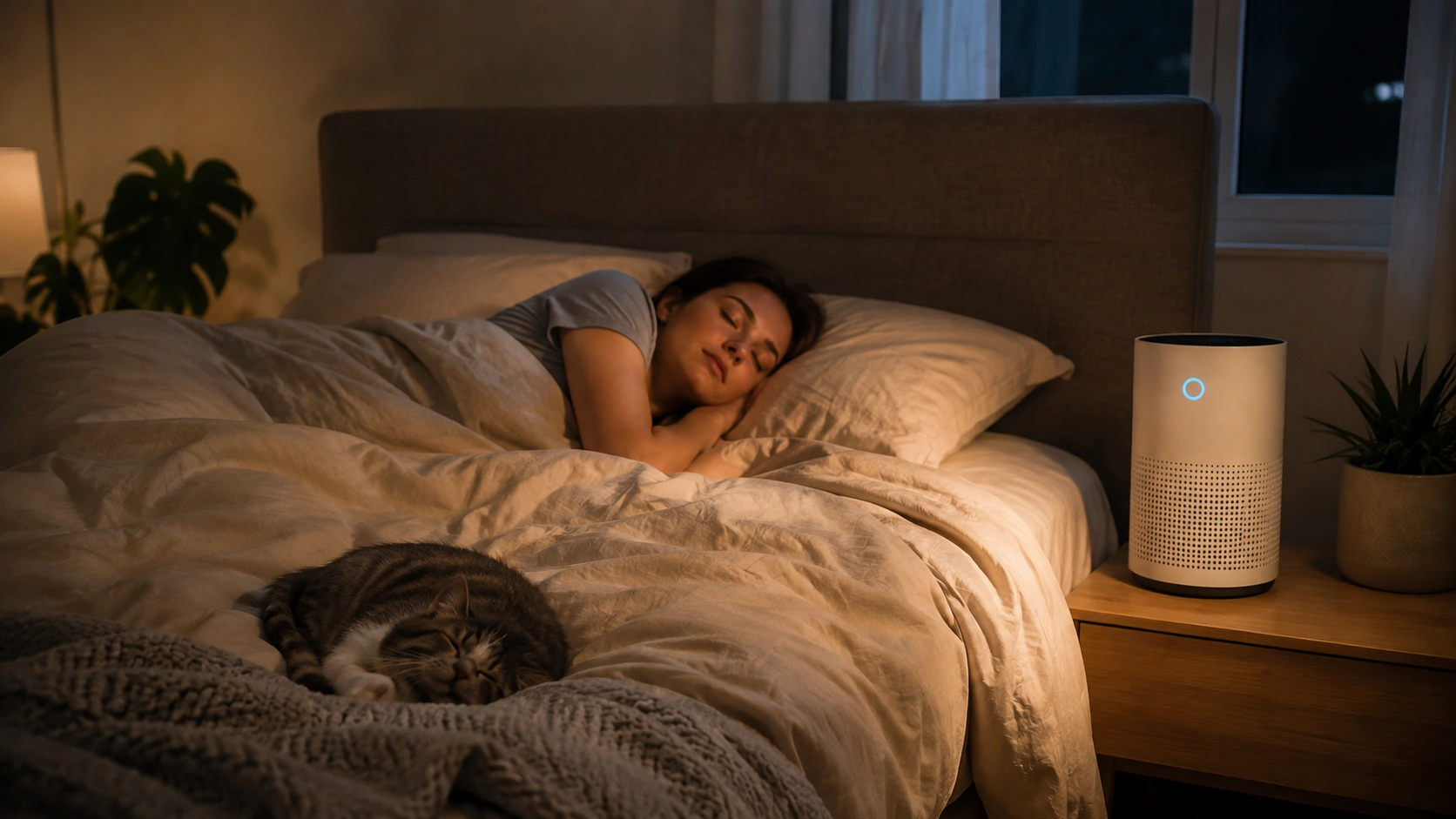
Do Air Purifiers Really Help With Pet Allergies?
Yes. A true HEPA air purifier captures airborne pet dander, the microscopic skin flakes that trigger most pet allergies, along with hair fragments and allergen-carrying dust.
Running one continuously, especially in the bedroom, reduces the airborne allergens that cause sneezing, congestion, and itchy eyes.
Many allergy sufferers notice improvement within one to two weeks of regular use, though a purifier works best alongside cleaning rather than as a replacement for it.
What Is The Best Air Purifier For Pet Hair?
The best air purifiers for pet hair use a strong, washable pre-filter to capture fur at the intake before it clogs the finer filters.
The Levoit Vital 200S-P is a standout because its U-shaped intake is engineered specifically to trap pet hair without choking. Any unit with a washable pre-filter, such as the Coway Airmega AP-1512HH, will handle hair far better than a sealed, single-filter design.
Will An Air Purifier Remove Pet Odor And Dog Smell?
An air purifier removes pet odor only if it has an activated carbon filter, because odor is a gas that a HEPA filter passes straight through.
For strong dog smell or cat litter box odor, the amount of carbon matters most. Units with pellet-based carbon, like the Winix 5510, hold far more odor-absorbing material and outperform thin carbon-coated sheets. Cleaning the odor source still matters, since a purifier treats airborne smell rather than the surface it comes from.
What Is The Best Air Purifier For Cat Litter Box Smell?
The best choice for cat litter smell is a unit with a large activated carbon filter placed near the litter area. The Winix 5510’s pellet carbon filter is particularly effective at absorbing the ammonia-driven odor that litter boxes produce.
No HEPA filter alone will help with litter smell, so carbon capacity is the deciding factor. Scooping regularly and pairing that with the purifier gives the best result.
How Big An Air Purifier Do I Need For My Room?
Size the purifier to clean the room’s air four to five times per hour, not just once. Advertised coverage figures are usually based on a single air change per hour, which is too weak for allergen control, so the real allergen-grade coverage is often about a third of the headline number.
Check the coverage listed at 4.8 ACH, and for a busy pet household, choose a unit rated slightly larger than the room to avoid running it at full speed all day.
How Often Should Pet Air Purifier Filters Be Replaced?
In pet households, HEPA and carbon filters typically need replacing every six to eight months, sooner than the nine to twelve months normal use allows, because hair and dander load them faster.
Washable pre-filters should be rinsed or vacuumed every two to four weeks. A filter indicator helps, but airflow that feels weaker or odor that lingers longer are practical signs a replacement is overdue.
Are Air Purifiers With Ionizers Safe For Pets?
Purifiers that rely on ionizers can produce small amounts of ozone, which may irritate the sensitive respiratory systems of birds and other small animals.
The safest approach is to choose a unit that cleans mechanically with HEPA and carbon filtration, or one where the ionizer can be switched off, as on the Coway Airmega and the Winix 5510. Mechanical filtration alone is highly effective, so an ionizer is never required for good pet-home performance.
Should The Air Purifier Run All The Time?
Running the purifier continuously gives the best results, because pets shed dander throughout the day and intermittent use lets levels rebuild. Most units are energy efficient enough to run around the clock for only a few dollars a month.
Auto mode is ideal, since it raises the fan speed when dander spikes and idles when the air is clean, keeping the room consistently filtered without wasting power.
Where Is The Best Place To Put A Pet Air Purifier?
Place the purifier near the source of the problem, such as a litter box, pet bed, or a favorite lounging spot, so it captures hair, dander, and odor before they spread through the home.
It needs several inches of clearance around the intake and outlet, so it should not be wedged into a corner or behind furniture. For allergy relief, the bedroom is the highest-value location, since that is where the body spends the most hours.
Can One Air Purifier Handle Multiple Pets?
One purifier can handle multiple pets if it is sized for the room’s heavier combined load, which usually means choosing a larger unit with a higher CADR and, ideally, a dedicated pet filter.
The Alen BreatheSmart 75i is a strong option for multi-pet homes and open spaces. In a larger house, running more than one purifier, with a unit in each main room, often works better than relying on a single machine to clean the entire home.
Conclusion
The best air purifier for pets is the one that matches the specific problem, the room, and the budget, rather than the one with the flashiest marketing.
The essentials never change: a true HEPA filter for dander and allergens, a substantial activated carbon filter for odor, and enough airflow to clean the room four to five times an hour.
For most pet owners, the Levoit Vital 200S-P offers the smartest balance of hair handling, cleaning power, and cost. Buyers who prize reliability will be well served by the Coway Airmega AP-1512HH.
When odor is the real complaint, the Winix 5510’s pellet carbon is hard to beat. The Levoit Core 400S brings genuine smart automation to larger rooms, the Alen BreatheSmart 75i covers big multi-pet homes with room to spare, and the Levoit Core 300S keeps small spaces clean without straining the budget.
Whichever model fits best, the payoff is the same: cleaner air, fewer allergy symptoms, less hair on every surface, and a home that no longer announces its pets before they walk into the room. Pair the right purifier with regular filter maintenance, and it will quietly earn its place for years.

Team Newszii is composed of individuals with professional backgrounds in content writing. We specialize in writing on a variety of topics including Lifestyle, Entertainment, Humor, Women, Food, Travel, Technology, and Blockchain Technology. Our team is driven by a passion for creating unique, accurate, and engaging content.