
November 3rd, 2025 | Updated on April 30th, 2026
You've spent an hour creating short-form video content, and now you're staring at your screen facing a very modern dilemma: Should this go on Instagram Reels or TikTok? Or both?
If you're posting on only one platform in 2025, you're leaving serious reach on the table. But uploading identical content to both without adapting it won't work either. Instagram Reels and TikTok look almost identical on the surface — vertical short-form video, music, effects, comment sections — but underneath they run on fundamentally different algorithms, serve different audiences, and reward different creator behaviors.
This guide breaks down everything you need to know: how each algorithm actually works, what the 2025 reach data really says, and a practical use-case guide so you know exactly which platform (or both) deserves your time.
Why the Instagram Reels vs TikTok Debate Matters in 2025
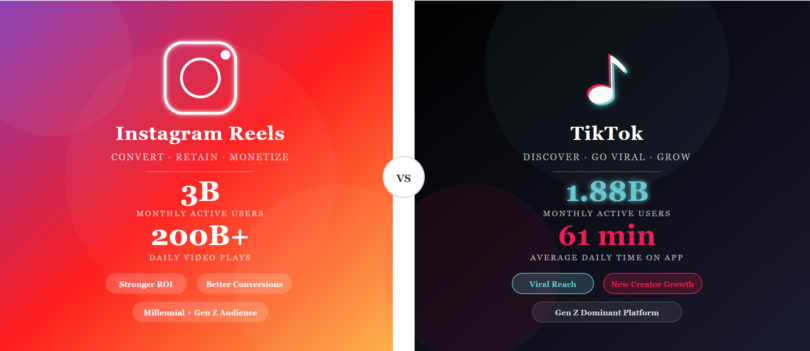
Short-form video is now the dominant content format on the internet. By 2025, Instagram Reels are played over 200 billion times per day across Meta's platforms, while the average TikTok user watches 265 videos per day — compared to 177 on Reels. These are not niche features. They are the primary growth engine for creators, brands, and businesses at every scale.
Instagram Reels now account for 35% of all time spent on the Instagram app, while TikTok users average 61 minutes per day on the platform compared to Instagram's 49 minutes. The platform you choose — and how you use it — directly shapes how fast you grow, how much money you make, and what kind of audience you attract.
The choice is not just philosophical. It is algorithmic. So let's get into exactly how each one works.
How the Instagram Reels Algorithm Works
Instagram's Reels algorithm has one job: keep people scrolling. It does that by predicting — with remarkable accuracy — which videos any given user is most likely to watch, reshare, or save.
When you post a Reel, Instagram first shows it to a small test audience made up of both your followers and non-followers the platform thinks will enjoy it. The best-performing Reels from that initial group are then pushed to a slightly wider audience, and the best of those to a wider group still. This cascading distribution model rewards engagement quality, not follower count — and it's why a creator with 500 followers can sometimes out-reach one with 500,000.
Key Signals the Instagram Reels Algorithm Weighs
⏱ Watch Time & Completion Rate
Did people watch all the way through, or swipe away in the first three seconds? Completion rate is the single most weighted signal in Instagram's ranking model.
↗ Reshares
Instagram reports that Reels are reshared more than 4.5 billion times per day across Instagram and Facebook combined. The algorithm treats reshares as the strongest possible endorsement of content.
🔖 Saves
Saving a Reel signals lasting value. It tells Instagram the viewer wants to return to it, which pushes it further into recommendation queues.
💬 Comments & Likes
Standard engagement signals, though they carry significantly less algorithmic weight than watch time and reshares.
♪ Audio Usage
Instagram's algorithm measures how likely viewers are to use your audio in their own Reels. Content with high "audio use intent" gets a meaningful distribution boost.
What "Recommendation-Friendly" Means
Instagram explicitly advises creators to post "recommendation-friendly content" — meaning content that avoids low-quality, objectionable, or sensitive material that could restrict distribution. Content that crosses those lines may still be published, but it will only be shown to your existing followers, which effectively caps your reach at a fraction of its potential.
Where Instagram Reels Can Appear
A single Reel has four separate distribution surfaces: the dedicated Reels tab (continuous full-screen scroll), the Explore page (trending and interest-based discovery), your followers' main feed (home feed recommendations), and Stories (when shared cross-format). This multi-surface exposure is a key structural advantage over static posts, which typically appear only in the feed and on the Explore page.
How the TikTok Algorithm Works
TikTok's For You Page (FYP) algorithm is widely regarded as the most powerful content discovery engine in social media — and it operates on fundamentally different principles than Instagram's approach.
On TikTok, your follower count is nearly irrelevant. A brand-new account posting its first video has the same distribution potential as an account with 10 million followers. The algorithm surfaces content based almost entirely on content quality and early engagement signals, not account authority or existing audience size.
Key Signals the TikTok Algorithm Weighs
📊 Watch Depth
TikTok tracks precisely how far into a video viewers get before dropping off. Videos watched to near-completion receive dramatically more distribution.
🔁 Completion Rate & Rewatches
TikTok rewards loops. A 15-second video watched three times generates stronger algorithmic signal than a 60-second video watched once.
↗ Shares
TikTok users share content at roughly 4× the rate of Instagram users (170 shares per post vs. 41 on Instagram). Shares are the most powerful single signal for going viral on TikTok.
💬 Comments & Likes
TikTok's average comments per post grew by 73.7% between 2023 and 2024, reflecting a highly interactive community the algorithm actively rewards.
🧠 User Interaction History
The FYP learns preferences at a granular level: which sounds you engage with, which creators you rewatch, which topics cause you to pause mid-scroll.
TikTok's Initial Distribution Model
TikTok reportedly surfaces new videos to approximately 300 initial viewers as a test cohort. Content that earns strong early signals gets pushed to a broader audience in escalating waves. Creators report 50% higher reach when posting during peak algorithm-trigger windows — periods when engagement signals accumulate fastest and the escalation cycle fires most aggressively.
TikTok's recommendation engine drives approximately 85% of total video views on the platform. By comparison, Instagram's algorithmic surfaces (Explore + Reels recommendations) contribute around 57% of Reels views — a meaningful gap that explains why new creators on TikTok so often grow faster than new creators on Instagram.
Instagram Reels vs TikTok: Reach & Engagement Data (2025)
Here is what the 2025 numbers actually say about both platforms: