Published on August 11th, 2026
A commercial roof is one of the most expensive assets on a building, and it protects everything underneath it. When it leaks, sags, or fails inspection, the cost of getting the repair wrong tends to be far higher than the cost of getting it right the first time.
That is where a commercial roofing contractor comes in. The trouble is that “commercial roofing contractor” covers everyone from a two-person crew that mostly does residential work to a fully staffed company with manufacturer certifications, in-house engineering, and 24-hour emergency service. The label alone tells you very little.
This guide breaks down what these contractors actually do, how the major commercial roofing systems compare, how repair and replacement decisions get made, what drives pricing, and the specific questions that separate a reliable company from a risky one.
It also covers what to look for when finding a reliable contractor for any home or building service, so you can make a more informed hiring decision.
Prices, licensing rules, permit requirements, and warranty terms vary by location, building type, roofing system, and manufacturer, so the focus here is on how to evaluate options rather than on numbers that would be misleading if quoted as universal.
What Does a Commercial Roofing Contractor Do?
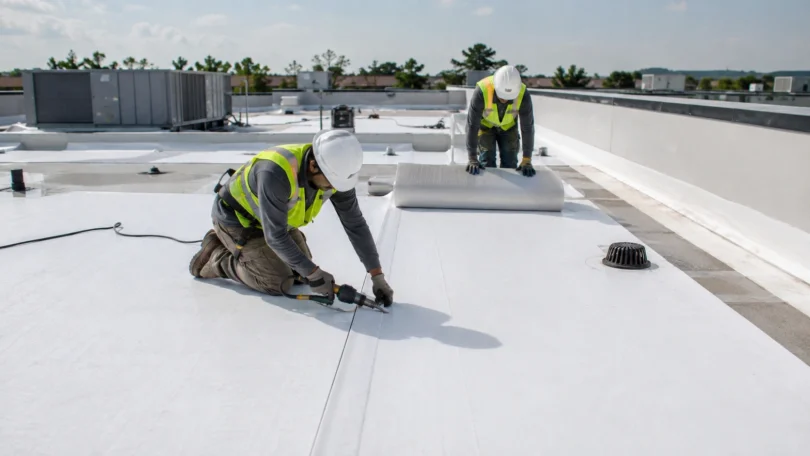
A commercial roofing contractor installs, repairs, replaces, inspects, and maintains roofing systems on commercial and industrial buildings — offices, warehouses, retail centers, restaurants, and factories.
Unlike residential roofers, they specialize in low-slope and flat roofs using systems such as TPO, EPDM, PVC, modified bitumen, built-up roofing, and metal, and they handle the drainage, insulation, code compliance, safety, and manufacturer warranty requirements those larger roofs demand.
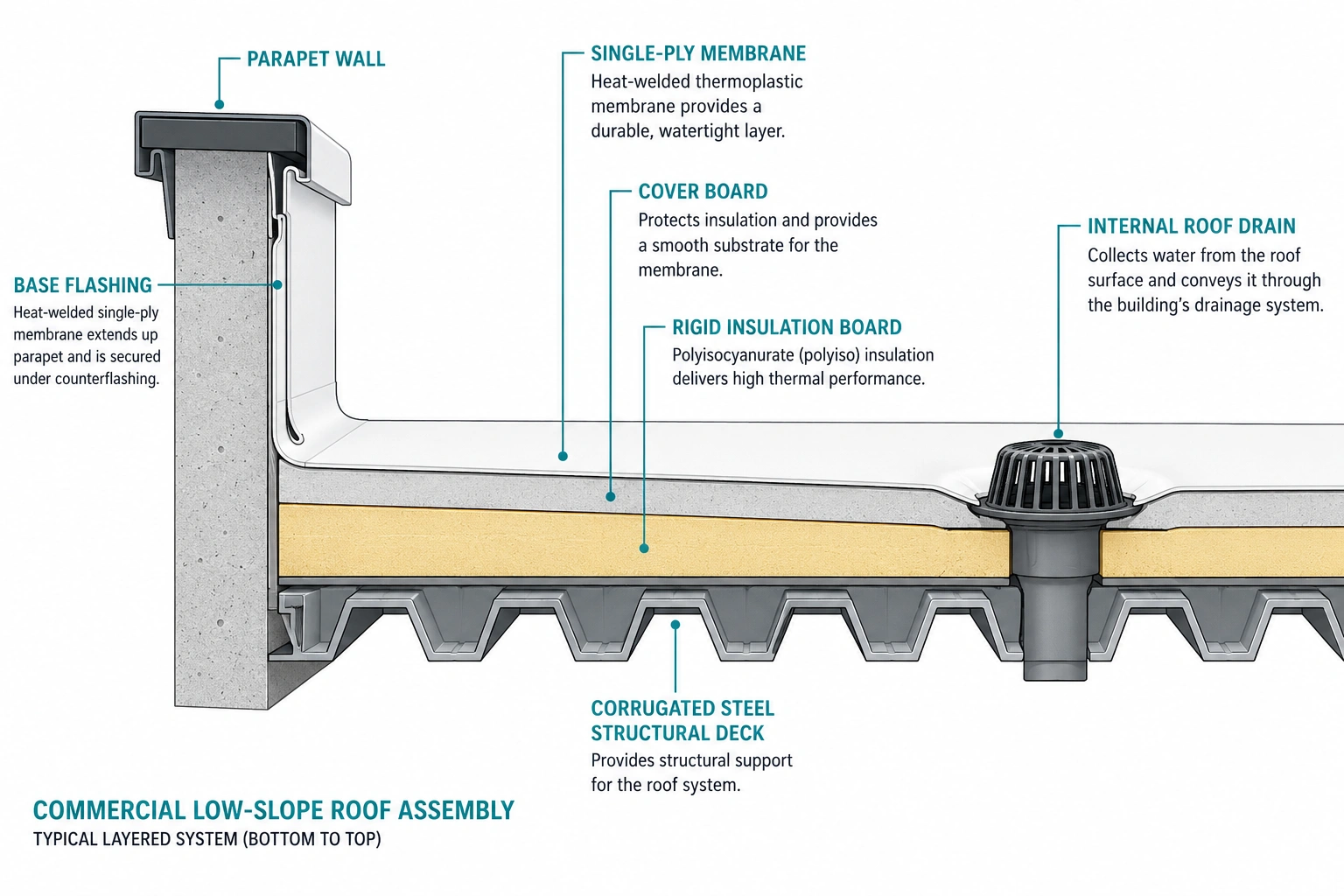
A commercial roofing contractor manages the full lifecycle of a commercial roof. That work falls into a handful of core services.
Commercial roof installation and replacement. On new construction or at the end of an existing roof’s life, the contractor removes or covers the old system and installs a new one, including insulation, membrane or panels, flashing, drains, and edge details.
Commercial roof repair. This ranges from patching a single puncture or resealing a seam to fixing widespread flashing failures. Commercial flat roof repair often centers on seams, penetrations, and drainage points, which is where most leaks begin.
Commercial roof inspection. A professional inspection documents the roof’s condition, identifies problems, estimates remaining service life, and creates a paper trail that supports warranty claims, insurance, and budgeting.
Commercial roof maintenance. Scheduled maintenance — cleaning drains, resealing details, clearing debris, and correcting small issues — is the least glamorous service and often provides strong long-term value.
Emergency and storm response. After hail, wind, or heavy rain, contractors provide temporary protection and permanent repairs, often coordinating with insurance adjusters.
A strong commercial roofing company also handles the parts owners rarely see: pulling permits, meeting local building codes, following applicable workplace safety requirements (in the U.S., OSHA regulations), protecting the interior and grounds during work, and registering manufacturer warranties correctly so they actually hold up when a claim is filed.
The distinction from residential roofing matters. Commercial roofs are usually low-slope or flat, far larger, and built in layers — deck, insulation, cover board, and membrane — rather than shingles over felt.
They rely on internal or edge drainage instead of steep-slope runoff. A contractor without genuine commercial experience may install a system competently in a general sense and still get the drainage, insulation values, or membrane seams wrong in ways that cause leaks later.
How to Choose a Commercial Roofing Contractor
Choosing well is mostly about verification. The following criteria separate a dependable commercial roofing contractor from a gamble, and each one can be checked before any money changes hands.
Commercial experience specifically. Ask how many projects the company has completed on buildings like yours, using the same roofing system. A crew that excels at residential shingles is not automatically qualified for a 40,000-square-foot TPO warehouse roof. Similar-project experience is one of the most reliable indicators of how a contractor will perform on your roof.
Licensing. Licensing requirements vary by state, county, and city. Confirm the contractor holds the licenses your jurisdiction requires and that those licenses are current. Where licensing exists, verify it with the issuing authority rather than taking a copy at face value.
Insurance. A commercial roofing contractor should carry general liability insurance and workers’ compensation coverage. Request a certificate of insurance sent directly from their insurer or agent, and confirm the coverage is active for the project dates. Without workers’ comp, an injury on your roof can become your liability.
Manufacturer certifications. Membrane manufacturers such as those behind TPO, EPDM, and PVC systems certify contractors who meet training and installation standards. Certification matters for a practical reason: many of the strongest manufacturer warranties, including no-dollar-limit system warranties, are only available when a certified contractor installs the system. It also signals ongoing training.
References and completed work. Ask for references from commercial projects finished in the last few years, ideally on comparable buildings. Call them. Better still, ask to see a completed roof of similar type and age.
Written estimates. A serious contractor provides a detailed written estimate that specifies the system, materials, scope, exclusions, and terms — not a number scribbled on a business card. Vague bids invite disputes and change orders later.
Warranties. Understand the two kinds. A workmanship warranty from the contractor covers installation errors. A manufacturer warranty covers the materials and, in stronger forms, the system as a whole. Get both in writing and read what voids them.
Safety record. Commercial roofing is high-risk work. Ask about their safety program and, where available, their incident history. A poor safety culture is both an ethical concern and a signal of how they run jobs generally.
Communication and project management. Note how they communicate during bidding. Slow, vague responses before you are a customer rarely improve after the contract is signed. Ask who the point of contact will be and how progress gets reported.
Contracts and change orders. The contract should define scope, price, schedule, payment terms, and how change orders are handled. Change orders — adjustments once hidden conditions appear, like a wet or rotted deck — are normal, but the process for pricing and approving them should be spelled out before work starts.
Contractor Evaluation Checklist
| Evaluation Factor | What to Verify | Why It Matters |
|---|---|---|
| Commercial experience | Projects on similar buildings and systems | Predicts quality on your specific roof |
| Licensing | Current, valid for your jurisdiction | Legal requirement; varies by location |
| General liability insurance | Certificate direct from insurer, active dates | Protects you from property/damage claims |
| Workers’ compensation | Active coverage for the crew | Shields you from injury liability |
| Manufacturer certification | Certified for the system being installed | Often required for the best warranties |
| References | Recent, comparable commercial projects | Real-world performance evidence |
| Written estimate | Detailed scope, materials, exclusions | Prevents disputes and surprise costs |
| Warranties | Workmanship and manufacturer, in writing | Defines who covers what, and for how long |
| Safety program | Documented program; incident history | Reflects risk management and job discipline |
| Contract and change-order terms | Scope, price, schedule, change process | Controls cost and timeline surprises |
Commercial Roofing Systems Compared
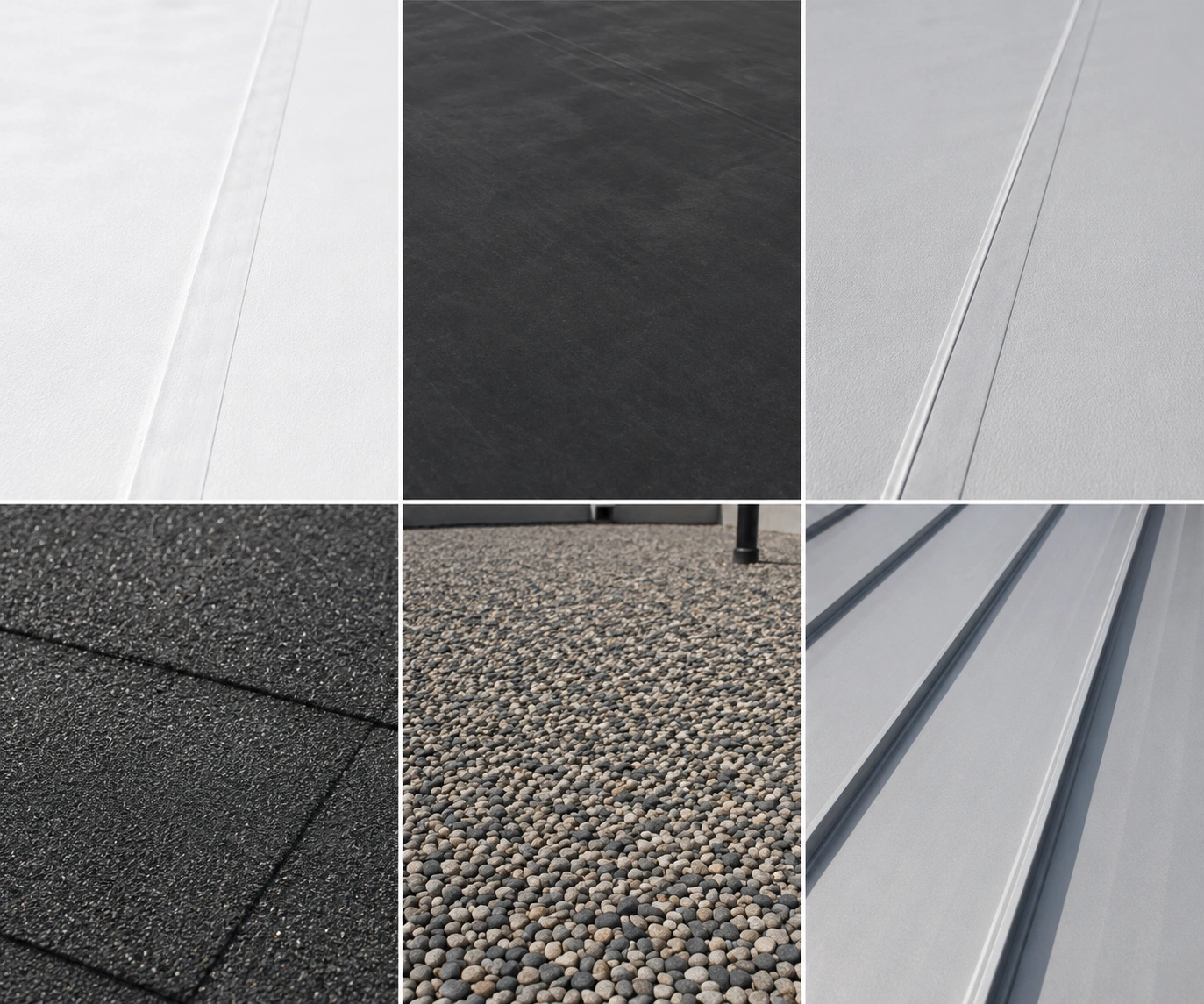
Most commercial roofs use one of a handful of systems. None is universally best; the right choice depends on the building, climate, budget, roof traffic, and how long the owner plans to hold the property. A capable contractor should explain the trade-offs rather than push a single product.
TPO (thermoplastic polyolefin). A single-ply membrane, usually white, with heat-welded seams. Its reflective surface can reduce cooling load in hot, sunny climates. TPO is widely used and competitively priced, though product quality and thickness vary between manufacturers, so specifications matter.
EPDM (ethylene propylene diene monomer). A durable synthetic rubber single-ply membrane, typically black, known for a long track record and good performance in cold climates. The dark surface absorbs heat, which can be a drawback in hot regions unless a reflective coating is added. Older seam methods relied on adhesives; welded and taped systems have improved reliability.
PVC (polyvinyl chloride). A single-ply membrane with strong resistance to chemicals, grease, and fire, with heat-welded seams. It is a common choice for restaurants and buildings with kitchen exhaust or industrial fumes. PVC generally sits at a higher price point than TPO or EPDM.
Modified bitumen. An asphalt-based system installed in multiple plies, a modern evolution of traditional built-up roofing. It offers good durability and is often used where foot traffic is expected. Some installation methods involve torches or hot asphalt, which raise safety considerations.
Built-up roofing (BUR). The classic “tar and gravel” roof, built from alternating layers of bitumen and reinforcing fabric, topped with gravel or a cap sheet. It is durable and puncture-resistant but heavy and labor-intensive to install and repair.
Metal roofing. Standing-seam and other metal systems offer long service life and work on both low- and steep-slope commercial buildings. Metal carries a higher upfront cost and requires careful detailing at seams and fasteners to prevent leaks and manage expansion.
Roof coatings. Fluid-applied coatings — acrylic, silicone, and others — are not standalone roofs but restoration systems applied over an existing roof to extend its life, seal minor issues, and add reflectivity. They can be cost-effective when the underlying roof is still structurally sound, and far less so when it is not.
Roofing System Comparison
| System | Typical Strengths | Typical Limitations | Often Suited To |
|---|---|---|---|
| TPO | Reflective, widely available, competitive cost | Quality varies by manufacturer | Warehouses, retail, offices |
| EPDM | Long track record, performs in cold climates | Dark surface absorbs heat | Offices, cooler regions |
| PVC | Chemical, grease, and fire resistant | Higher material cost | Restaurants, industrial |
| Modified bitumen | Durable, tolerates foot traffic | Some methods use heat/torches | Buildings with rooftop traffic |
| Built-up (BUR) | Puncture-resistant, proven | Heavy, labor-intensive | Older or high-traffic roofs |
| Metal | Long life, low/steep slope | Higher upfront cost, detailing critical | Long-term ownership, mixed slopes |
| Coatings | Extends life, adds reflectivity | Only for sound existing roofs | Roof restoration |
One term worth demystifying: reflectivity. A roof membrane is often described by how much sunlight it reflects and how well it releases absorbed heat. A highly reflective (“cool roof“) membrane can lower rooftop temperatures and cooling costs in hot climates, while a darker membrane can be an asset in cold climates where heat retention helps. The right direction depends on where the building is, not on which sounds more advanced.
Commercial Roof Repair vs. Replacement
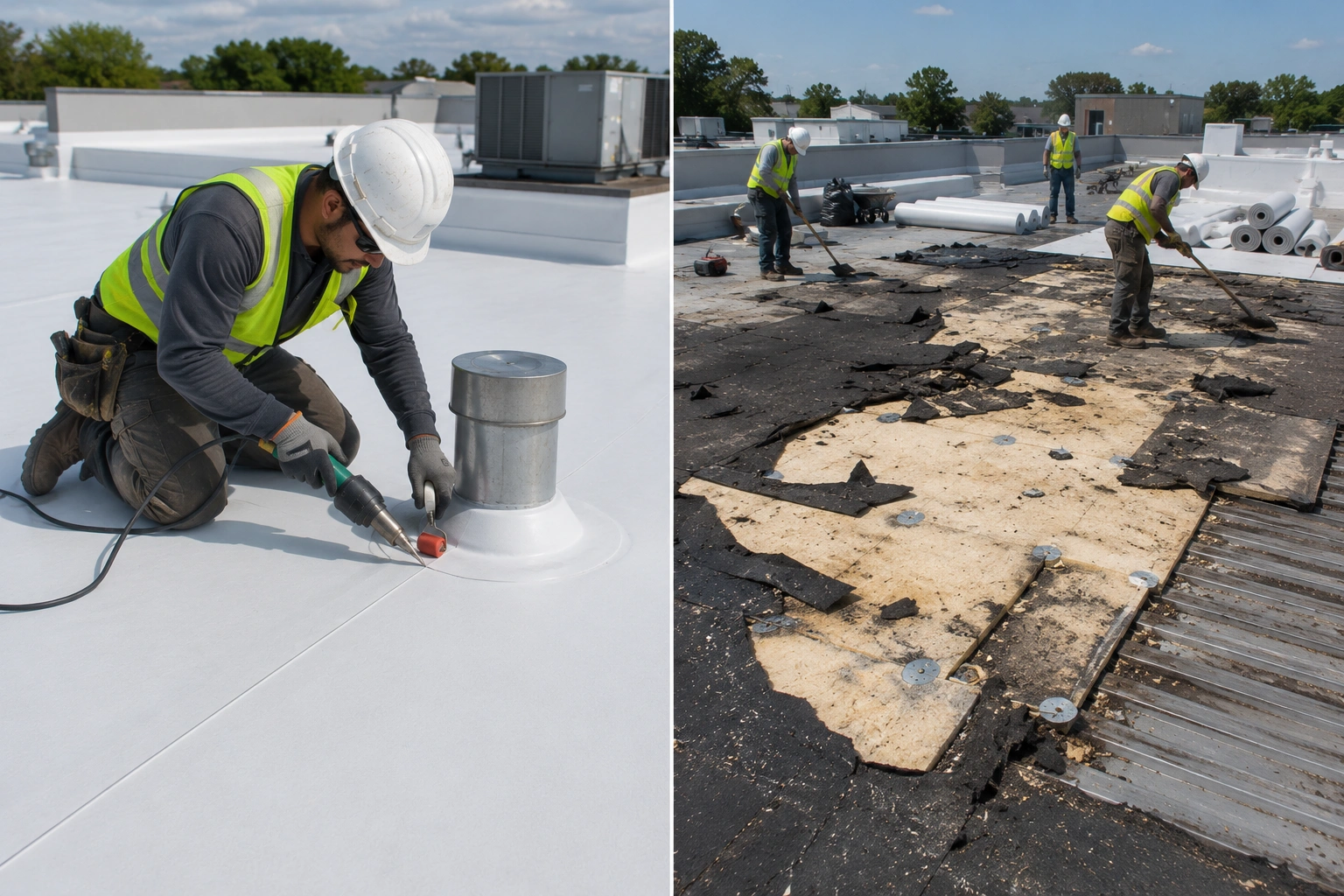
The most common question owners face is whether to repair a roof or replace it. There is no fixed rule, but a few factors point the decision one way or the other.
Repair usually makes sense when the roof is still within its expected service life, the damage is localized, the deck and insulation underneath are dry, and leaks are isolated to specific points like a seam or penetration. Repair is faster, cheaper, and less disruptive.
Replacement tends to make more sense when the roof is near or past its expected lifespan, leaks are widespread or recurring, moisture has saturated the insulation, or repairs have become a yearly expense. Wet insulation is a common tipping point — once water is trapped in the roofing layers, patching the surface does not solve the underlying problem.
A middle path is worth knowing about: re-covering (installing a new membrane over the existing one) or coating restoration can extend life at lower cost when the structure is sound. Building codes often limit how many roofing layers a building can carry, so this option is not always available.
| Factor | Points Toward Repair | Points Toward Replacement |
|---|---|---|
| Roof age | Well within service life | Near or past expected lifespan |
| Damage extent | Localized, isolated | Widespread or recurring |
| Insulation condition | Dry | Saturated with moisture |
| Leak history | Occasional, single-point | Frequent, multiple locations |
| Repair frequency | Rare | Repeated year after year |
| Upfront cost | Lower | Higher, but resets the lifecycle |
| Disruption | Minimal | Greater |
A trustworthy commercial roofing contractor will document why they recommend one path over the other, ideally with inspection photos and moisture readings, rather than defaulting to the more expensive option.
Commercial Roofing Cost Factors
Anyone quoting a firm per-square-foot price for commercial roofing without seeing the building should be treated with caution. Real pricing depends on too many variables to reduce to a single number, and those variables differ by region and market. What can be explained is what drives the cost, so owners can understand an estimate rather than just react to the total.
Roof size and complexity. Larger roofs cost more in absolute terms, though the per-unit cost sometimes drops with scale. Complexity — many penetrations, rooftop equipment, skylights, and odd shapes — raises labor.
Roofing system and materials. PVC and metal generally cost more than TPO or EPDM. Insulation thickness, membrane thickness, and cover boards all affect the total.
Tear-off vs. re-cover. Removing and disposing of an old roof adds labor and landfill cost. Re-covering over an existing roof, where code allows, can reduce that.
Deck condition. Hidden rot or moisture discovered after tear-off leads to repairs — and change orders. This is a frequent source of cost variance.
Building height and access. Taller buildings and tight sites complicate material handling and safety, raising labor.
Insulation and code upgrades. Local energy codes may require insulation levels above what the old roof had, adding material.
Warranty level. Longer and no-dollar-limit manufacturer warranties can carry higher costs because they require specific materials and certified installation.
Location and season. Labor rates, permit fees, disposal costs, and demand all vary geographically and seasonally.
Major Commercial Roofing Cost Factors
| Cost Factor | Effect on Price | Notes |
|---|---|---|
| Roof size | Larger total, sometimes lower per unit | Economies of scale vary |
| System and materials | Higher for PVC, metal | TPO/EPDM often more economical |
| Tear-off vs. re-cover | Tear-off adds labor and disposal | Re-cover subject to code limits |
| Deck condition | Hidden damage adds cost | Common source of change orders |
| Building height/access | Difficult access raises labor | Safety and logistics |
| Code and insulation upgrades | Can increase materials | Driven by local energy codes |
| Warranty level | Stronger warranties cost more | Require certified installation |
| Location and season | Highly variable | Regional labor and demand |
The practical takeaway: compare estimates on the same scope. A cheaper bid that assumes a re-cover while a competitor prices a full tear-off is not actually cheaper — it is a different job. Ask each contractor to itemize so the comparison is fair.
Commercial Roof Inspection Checklist
A thorough commercial roof inspection looks well beyond the visible surface. Owners can use this checklist to understand what a professional should examine, and to spot early problems between professional visits.
Rooftop access carries fall and equipment hazards, so anyone going up should be trained and equipped, and much of this is best left to a contractor.
- Membrane surface — punctures, blisters, cracks, splits, shrinkage, or ponding stains
- Seams and welds — separation, lifting edges, or failed adhesive
- Flashing — at walls, curbs, and edges, checking for lifting, cracks, or gaps
- Penetrations — around vents, pipes, HVAC curbs, and skylights, where leaks concentrate
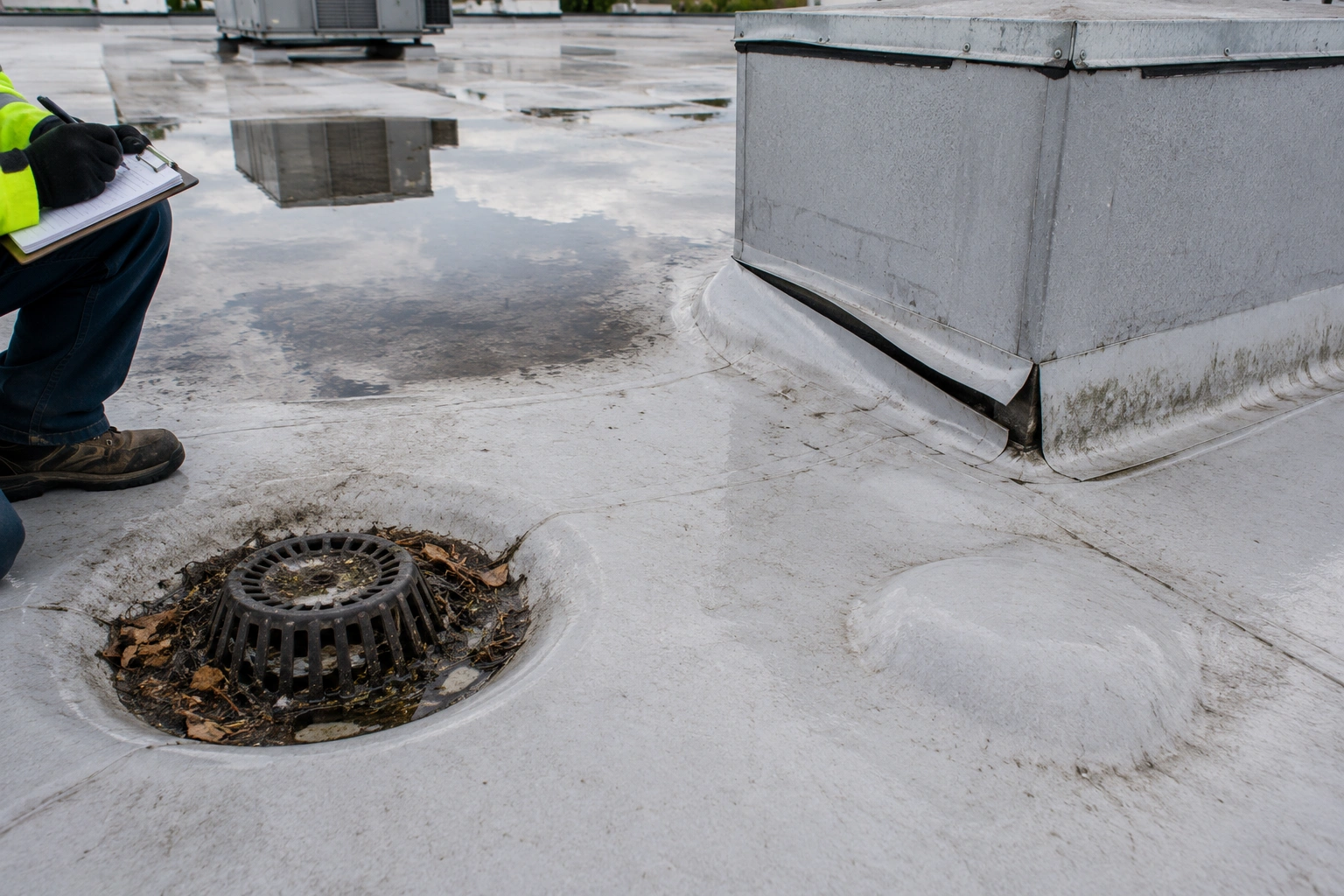
- Drains, scuppers, and gutters — blockages, debris, or standing water 48 hours after rain
- Rooftop equipment — condensate lines, loose fasteners, and damage from foot traffic
- Parapet walls and coping — cracks, open joints, or loose caps
- Field of the roof — ponding, low spots, and areas that stay wet
- Interior signs — ceiling stains, damp insulation, or musty odors inside the building
- Documentation — dated photos and notes to track changes over time and support warranty claims
Ponding water — areas that stay wet more than a couple of days after rain — deserves special attention. Standing water accelerates membrane breakdown and points to drainage or slope problems that repairs alone may not fix.
A good practice is two professional inspections a year, in spring and fall, plus an inspection after any major storm.
Commercial Roof Maintenance
Maintenance is often where commercial roofing dollars go furthest. A roof that is inspected, cleaned, and touched up on schedule commonly outlasts an identical roof that is ignored until it leaks. The difference is not the materials; it is the upkeep.
A basic maintenance program includes keeping drains and gutters clear, removing debris, checking and resealing flashing and penetrations, addressing small membrane damage before it spreads, and documenting the roof’s condition over time. Many manufacturers also require documented maintenance to keep their warranties valid, so skipping it can quietly void coverage.
Many commercial roofing companies offer maintenance agreements. These typically bundle scheduled inspections, priority emergency response, and minor repairs for an annual fee. They can be worthwhile — but read what is and is not included, since “maintenance plan” means different things to different companies.
How to Hire a Commercial Roofing Contractor
A disciplined hiring process reduces risk more than any single credential. A workable sequence:
- Define the scope. Know whether you need repair, replacement, inspection, or maintenance, and gather any history and warranty documents on the existing roof.
- Shortlist qualified companies. Search for a commercial roofing contractor near you, then filter by commercial experience, licensing, insurance, and manufacturer certifications before making contact.
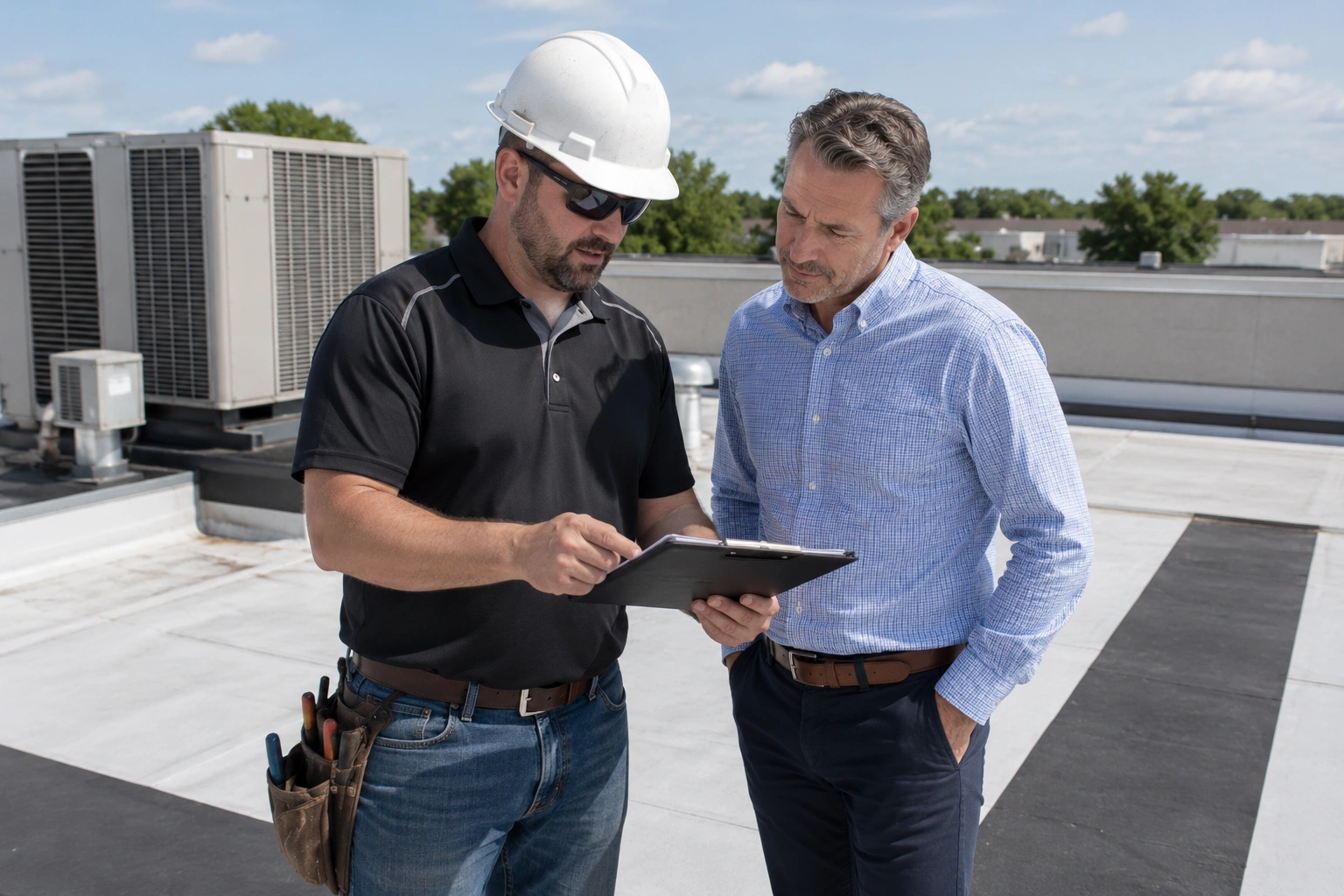
- Request site visits. Serious estimates come after a contractor has been on the roof, not from satellite images alone.
- Get multiple written estimates on the same scope. Three is a common benchmark. Insist each specifies system, materials, thickness, tear-off vs. re-cover, and exclusions.
- Verify credentials independently. Confirm licensing with the issuing authority and insurance directly with the insurer.
- Check references and completed work. Call recent commercial clients; visit a comparable roof if possible.
- Compare on value, not just price. The lowest bid may reflect thinner materials, a shorter warranty, or a narrower scope.
- Review the contract carefully. Confirm scope, price, schedule, payment terms, warranty, and change-order process before signing.
Payment terms deserve a note: a large upfront payment before any work is a warning sign. Reasonable deposits happen, but the bulk of payment should track completed work.
Questions to Ask Before Hiring
The right questions surface problems before they become expensive. Ask each candidate:
- How many commercial projects like this one have you completed, and can you share references?
- Are you licensed for this jurisdiction, and can the license be verified with the issuing authority?
- Can your insurer send a certificate showing active general liability and workers’ compensation coverage?
- Are you a certified installer for the roofing system you are proposing?
- What manufacturer warranty and what workmanship warranty come with this project, and what voids them?
- Will you provide a detailed written estimate specifying system, materials, and exclusions?
- Who is my point of contact, and how will progress be reported?
- How are change orders priced and approved if hidden damage is found?
- What is your safety program, and what is your recent safety record?
- What is the projected timeline, and what happens if weather causes delays?
Answers that are specific, documented, and consistent are a good sign. Answers that are evasive, verbal-only, or dismissive of documentation are not.
Best Contractor for Different Needs
There is no single best commercial roofing contractor for every situation. The best fit depends on the building and the job. Rather than naming any company, here is what to prioritize by scenario.
Restaurants. Kitchen exhaust puts grease and heat on the roof, which degrades some membranes. Prioritize contractors experienced with grease-resistant systems like PVC and with working around exhaust equipment.
Warehouses. Large, relatively simple roofs reward contractors with the crew size and logistics to handle scale efficiently, often with single-ply systems like TPO.
Offices. Comfort, energy performance, and minimal disruption matter. Look for experience balancing insulation and reflectivity, a track record of clean, low-disruption jobs on occupied buildings, and an understanding of smart building and property upgrades.
Retail buildings. Multiple tenants and continuous business hours make scheduling and communication critical. Prioritize contractors who can phase work and keep stores open.
Industrial properties. Chemical exposure, heavy equipment, and complex penetrations demand contractors with genuine industrial experience and the right chemical-resistant systems.
New construction. Coordination with general contractors and other trades is essential. Look for companies used to working within a broader construction schedule.
Emergency repairs. Response time is everything. Prioritize contractors offering genuine 24-hour emergency service and the ability to provide temporary protection fast.
Maintenance. Consistency matters more than size. A reliable maintenance agreement with clear documentation often serves better than a big-name installer that treats upkeep as an afterthought.
Replacement. Manufacturer certification and warranty strength come to the front here, since a replacement is a long-term investment.
The common thread: match the contractor’s demonstrated experience to your specific building type and job, and verify it with references on comparable projects.
Common Hiring Mistakes
Most bad roofing outcomes trace back to a short list of avoidable mistakes.
Choosing on price alone. The lowest bid often reflects thinner materials, a weaker warranty, or a narrower scope — costs that reappear later.
Skipping credential verification. Accepting a photocopied license or insurance certificate without confirming it with the issuer. Documents can be outdated or fabricated.
Accepting verbal agreements. If the scope, warranty, or timeline is not in writing, it effectively does not exist when a dispute arises.
Ignoring commercial-specific experience. Hiring a capable residential roofer for a low-slope commercial system is a frequent and costly error.
Overlooking the warranty fine print. Not understanding what voids coverage — often skipped maintenance or unauthorized rooftop work.
Paying too much upfront. Large advance payments transfer risk to the owner and occasionally precede a contractor disappearing.
Not clarifying change orders. Without an agreed process, hidden-damage discoveries become billing disputes.
Comparing bids on different scopes. A re-cover bid and a tear-off bid are not comparable, even though both are “for the roof.”
Maintenance Tips
Practical habits that protect a commercial roof and its warranty:
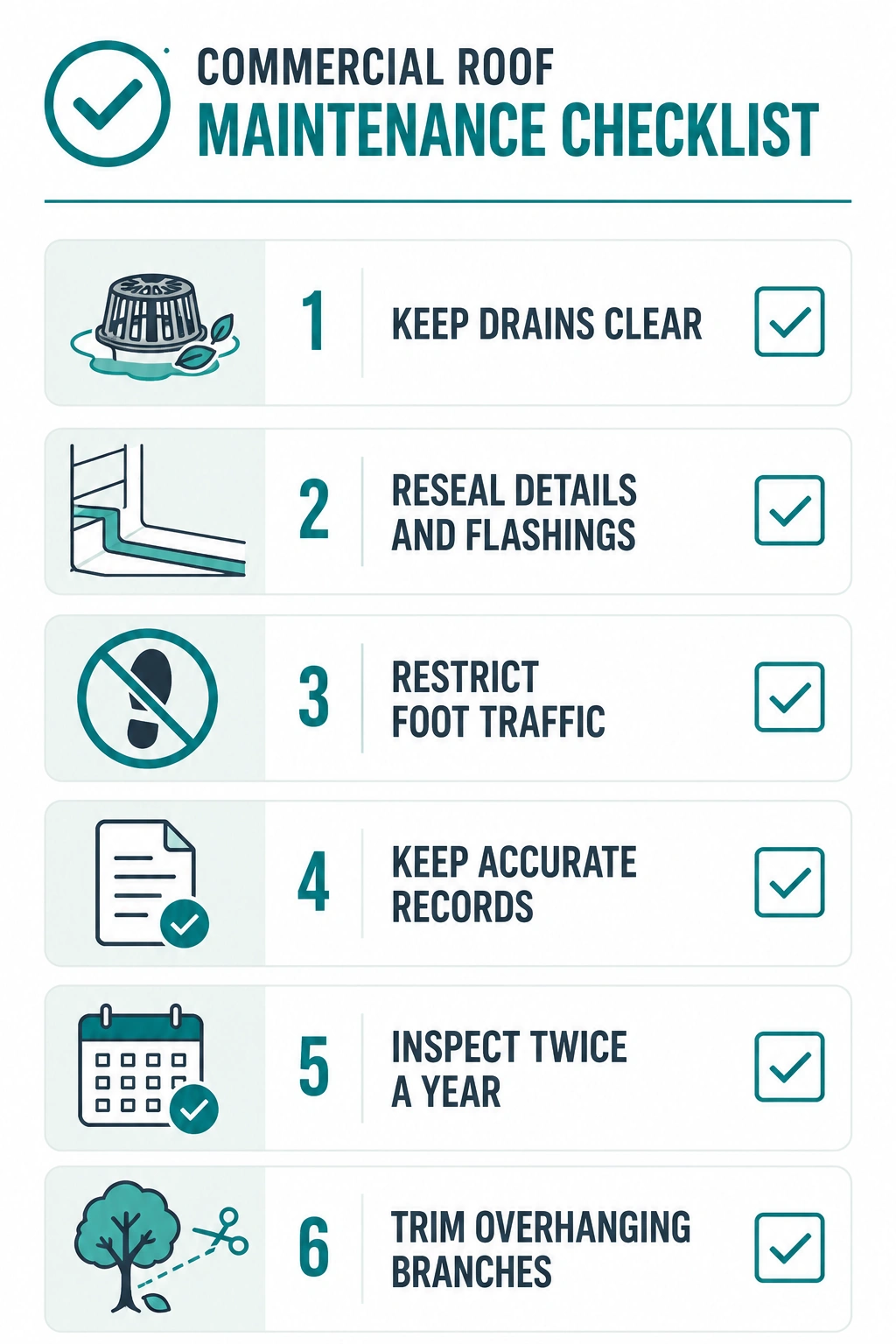
- Schedule professional inspections twice a year and after major storms.
- Keep drains, scuppers, and gutters clear so water leaves the roof quickly.
- Address ponding water and small membrane damage before they spread.
- Trim nearby trees to reduce debris and limb damage.
- Restrict and document rooftop foot traffic; unauthorized traffic damages membranes and can void warranties.
- Coordinate with HVAC and other trades so their work does not damage the roof, and inspect after they have been up there.
- Keep dated records of every inspection and repair to support warranty and insurance claims.
- Review maintenance requirements in the manufacturer warranty and follow them exactly.
FAQs
What is the difference between a commercial and a residential roofing contractor?
Commercial contractors specialize in low-slope and flat roofs using systems like TPO, EPDM, PVC, and metal, on larger buildings with different drainage, insulation, code, and safety demands. Residential contractors focus on steep-slope shingle roofs. The skills overlap only partially.
How long does a commercial roof last?
Service life varies widely by system, installation quality, climate, and maintenance. Single-ply and modified systems generally last a couple of decades under good maintenance, and metal often longer, but a manufacturer or contractor should give a specific estimate for your roof rather than a blanket figure.
How much does commercial roofing cost?
There is no reliable universal price. Cost depends on size, system, tear-off vs. re-cover, deck condition, access, code upgrades, warranty level, and local market rates. Get multiple written estimates on the same scope to compare fairly.
How often should a commercial roof be inspected?
A common recommendation is twice a year, in spring and fall, plus after any major storm. Regular inspection catches small problems before they become leaks and helps keep warranties valid.
Should I repair or replace my commercial roof?
Repair generally fits localized damage on a roof still within its service life with dry insulation. Replacement fits widespread or recurring leaks, saturated insulation, or a roof past its expected lifespan. An inspection with moisture readings should guide the call.
What is the best commercial roofing system?
There is no single best system. TPO, EPDM, PVC, modified bitumen, built-up, and metal each have strengths and limitations depending on climate, budget, roof traffic, and building use. The right choice is building-specific.
What licenses and insurance should a commercial roofing contractor have?
Requirements vary by location, but at minimum look for the licensing your jurisdiction mandates, general liability insurance, and workers’ compensation coverage — all verified directly with the issuing authority and insurer.
What is a manufacturer certification, and why does it matter?
Manufacturers certify contractors who meet training and installation standards. Certification is often required to access the strongest system warranties, including no-dollar-limit coverage, and signals ongoing training.
What voids a commercial roof warranty?
Common causes include skipped required maintenance, unauthorized repairs, rooftop modifications or equipment installed without approval, and undocumented foot traffic. Read the specific warranty terms, since they vary by manufacturer.
How do I find a reliable commercial roofing contractor near me?
Search locally, then filter by commercial experience, current licensing, active insurance, and manufacturer certification. Verify credentials independently, check references on comparable projects, and compare detailed written estimates on identical scope.
Conclusion
Hiring a commercial roofing contractor is less about finding the single best company and more about verifying the right one for a specific building and job.
The strongest signals are consistent: real commercial experience on comparable projects, current licensing, active insurance, relevant manufacturer certifications, detailed written estimates, warranties in writing, a serious safety program, and clear communication about scope, timeline, and change orders.
The systems matter too. TPO, EPDM, PVC, modified bitumen, built-up roofing, metal, and coatings each fit some buildings better than others, and a good contractor explains the trade-offs instead of selling a single answer.
Costs, licensing rules, permit requirements, and warranty terms all vary by location, building type, roofing system, and manufacturer — so treat any universal price or guarantee with skepticism, get multiple estimates on the same scope, and put everything in writing. Do that, and the roof over a commercial building becomes an asset that is managed rather than a problem that is inherited.

Team Newszii is composed of individuals with professional backgrounds in content writing. We specialize in writing on a variety of topics including Lifestyle, Entertainment, Humor, Women, Food, Travel, Technology, and Blockchain Technology. Our team is driven by a passion for creating unique, accurate, and engaging content.