Published on August 5th, 2026
Most abandoned treadmills don't fail because they're bad machines. They fail because they were the wrong machine — too loud for the apartment, too small for the runner's stride, or quietly draining $44 a month for a subscription nobody wanted. What's left is an expensive clothes rack in the spare room.
That's what this guide is here to prevent. Below are the best treadmills for home use in 2026, sorted by who they're actually for: the daily runner, the budget-first beginner, the apartment walker, and the person who refuses to pay a monthly fee. This article will also explain treadmill specs simply and help you figure out exactly which one is right for your situation. So you can work out which machine actually suits your space, your budget, and how you plan to use it.
Worth knowing up front: this is a research-based buying guide, not a hands-on lab test.
Top Picks at a Glance
- Best overall: NordicTrack Commercial 1750 — the do-everything runner's treadmill
- Best under $1,000: Sole F63 — serious build quality without the premium price
- Best subscription-free: Sole F80 — no monthly fee, ever
- Best compact for small spaces: Horizon T101 — folds away, easy on the wallet
- Best walking pad / under-desk: MERACH UltraWalk W60 — steps while you work
- Best for serious runners and heavier users: Sole F85 — commercial-grade motor and decline
- Simplest to use (great for seniors): Sole F63 — no touchscreen, no learning curve
How These Picks Were Chosen
This guide draws on publicly available information rather than in-house testing. That means a side-by-side look at manufacturer specifications, how established independent testers rated each model after hands-on testing, and health guidance from published research by groups such as the CDC and the American Heart Association.
Where reviewers disagree, or a spec looks impressive but hides a catch, this guide says so. The picks reflect that research and expert consensus, not paid placement.
One honest caveat: treadmill prices move around constantly with sales and promotions. Every figure below was accurate at the time of writing, so check the current price on the retailer's page before you buy.
The Best Treadmills for Home Use in 2026
Best Overall — NordicTrack Commercial 1750
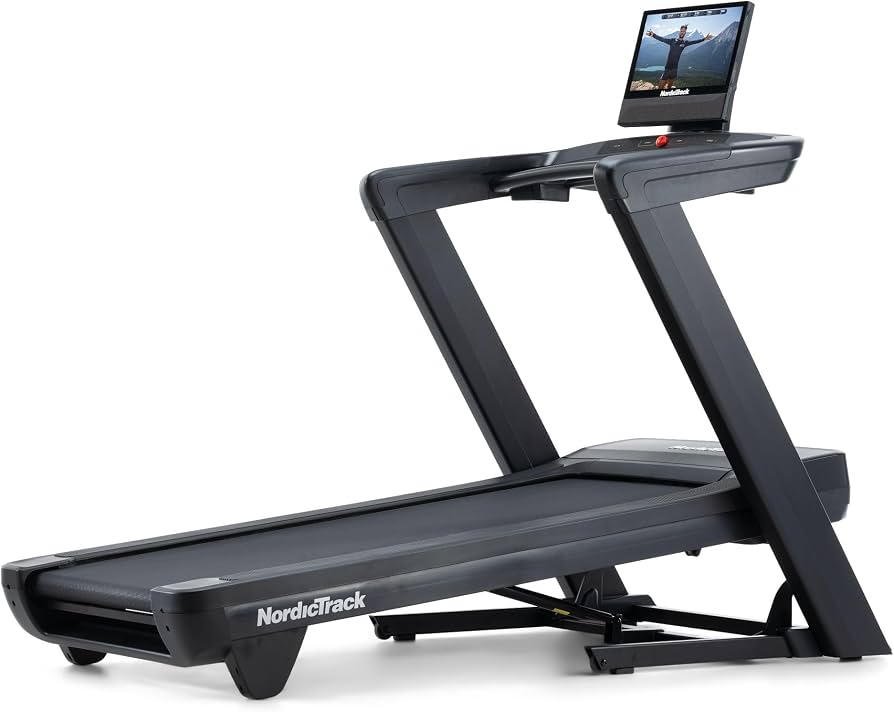
Quick verdict: The 2026 Commercial 1750 is the versatile, do-everything option for buyers whose budget stretches to it. A strong 4.25 CHP motor, a full 22" x 60" deck, and a -3% to 12% incline-and-decline range make it as comfortable for recovery walks as for marathon training. The one catch: its smartest features sit behind an iFIT subscription.
| Spec | Detail |
|---|---|
| Motor | 4.25 CHP |
| Deck (W x L) | 22" x 60" |
| Incline / decline | -3% to 12% |
| Top speed | 12 mph |
| Weight capacity | 400 lb |
| Screen | 16" pivoting HD touchscreen (streams Netflix, Spotify) |
| Folding | Yes — SpaceSaver with EasyLift Assist |
| Warranty | 10-yr frame, lifetime motor, 2-yr parts, 1-yr labor |
| Subscription | iFIT around $39/mo (optional; runs in manual mode without it) |
Pros
- Powerful motor that won't strain under daily running
- Rare decline (-3%) for downhill training and quad conditioning
- 400-lb capacity and a rock-solid frame
Cons
- The interactive experience leans hard on the paid iFIT subscription
- Bulky footprint even when folded
- Needs a strong Wi-Fi connection for streaming workouts
Who it's for: Runners and multi-goal households that want one machine to do everything. Who should skip it: Budget-focused walkers, or anyone who resents subscriptions — you'd be paying for a screen you won't use.
Pro tip: The 1750 still runs in manual mode without an iFIT subscription. If controlling speed and incline yourself is enough, factor that in before you assume the monthly fee is a must.
Best Under $1,000 — Sole F63
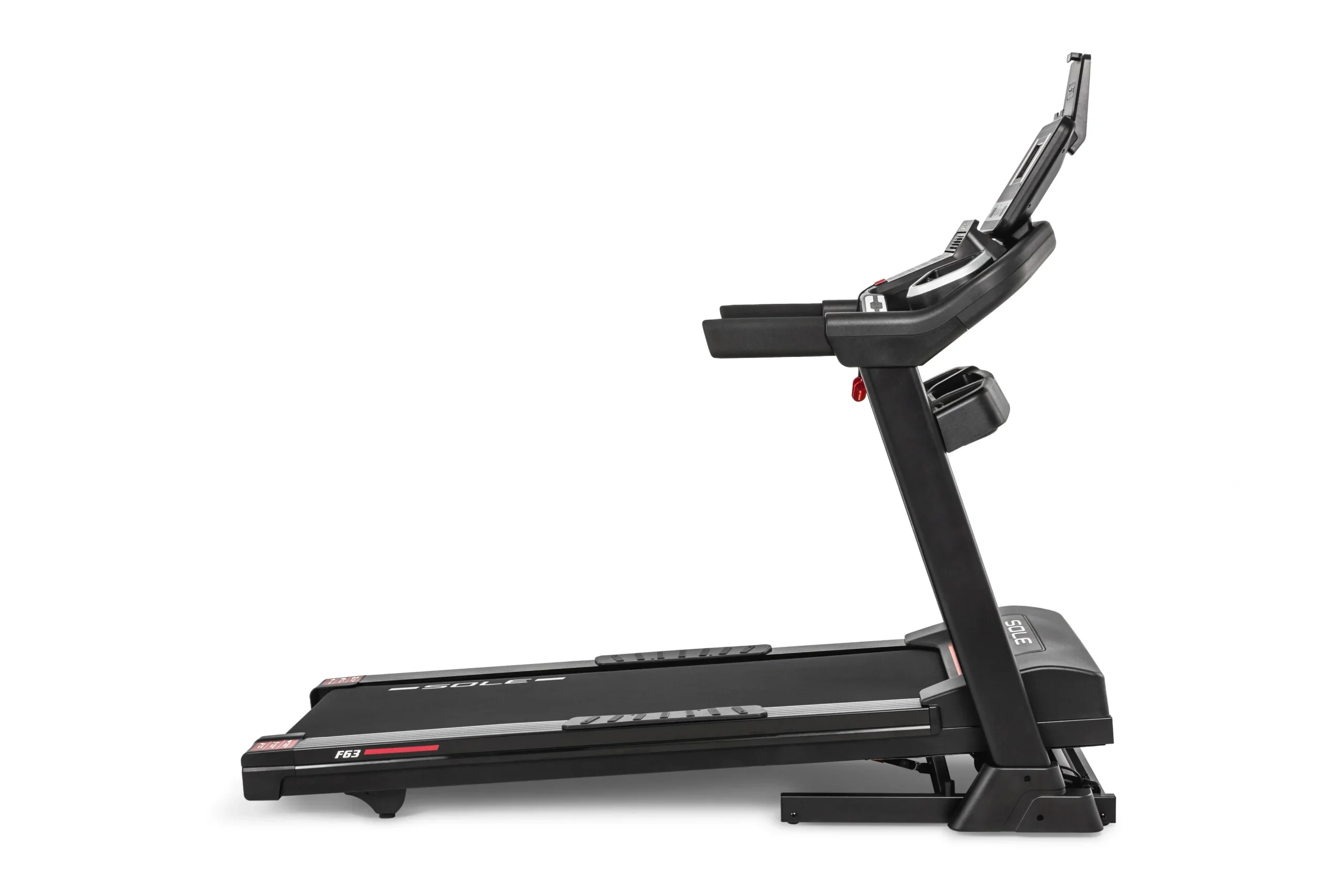
Quick verdict: The Sole F63 spends its budget where it counts — on the motor, frame, and warranty — rather than a flashy screen. For around $999, it comes with a 3.0 CHP motor, a two-ply belt, 15 incline levels, and a lifetime warranty on the frame and motor. That warranty alone beats what a lot of machines twice the price offer.
| Spec | Detail |
|---|---|
| Price | Around $999 (often listed at a higher regular price) |
| Motor | 3.0 CHP |
| Deck (W x L) | 20" x 60" |
| Incline | 15 levels |
| Top speed | 12 mph |
| Weight capacity | 325 lb |
| Screen | None (tablet holder instead) |
| Subscription | None — free companion app |
Pros
- Lifetime frame and motor warranty at a sub-$1,000 price
- Full 60" deck that suits taller users
- No subscription; stream on your own tablet
Cons
- Runs louder than pricier models, according to independent testing
- Heavy, and assembly is a two-person job
- No built-in touchscreen
Who it's for: Budget-first buyers, beginners, and anyone who wants durable basics over luxury extras. Who should skip it: Apartment dwellers who need whisper-quiet operation, or buyers set on an integrated screen.
Warning: Sole's optional room-of-choice delivery and in-room assembly add real cost. Without a helper and a free afternoon, it's worth paying for them upfront instead of getting caught out at checkout.
Best Subscription-Free — Sole F80
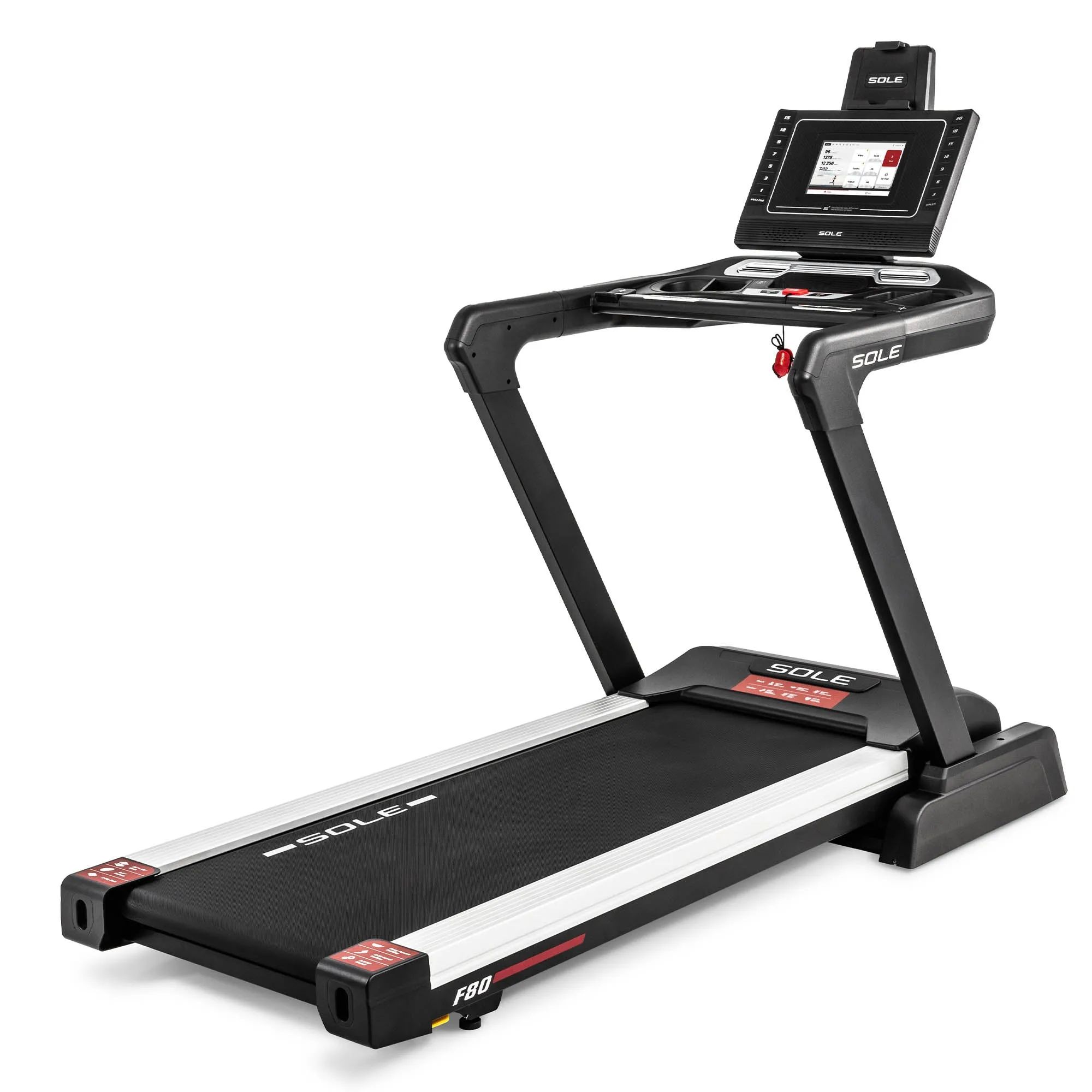
Quick verdict: The F80 is built for anyone who refuses to pay a recurring fee. It brings a 3.5 CHP motor, a wide 22" x 60" deck, and a touchscreen, along with a lifetime frame-and-motor warranty and no required subscription. You own it outright, screen and all.
| Spec | Detail |
|---|---|
| Price | Around $1,599 |
| Motor | 3.5 CHP |
| Deck (W x L) | 22" x 60" |
| Incline | 15 levels |
| Top speed | 12 mph |
| Weight capacity | 350 lb |
| Screen | 10.1" touchscreen |
| Subscription | None required |
Pros
- No monthly fee — a real long-term saving (see the cost section below)
- Wide 22" belt and strong motor handle daily running
- Lifetime frame and motor warranty
Cons
- Touchscreen is simpler than NordicTrack's connected experience
- Heavy; solo assembly is tricky
- Adjusts speed slightly slower than the fastest-reacting motors
Who it's for: Runners who want a serious machine without renting it month after month. Who should skip it: People who genuinely want guided, trainer-led classes — that's iFIT or Peloton territory.
Best Compact for Small Spaces and Apartments — Horizon T101
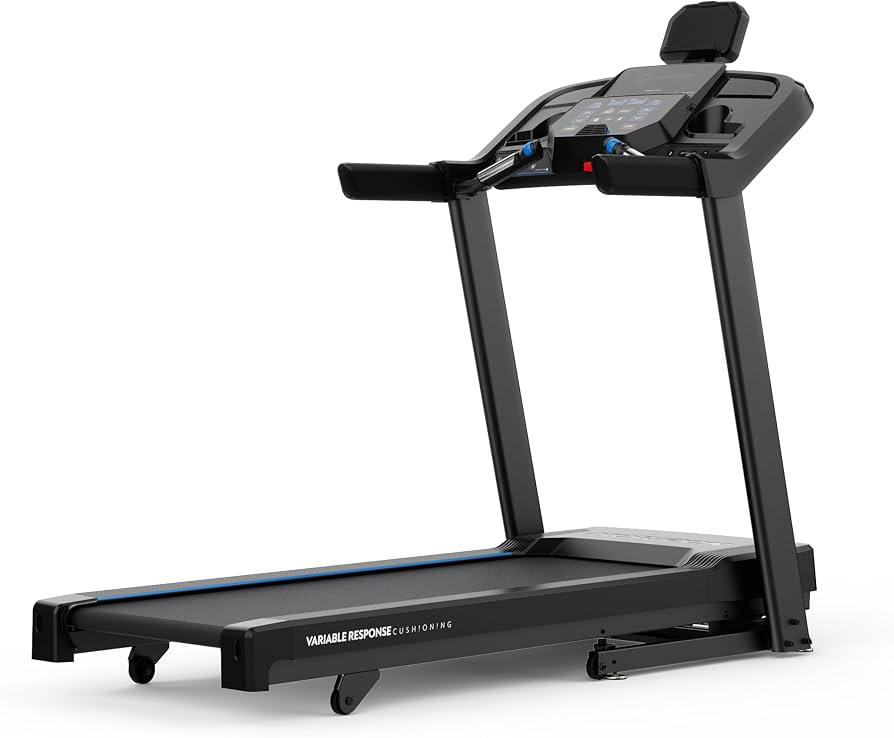
Quick verdict: The T101 is a sensible small-space pick: a real folding treadmill, not a flimsy pad, at roughly $649 to $699. Its 2.5 CHP motor and 20" x 55" deck handle walking and gentle jogging, and it still carries a lifetime frame-and-motor warranty.
| Spec | Detail |
|---|---|
| Price | Around $649 to $699 |
| Motor | 2.5 CHP |
| Deck (W x L) | 20" x 55" |
| Incline | Up to 10% |
| Weight capacity | 300 lb |
| Folding | Yes — hydraulic, with transport wheels |
| Extras | Bluetooth speakers, cooling fan, tablet holder, USB port |
| Warranty | Lifetime frame and motor, 1-yr parts and labor |
Pros
- Folds down and rolls away — a genuine space saver
- Lifetime frame and motor warranty at a budget price
- Cushioning that's kind to joints
Cons
- 55" deck feels short for taller runners at speed
- 2.5 CHP is fine for walking and jogging, not heavy daily running
- Basic display
Who it's for: Apartment and small-home walkers and light joggers. Who should skip it: Tall runners or anyone training hard — the deck and motor will start to feel limiting.
Best Walking Pad / Under-Desk — MERACH UltraWalk W60
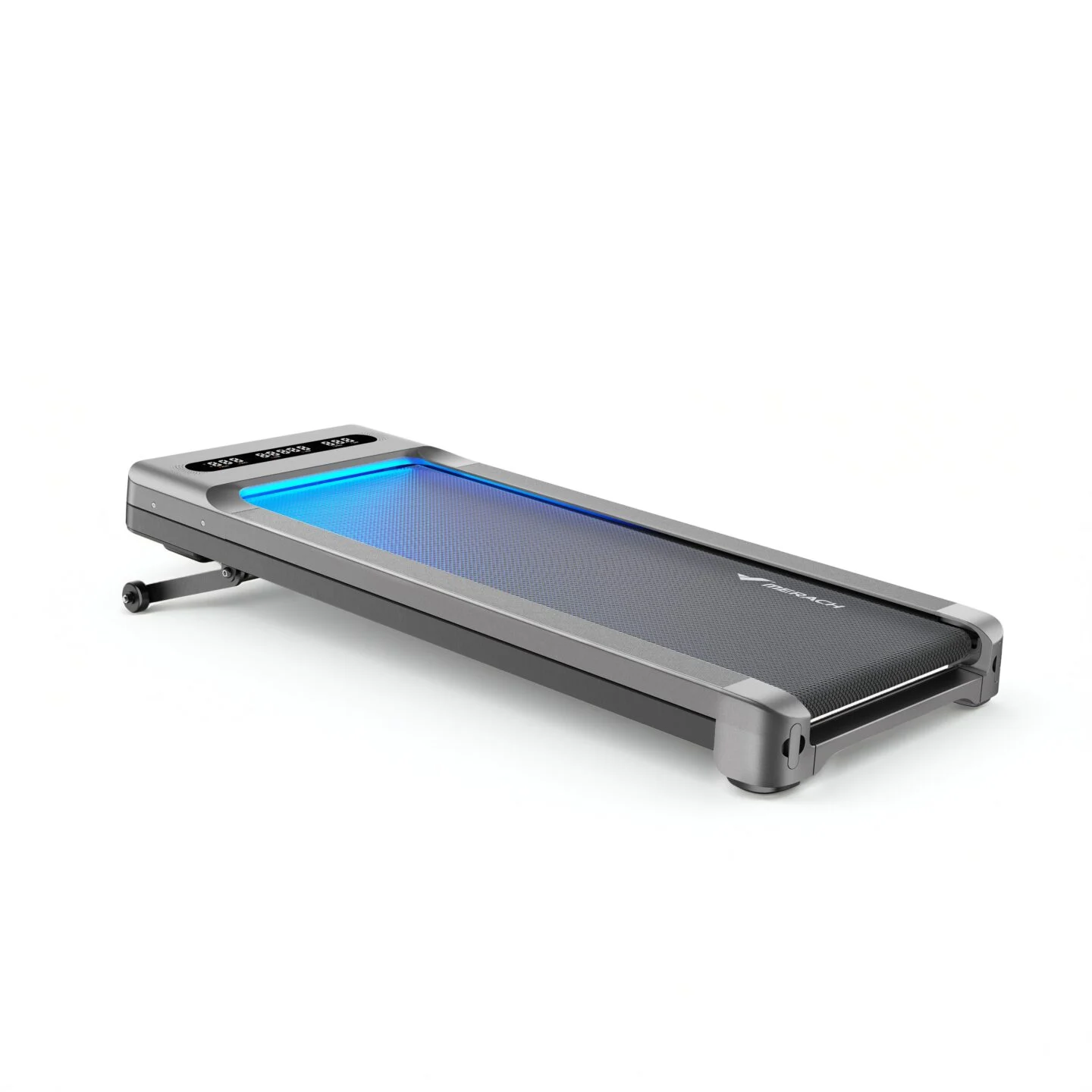
Quick verdict: For getting your steps in while you work, a walking pad beats a full treadmill on price and footprint. The MERACH UltraWalk W60 shows up fully assembled, with auto-incline, app tracking, and a treadmill-grade motor for around $280 to $300 — a lot of pad for the money.
| Spec | Detail |
|---|---|
| Price | Around $280 to $300 |
| Motor | 3.5 peak HP brushless |
| Incline | Auto, up to about 12% |
| Assembly | None — ships ready to use |
| Extras | App connectivity, transport wheels, vertical storage |
Pros
- Zero assembly — unbox, plug in, walk
- Auto-incline is rare at this price
- Slides away easily in tight spaces
Cons
- Walking only — you can't run on it
- Short belt restricts stride at faster paces
- Fewer features and less cushioning than a full treadmill
Who it's for: Work-from-home professionals chasing a daily step goal. Who should skip it: Anyone who wants to jog or run — you'll want a real treadmill instead.
Pro tip: A walking pad and a treadmill aren't interchangeable. If your plan involves any running, now or later, skip the pad — see the decision guide below.
Best for Serious Runners and Heavier Users — Sole F85
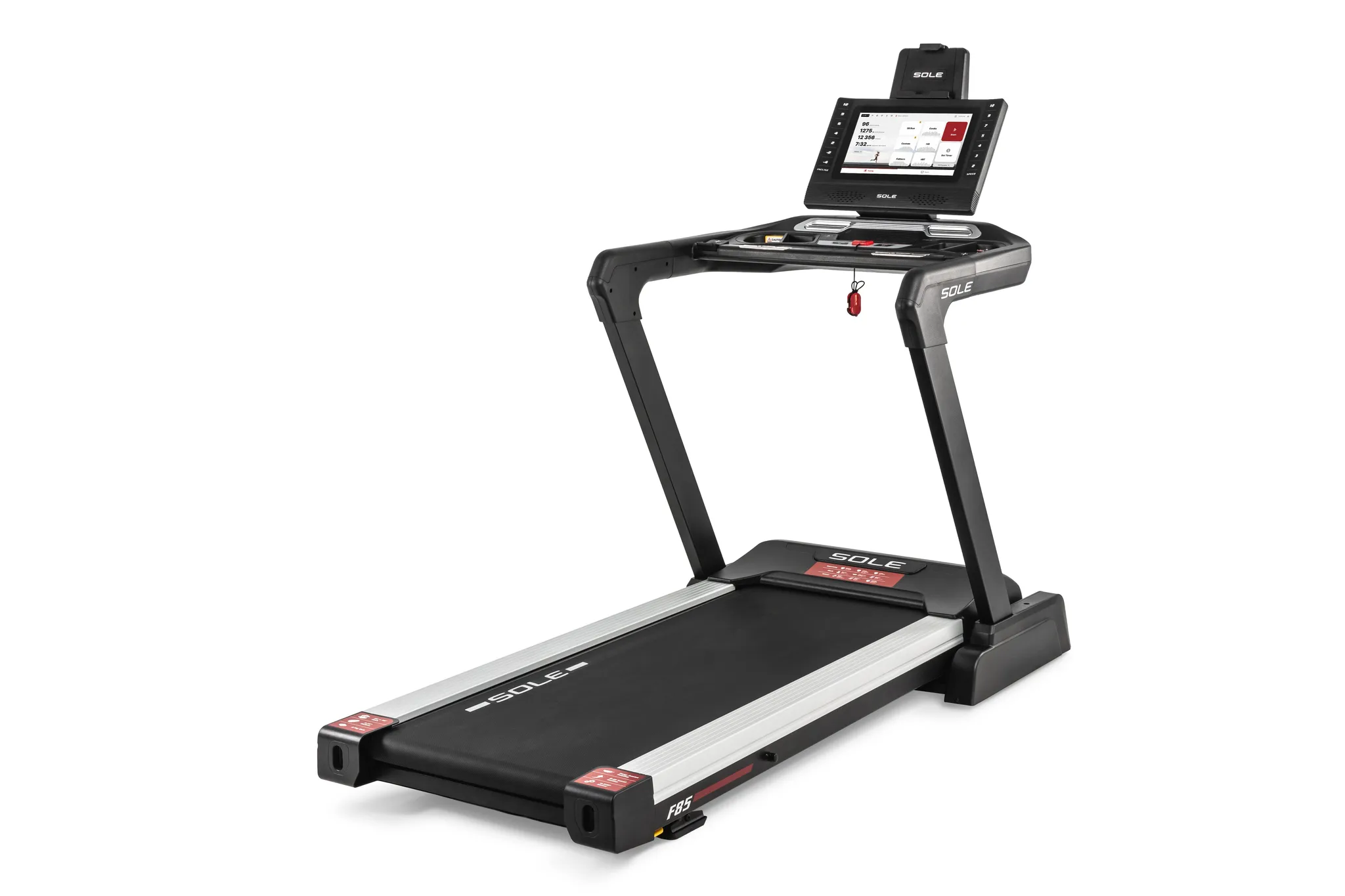
Quick verdict: For serious mileage or a heavier runner, the motor and frame matter more than the screen. The F85 steps up to a 4.0 CHP motor, a -6% to 15% incline-and-decline range, and Sole's lifetime warranty, with no subscription required.
| Spec | Detail |
|---|---|
| Price | Around $2,199 |
| Motor | 4.0 CHP |
| Incline / decline | -6% to 15% |
| Deck | 22" x 60" |
| Weight capacity | 375 lb |
| Subscription | None required |
Pros
- Commercial-feel motor for high-mileage running
- Wide incline and decline range for varied training
- Lifetime frame and motor warranty, no monthly fee
Cons
- Premium price
- Large, heavy, and needs real floor space
- Overkill for walkers
Who it's for: Dedicated runners, marathon trainees, and heavier users who need durability. Who should skip it: Casual walkers — most of that capability would go unused.
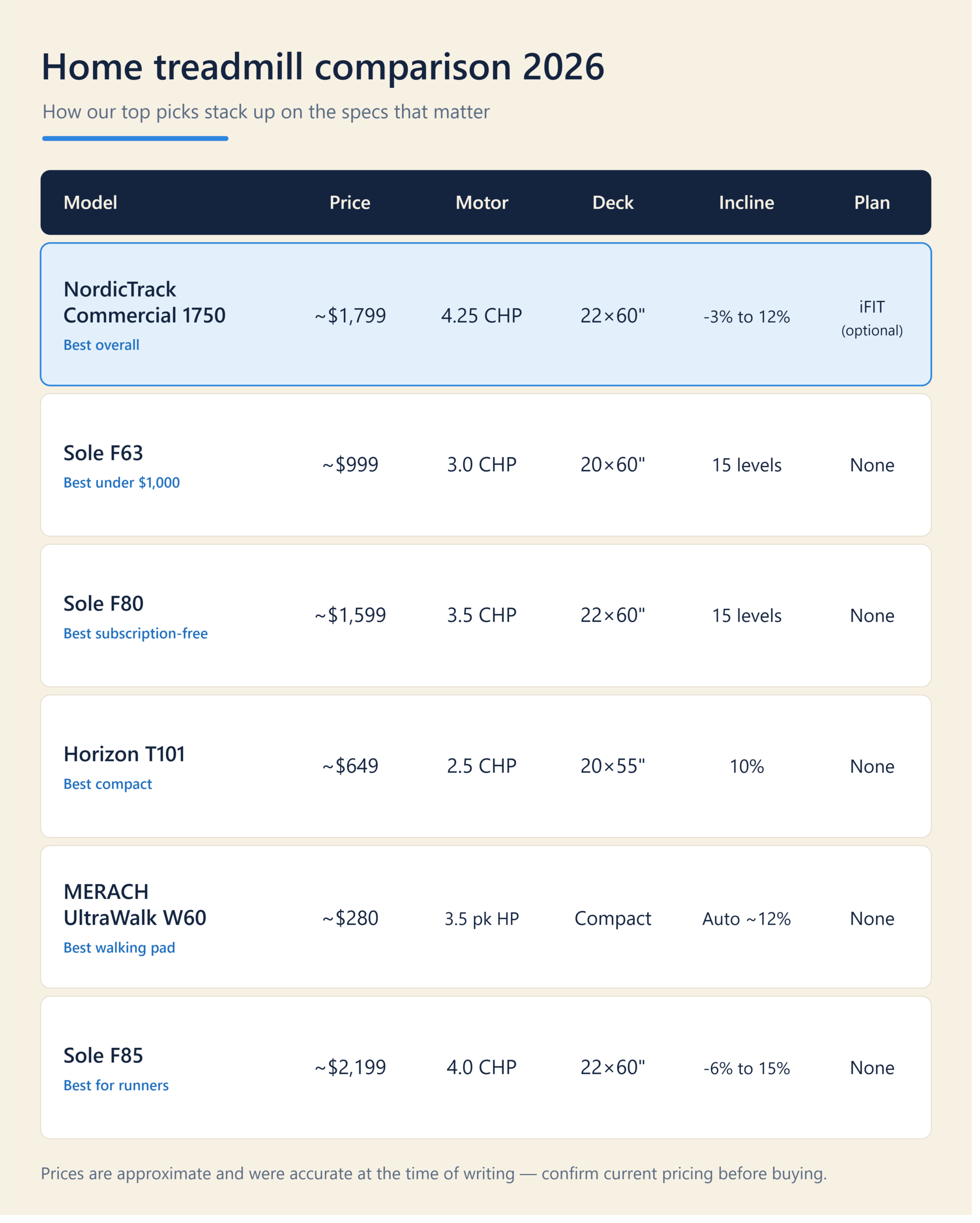
At-a-Glance Comparison
How to Choose a Treadmill for Home: Buying Guide
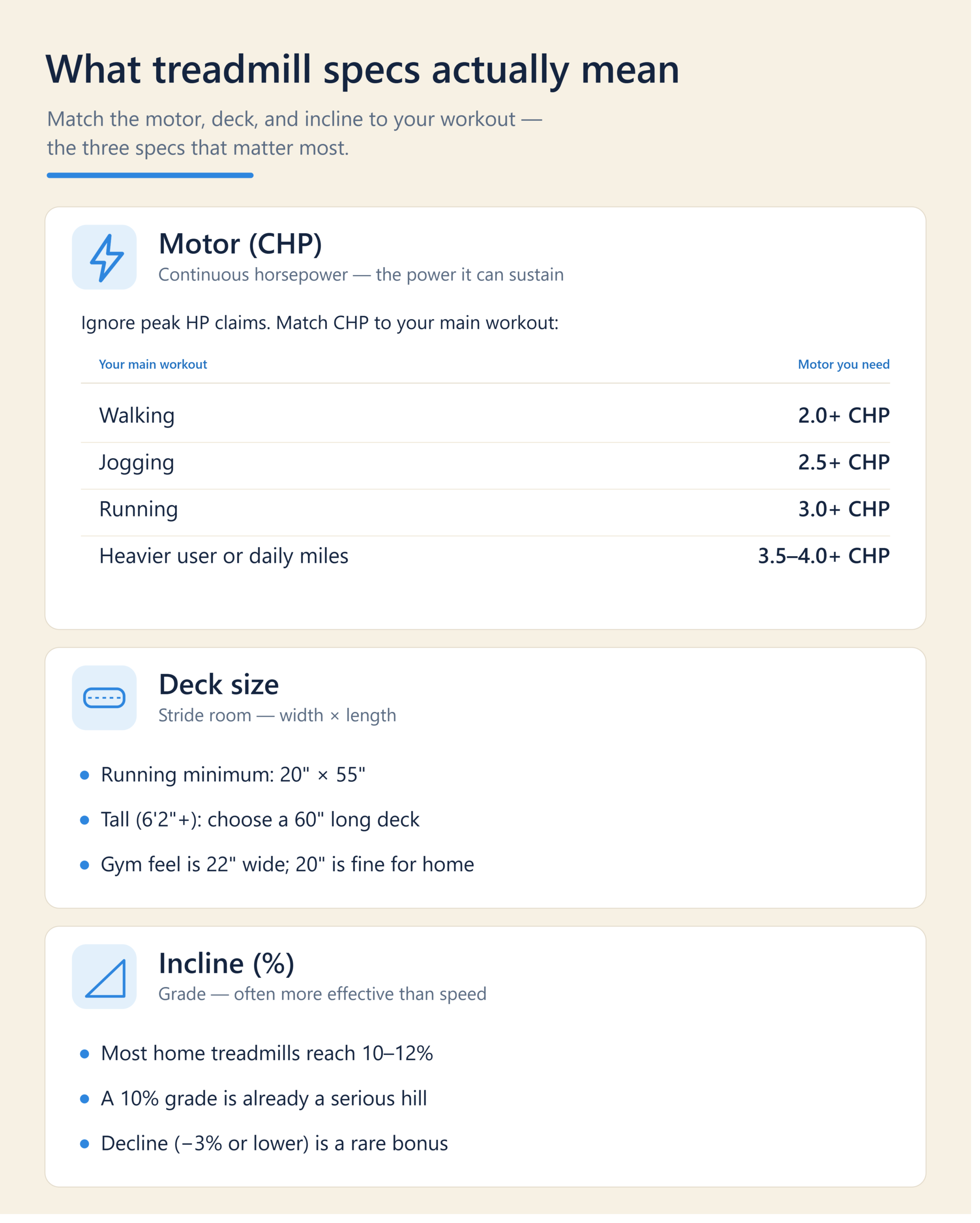
Forget the marketing. Three specs decide whether a treadmill is right for you: the motor, the deck, and the incline. Get those right and the rest is just detail.
What CHP Motor Do You Actually Need?
CHP stands for continuous horsepower — the power a motor can sustain, workout after workout. Ignore "peak HP," which is just a brief burst number used for marketing.
| Your main use | Motor you need |
|---|---|
| Walking | 2.0+ CHP |
| Jogging | 2.5+ CHP |
| Running (regular) | 3.0+ CHP |
| Heavier user or daily miles | 3.5 to 4.0+ CHP |
Weight and speed add up fast. A 3.0 CHP motor might carry a lighter walker for years, then struggle under a heavier runner doing daily fast sessions. When you're unsure, size up — a slightly stronger motor runs cooler, quieter, and longer.
What Size Deck Do You Need?
Deck size is really about stride room. For running, look for at least 20" x 55", and a 60" length if you're taller than about 6'2" — a cramped deck forces you to shorten your stride and stare at your feet. Gym treadmills run 22" wide and feel luxurious, but 20" is the practical home choice for most people.
How Much Incline Is Enough?
Most home treadmills top out at 10% to 12% incline, and for most users that's plenty — a 10% grade is a serious hill. Premium machines reach 15%, and a few add decline (negative incline) for downhill training, which helps road runners but isn't essential.
Incline is also worth more than most people think. Walking up a grade burns noticeably more calories and works your glutes and hamstrings, with less impact on your joints than grinding out faster flat miles.
Other Specs Worth Checking
- Cushioning: Good shock absorption reduces impact versus running on pavement — important for daily runners and anyone with knee or hip concerns.
- Weight capacity: Pick a machine rated at least 50 lb above your body weight for durability and stability.
- Folding vs. non-folding: Folding saves floor space, but steep-incline models usually don't fold, and you still need clearance behind the belt to use it safely.
- Noise: For apartment living or early-morning runs, noise matters. Quieter machines usually have larger, better-built motors, and a treadmill mat underneath helps.
Before you buy, run through this quickly: measure the room (including ceiling height minus about 20" for incline clearance); match the motor's CHP to your weight and workout; confirm the deck length fits your stride; check the weight capacity (your body weight plus 50 lb at minimum); add up any subscription cost over three years; make sure the folded footprint fits your storage plan; read the full warranty; and plan for delivery and assembly.
Find Your Treadmill: A 5-Question Shortcut
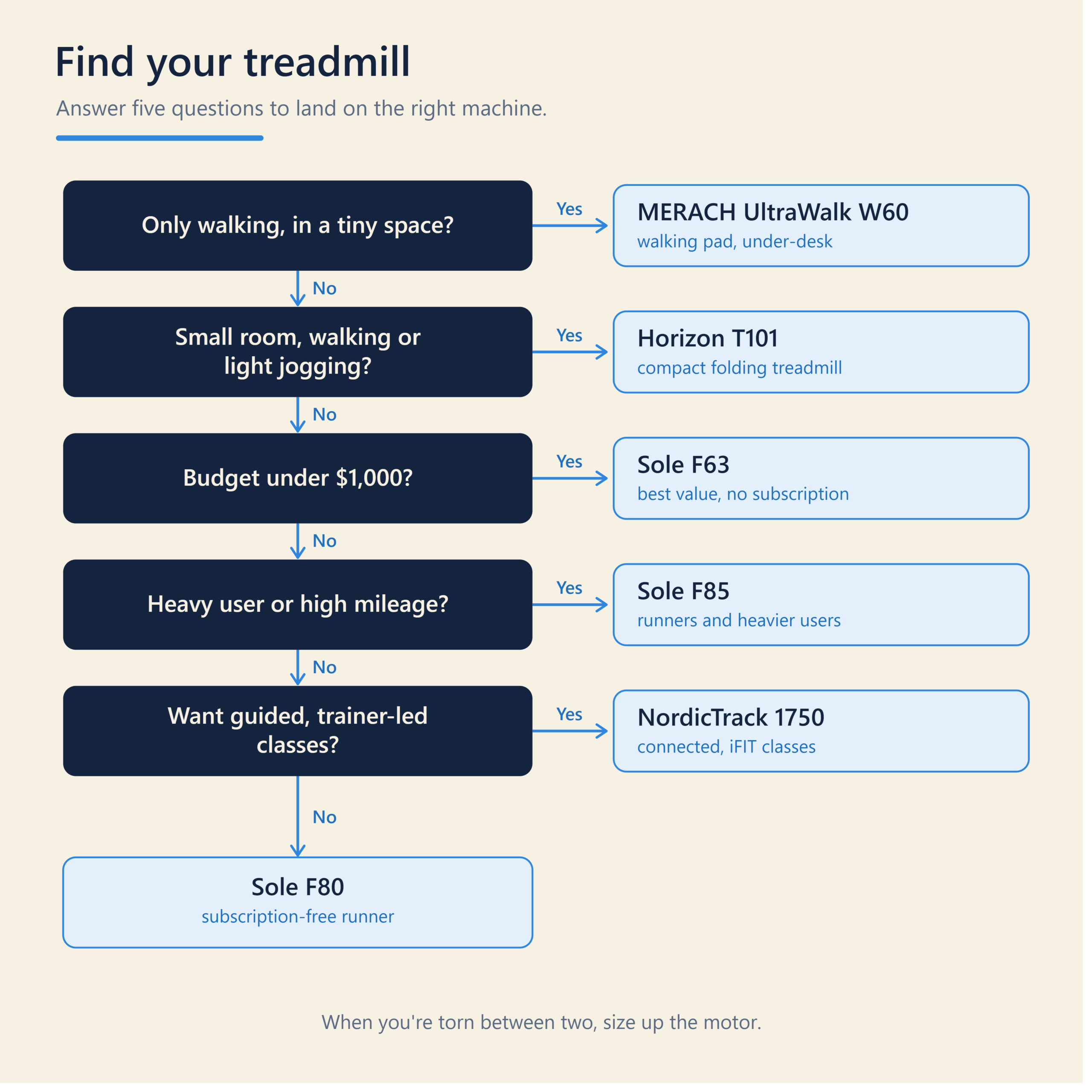
- Will you ever run, or only walk? Only walk and tight on space, choose a walking pad or the Horizon T101. Otherwise, keep going.
- What's your budget? Under $1,000, the Sole F63. Between $1,000 and $2,000, the NordicTrack 1750 or Sole F80.
- Do you want guided, trainer-led classes? Yes, the NordicTrack 1750 with iFIT. No, the Sole F80 or F63.
- Are you a heavier user or high-mileage runner? Yes, the Sole F85 or the 400-lb NordicTrack 1750.
- Is a monthly fee a dealbreaker? Yes, any Sole model. No, the NordicTrack 1750 unlocks the most.
The True Cost of a Home Treadmill
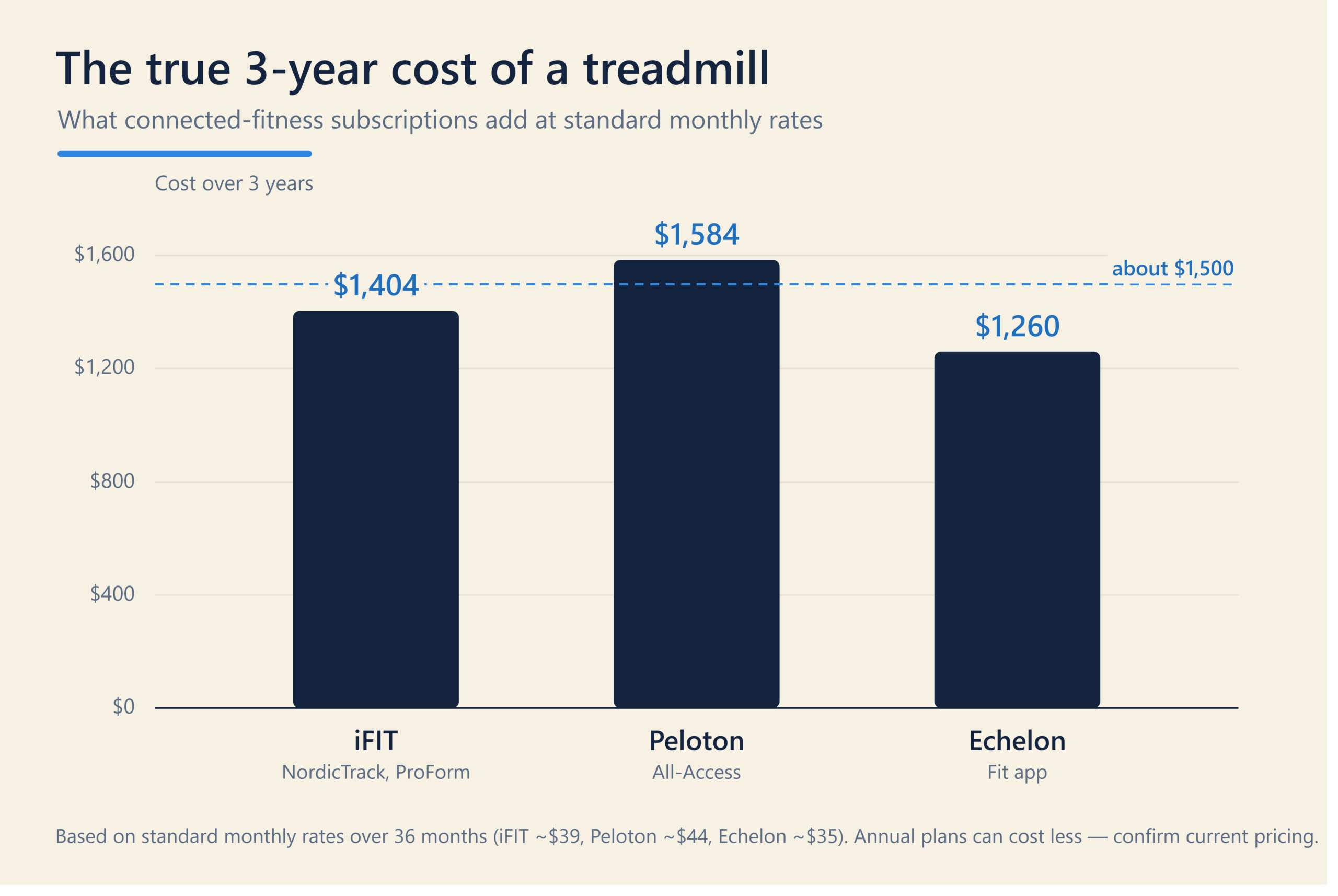
The sticker price is only half the story. Connected treadmills often need a subscription to unlock their best features, and that meter keeps running for years.
How the Price Tiers Break Down
| Tier | Price | What you get |
|---|---|---|
| Walking pad | Under $500 | Steps only, no running, minimal features |
| Budget | $500 to $1,000 | Solid walking and jogging; simpler build |
| Sweet spot | $1,000 to $2,000 | Real running machines with strong motors |
| Premium | $2,000+ | Commercial-grade motors, decline, big screens |
What the Subscription Really Costs
Over three years, the fee often rivals a second treadmill.
| Platform | Monthly | 3-year total |
|---|---|---|
| iFIT (NordicTrack / ProForm) | ~$39 | ~$1,200 to $1,400 |
| Peloton All-Access | ~$44 | ~$1,584 |
| Echelon Fit | ~$35 | ~$1,260 |
That's why a subscription-free Sole can end up cheaper than a lower-priced connected machine. Add the fee to the sticker before you compare.
Is A Home Treadmill Worth It?
For a lot of people, yes. A typical gym membership runs about $39 to $44 a month, so a mid-range treadmill can pay for itself in roughly six months to two years once you factor in the membership, the gas, and the commute time you're skipping — as long as you actually use it. There's a health angle too: the CDC recommends at least 150 minutes of moderate activity a week, and a treadmill is one of the most reliable ways to hit that whatever the weather.
Buyer tip: Treadmills go on sale on a predictable schedule — around New Year, Black Friday, and the holidays. If you're not in a rush, waiting for one of those can save you a fair bit. It's also worth asking about open-box or refurbished units.
Treadmill vs. Walking Pad: Which Do You Actually Need?
| If you... | Choose a... |
|---|---|
| Only want steps while working, in a tight space | Walking pad |
| Walk and occasionally jog | Compact folding treadmill (Horizon T101) |
| Run, or plan to | Full treadmill (Sole F80, NordicTrack 1750) |
| Are over 6' and run | Full treadmill with a 60" deck |
| Have almost no floor space and never run | Walking pad |
The most common mistake here is buying a walking pad and expecting to run on it later. You can't — the belts are short and the top speed is barely a jog. Match the machine to what you'll actually do, not the athlete you imagine becoming.
Common Mistakes to Avoid
- Under-buying the motor. A too-small motor overheats and wears out early under a heavier or faster user.
- Ignoring subscription lock-in. A "$1,499" connected treadmill can quietly become a $2,900 machine over three years.
- Forgetting ceiling clearance. Incline raises the deck — and you — so measure ceiling height, then subtract about 20".
- Buying a walking pad to run on. It won't work. Buy the right category the first time.
- Chasing a 15% to 20% incline. Almost nobody uses it. A 10% grade already delivers a punishing workout.
- Overlooking the deck length. Taller runners on a short deck shorten their stride and quit sooner.
Treadmill Myths, Debunked
- "More horsepower is always better." Only up to a point. Match CHP to how you'll use it — a walker doesn't need 4.0 CHP.
- "Expensive equals necessary." A well-built sub-$1,000 treadmill can outlast pricier machines. The premium often buys a screen, not durability.
- "Treadmills wreck your knees." Quality cushioning reduces impact compared with pavement; for many people with joint concerns, a treadmill is gentler than outdoor running.
- "You need a big touchscreen." What you really need is a good motor, deck, and frame. The screen is optional — and it's what the subscription is really selling.
Setup, Maintenance, and Making It Last
Delivery and assembly: Full treadmills arrive in one heavy box. Assembly is doable but much easier with two people, and paid in-room delivery and setup are worth it if you're on your own.
A simple maintenance rhythm:
- Every use: wipe down sweat and keep the deck clear.
- Monthly: check belt alignment and tension.
- Every few months: lubricate the belt as the manual says, since skipping it is a common cause of early wear.
Keeping it quiet in an apartment: A treadmill mat helps, keep the belt lubricated, and go for a model with a bigger motor — most of the noise comes from an overworked one.
How long do treadmills last? A quality home treadmill that's looked after will usually last many years, which is exactly why it pays to buy the right motor and frame up front instead of replacing a cheap machine every couple of years.
Maintenance tip: A belt that slows or bogs down when you raise the speed or incline is a warning sign — the motor's struggling. Catch it early, because left alone it wears a treadmill out fast.
The Health Benefits of Home Treadmill Training
A treadmill isn't only about skipping the gym — the wider benefits are well documented by major health organizations:
- Heart health: The CDC and American Heart Association recommend at least 150 minutes of moderate aerobic activity per week, and a home treadmill makes that easy to hit year-round.
- Blood pressure:Regular aerobic exercise is consistently linked to lower blood pressure, with benefits that can appear within weeks.
- Steps and longevity: Research links roughly 6,000 to 8,000 daily steps to substantial cardiovascular and mortality benefits in older adults, and 8,000 to 10,000 in younger adults — targets a treadmill helps you reach on any schedule.
- Sleep and mood: Aerobic exercise is associated with better sleep quality and the release of endorphins that lift mood and reduce stress.
That convenience is the real draw. The best workout is the one you'll actually do, and a machine in the spare room takes away most of the excuses.
Which Treadmill Suits Which User
- The apartment walker: Horizon T101 or the MERACH W60 walking pad — compact, quiet-friendly, affordable.
- The budget beginner: Sole F63 — durable, simple, lifetime warranty, no fee.
- The daily runner: NordicTrack Commercial 1750 (for classes) or Sole F80 (without them).
- The heavier user or marathon trainee: Sole F85 or the 400-lb NordicTrack 1750.
- The senior or tech-averse user: Sole F63 — no touchscreen, intuitive controls, gentle cushioning.
- The two-person household: A 3.5+ CHP motor (F80 or 1750) built for heavier combined use.
Frequently Asked Questions
How Much Should You Spend On A Treadmill For Home Use?
For quality that lasts, expect to spend at least $1,000, and most solid running treadmills land between $1,000 and $2,000. Walkers can spend less, while serious runners or heavier users should budget $2,000 or more for a stronger motor and longer lifespan.
What CHP Motor Do You Need For A Treadmill?
Around 2.0 CHP for walking, 2.5 for jogging, and 3.0 or more for running. Heavier users or daily runners should look for 3.5 to 4.0 CHP so the motor runs cool and lasts.
What Size Treadmill Deck Do You Need For Running?
At least 20 inches by 55 inches. For anyone taller than about 6'2", a 60-inch deck keeps the stride from feeling cramped at speed.
Are Folding Treadmills Any Good?
Yes. A quality folding treadmill saves floor space with no real performance penalty. Just note that very steep incline models usually don't fold.
Do You Have To Pay A Subscription To Use A Treadmill?
No. Connected models like NordicTrack still run in manual mode without a subscription, and brands like Sole require no subscription at all. Only guided classes and auto-adjusting workouts need a paid plan.
How Much Is iFIT Per Month?
iFIT is around $39 per month, with a discounted annual option. For comparison, Peloton All-Access is about $44 a month and Echelon is roughly $35. Confirm current pricing before buying.
Is Running On A Treadmill Bad For Your Knees?
Generally no. Quality deck cushioning reduces impact compared with concrete, which is why treadmills are often recommended for people with joint concerns. Poor form or overtraining causes more problems than the machine.
How Long Should You Walk On A Treadmill Each Day?
To meet standard guidelines, aim for about 30 minutes most days, which adds up to roughly 150 minutes a week. For step goals, 6,000 to 10,000 steps a day is associated with strong health benefits.
Treadmill Or Walking Pad — Which Should You Buy?
Choose a walking pad only for walking, not running, and when a tiny footprint is needed, often under a desk. For any running, a full treadmill is the right call, because walking pads can't handle running speeds or a long stride.
How Long Do Home Treadmills Last?
A well-built, well-maintained treadmill lasts many years. Skipping belt lubrication and buying an under-powered motor are the fastest ways to shorten that lifespan.
Key Takeaways
- The right match beats the "best" machine. Fit the treadmill to your space, body, budget, and habits, and you'll sidestep the expensive-clothes-rack problem.
- Three specs decide everything: motor (CHP), deck size, and incline. Get a feel for those and you're much harder to upsell.
- Count the subscription. Over three years it can rival a second treadmill, so a fee-free Sole may cost less than a cheaper connected model.
- Best overall: NordicTrack Commercial 1750. Best value: Sole F63. Best fee-free runner: Sole F80.
Your Next Step
Pick the one or two models that line up with your answers to the five-question shortcut, then check today's price and, if you can, time your purchase around one of those sales. For a closer look, track down dedicated reviews and comparisons of your shortlist, along with a full treadmill buying guide, a walking-pad roundup, and a budget-treadmill guide to double-check your pick.

Team Newszii is composed of individuals with professional backgrounds in content writing. We specialize in writing on a variety of topics including Lifestyle, Entertainment, Humor, Women, Food, Travel, Technology, and Blockchain Technology. Our team is driven by a passion for creating unique, accurate, and engaging content.