Published on August 12th, 2026
AI is changing how people search for information, compare businesses, and discover products and services.
Google Search now includes generative AI experiences such as AI Overviews and AI Mode, while users increasingly interact with search through longer, more conversational, visual, and multimodal queries.
These changes do not mean traditional SEO is disappearing. Google says that its generative AI search experiences are rooted in its core Search ranking and quality systems, so strong technical SEO, helpful content, authority, and a good user experience remain foundational.
For businesses in India, the opportunity is to combine these fundamentals with an approach that prepares content for AI-driven search experiences.
Partnering with a reliable AI SEO company in India can help businesses adapt their content, technical SEO, local visibility, and measurement strategies as search continues to evolve.
The Transition from Traditional SEO to AI-Driven SEO
Traditional SEO often focused heavily on keyword targeting, link building, technical improvements, and ranking individual pages for specific queries.
Those activities still matter, but search engines are now much better at understanding context, entities, relationships, and the underlying intent behind a query.
Instead of creating content around a keyword alone, businesses need to understand the question a customer is trying to answer, the problem they want to solve, and the information they need before taking action.
AI-driven SEO therefore puts greater emphasis on search intent, useful information, topical depth, clear site structure, and content that demonstrates genuine expertise.
The goal is not to create a separate page for every possible variation of a search query. Google’s current guidance specifically warns against producing large amounts of low-value pages simply to capture search variations or manipulate AI search visibility.
What Is AI SEO?
AI SEO can be understood as the evolution of SEO practices in response to AI-assisted and generative search experiences.
It combines established SEO fundamentals with better use of AI for research, analysis, content workflows, technical audits, and understanding search behavior.
An effective AI SEO strategy focuses on making a website useful and understandable to both people and search systems.
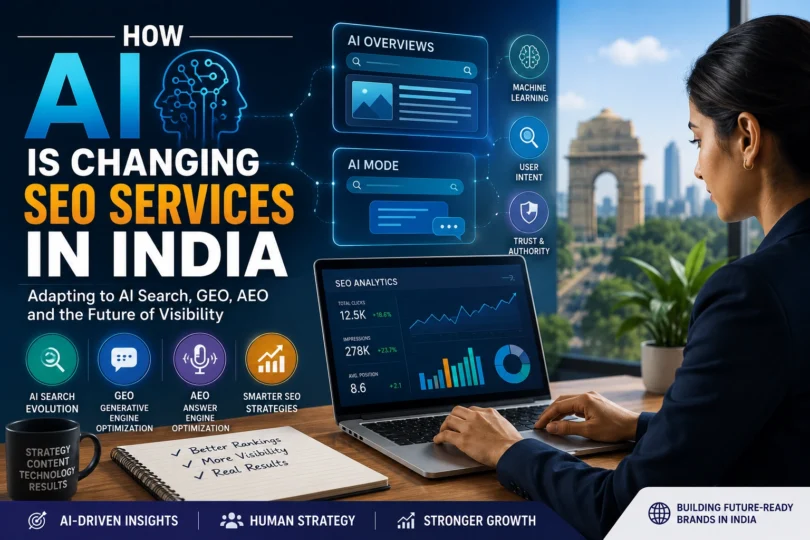
It can include traditional SEO, Generative Engine Optimization (GEO), Answer Engine Optimization (AEO), structured data, local SEO, multimedia content, and measurement of visibility across evolving search experiences.
AI Overviews and AI Mode: The New Search Landscape
One of the biggest changes in search is the expansion of generative AI experiences.
AI Overviews and AI Mode can provide synthesized answers and links to relevant sources, changing how users discover information and interact with websites.
This means businesses should think beyond a single traditional ranking position.
A page can potentially earn visibility through conventional search results as well as through links and references included in AI-generated search experiences.
Google’s 2026 guidance emphasizes that there is no separate technical checklist that replaces normal SEO.
The fundamentals still matter: create valuable, unique content, make important information accessible, maintain strong technical foundations, and provide useful supporting images and videos.
Three Areas of AI-Driven SEO
Generative Engine Optimization (GEO)
GEO is commonly used to describe efforts to improve the likelihood that content is referenced or surfaced by generative AI systems.
The concept is useful, but it should not be treated as a replacement for SEO or as a guaranteed way to make an AI system cite a page.
Strong GEO practices overlap heavily with good SEO: provide original and useful information, explain topics clearly, support important claims with evidence, demonstrate relevant expertise, organize information logically, and make important content accessible to search engines.
Answer Engine Optimization (AEO)
AEO focuses on making content useful for questions that search engines and answer-oriented systems may need to answer directly.
It is particularly useful for service businesses, local searches, FAQs, comparisons, and other situations where users want a clear answer rather than a general article.
Good AEO means answering important customer questions clearly and naturally, while providing enough context to demonstrate expertise.
Rather than forcing a page to repeat the same keyword, each section should solve a real information need.
AI-Assisted Traditional SEO
AI can make many SEO workflows faster. Keyword research, clustering, competitor analysis, content gap analysis, internal-linking suggestions, technical audit assistance, and data analysis can all benefit from AI-powered tools.
However, speed should not come at the expense of quality. AI-generated recommendations still need human review, business context, fact-checking, and strategic judgment.
The time saved through automation is most valuable when it allows SEO professionals to spend more time on strategy, original research, brand building, customer understanding, and creative problem-solving.
AI-Assisted Content and Google Search
Using AI to assist with content creation is not automatically a problem. AI can help with research, outlining, summarizing information, and organizing original material. The important question is whether the final content provides genuine value to users.
Google’s guidance warns against using generative AI or other automation to create large numbers of unoriginal pages primarily to manipulate search rankings.
Businesses should therefore use AI as an assistant rather than as a shortcut for publishing large volumes of low-value content.
Human review is especially important for claims involving health, finance, law, safety, statistics, pricing, or other information where accuracy and trust are critical.
First-Hand Experience and Trust Matter More
AI search makes generic information easier to produce, which increases the value of content that contains something genuinely useful or difficult to replicate.
Businesses should demonstrate first-hand experience, relevant expertise, original insights, case studies, examples, data, customer questions, and practical recommendations wherever appropriate.
Clear authorship, trustworthy sources, accurate business information, and evidence-backed claims can also strengthen the credibility of a website.
For service businesses, showing what the company actually does, who it serves, and what results or experience it can substantiate is more valuable than simply publishing another generic article on the same topic.
How to Stay Visible in the Age of AI SEO
1. Optimize Google Business Profile (GBP)
Google Business Profile remains important for local businesses. Keep business details accurate and consistent, clearly describe services, add useful photographs, maintain accurate opening information, and encourage genuine customer reviews.
Local landing pages and relevant business information should also provide clear context about where and how the business operates.
2. Optimize for Search Intent, Not Every Keyword Variation
People increasingly use natural-language and conversational queries, but businesses do not need to create a separate page for every possible wording. Instead, identify the underlying intent and create comprehensive content that answers the need behind related searches.
For example, a healthcare business should understand the different questions a prospective patient may have about cardiology services, location, treatment options, costs, and appointments, rather than creating dozens of thin pages that differ only by keyword wording.
3. Use Structured Data Correctly
Structured data can help search engines understand entities and information on a page and can make eligible content suitable for supported search features. It should be implemented accurately and consistently with the visible content on the page.
Structured data should support a strong page rather than be treated as a shortcut to rankings or AI visibility.
4. Create Original Images and Video
Search is no longer limited to text. Google recommends supporting textual content with high-quality, relevant images and videos when they genuinely help users.
For businesses, this can include original photographs, demonstrations, product videos, service explainers, before-and-after examples where appropriate, and other visual content that adds information rather than simply decorating a page.
5. Strengthen Technical SEO
AI-driven search does not eliminate technical SEO. Search engines still need to crawl, index, understand, and access a website effectively.
Businesses should continue to focus on crawlability, indexability, page experience, mobile usability, internal linking, canonicalization, redirects, site architecture, and other technical fundamentals.
6. Measure Visibility Beyond Traditional Rankings
SEO measurement is also evolving. In June 2026, Google announced new Search Console generative AI performance reports that provide dedicated visibility data for generative AI features such as AI Overviews and AI Mode. The rollout is initially limited to a subset of websites.
Businesses should continue monitoring traditional organic performance while also watching impressions, pages, countries, devices, conversions, and other available signals from emerging AI search experiences.
The objective is not simply to appear in an AI answer, but to earn qualified visibility and business outcomes.
Why Human-Led SEO Strategy Still Matters
AI can improve the speed of research, analysis, and production, but it does not remove the need for strategic judgment. Businesses still need people who understand their customers, market, positioning, products, competitors, and brand voice.
The strongest SEO strategies therefore combine AI-assisted efficiency with human expertise, original thinking, editorial judgment, technical knowledge, and continuous measurement.
Conclusion
Search is moving beyond a simple model of keywords and blue-link rankings toward a more contextual, multimodal, and AI-assisted experience.
Businesses that want to remain visible need useful and credible content, strong technical foundations, clear information architecture, local relevance, original media, and a genuine understanding of audience needs.
AI can make SEO research and execution faster, but it should support—not replace—human-led strategy and quality control.
By adapting to AI Overviews, AI Mode, evolving search behavior, and new measurement capabilities while continuing to follow established SEO fundamentals, businesses in India can build a stronger long-term digital presence.
Working with an experienced AI SEO company in India such as iSearch Solution can help businesses combine traditional SEO with emerging AI-search strategies in a practical, sustainable way.