
Published on November 6th, 2026
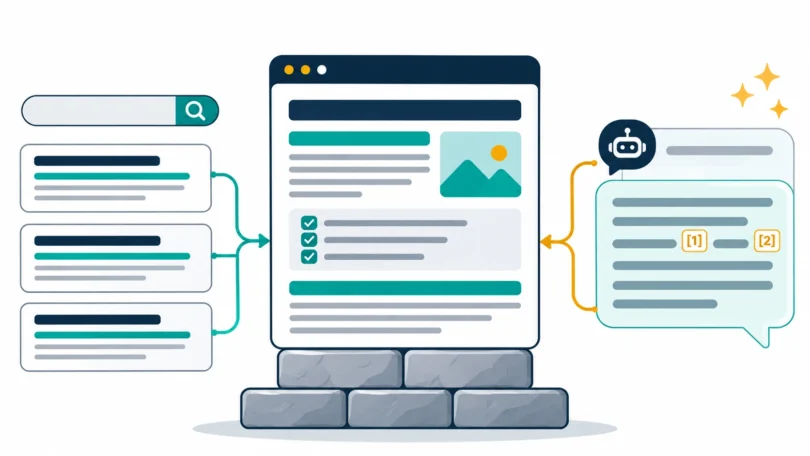
Good SEO is good GEO. Generative engines like ChatGPT, Gemini, Perplexity, and Google AI Overviews favour the same pages search engines already trust: content that answers the question quickly, is clearly structured, loads fast, is technically clean, carries real authority, matches intent, and stays current. You don’t need a brand-new playbook for AI search. You need to execute the fundamentals better than your competitors.
Every week, someone in a marketing Slack group asks the same question. “How do we get our brand into ChatGPT answers?” Then come the replies. New acronyms. Secret prompts. Expensive “AI visibility” audits. A promise that everything you knew about search is suddenly obsolete.
It isn’t.
I’ve watched search change many times. Mobile-first indexing, featured snippets, voice search, helpful content updates. Each shift arrived with a wave of panic and a fresh vocabulary. And each time, the sites that came out ahead were the ones that had quietly done the boring work well. Clear pages. Honest expertise. Fast, crawlable sites. Content people actually wanted to read.
Generative Engine Optimization, or GEO, is the latest chapter in that story. It’s a real shift in how people find information. But it is not a reset. AI tools pull from the same places search engines trust: pages that are clear, well structured, credible, and genuinely useful.
As we head into 2027, that matters more than ever. A growing share of questions now get answered inside an AI summary before anyone clicks a blue link. If your content isn’t the kind of source those summaries draw from, you become invisible in the moments that count.
This guide breaks down why the SEO foundation you built for Google is the same one AI engines pick from. We’ll walk through the six fundamentals that still win, what genuinely changes with GEO, the tools that make this easier, a 30-day action plan, and the mistakes worth avoiding. Let’s get into it.
What Is GEO, and How Is It Different from SEO?
Generative Engine Optimization (GEO) is the practice of making your content easy for AI-powered answer engines to find, understand, trust, and cite. Those engines include ChatGPT search, Google Gemini, Perplexity, Microsoft Copilot, and Google’s AI Overviews and AI Mode.
Search Engine Optimization (SEO) is the practice of helping your pages rank in traditional search results so people click through to your site.
On the surface, the goals look different. SEO chases rankings and clicks. GEO chases mentions and citations inside an AI-generated answer. But look one layer deeper and the two goals converge. Both systems are trying to solve the same problem: give a person the most reliable, relevant answer to their question as fast as possible.
Here is how they compare side by side.
| Factor | Traditional SEO | GEO (AI search) |
|---|---|---|
| Where you appear | Ranked list of links | Inside a written answer, often with source citations |
| What success looks like | Rankings, clicks, organic traffic | Mentions, citations, referral clicks, brand recall |
| How content is evaluated | Relevance, quality, links, technical health | Relevance, quality, clarity, credibility, extractability |
| How users search | Short keyword queries | Longer, conversational questions and follow-ups |
| Unit of value | The whole page | Often a passage, list, or definition within the page |
| Core foundation | Crawlable, useful, authoritative content | The same |
That last row is the whole point of this article. The foundation is identical.
There’s a practical reason for that. Many AI search experiences use a process called retrieval-augmented generation. Put simply, the model searches an index, retrieves relevant pages, and then writes an answer grounded in what it found. Google’s AI Overviews draw on Google’s own index. Other assistants lean on their own crawlers and partner search indexes. Either way, a page that can’t be crawled, understood, or trusted rarely makes it into the retrieved set.
So when someone says GEO is replacing SEO, they’ve got the relationship backwards. GEO sits on top of SEO. It’s SEO’s next chapter, not a different book.
Why AI Engines Pull from the Same Sources Search Engines Trust
AI answer engines have a reputation problem to manage. When an assistant confidently states something wrong, users notice, screenshots spread, and trust erodes. So the companies building these tools have every incentive to ground answers in sources that are already proven to be reliable.
Where do they find those sources? Largely in the same places search engines have spent two decades learning to evaluate.
Think about what an AI system needs before it can use your page in an answer:
- It has to discover the page. That means crawlers can reach it, it isn’t blocked, and it’s linked from somewhere.
- It has to understand the page. Clean HTML, logical headings, and clear language make the meaning obvious.
- It has to trust the page. Signals like reputable links, brand mentions, author expertise, and consistency across the web make a source feel safe to cite.
- It has to extract something useful. A crisp definition, a step-by-step list, or a direct answer is far easier to lift into a summary than a rambling paragraph.
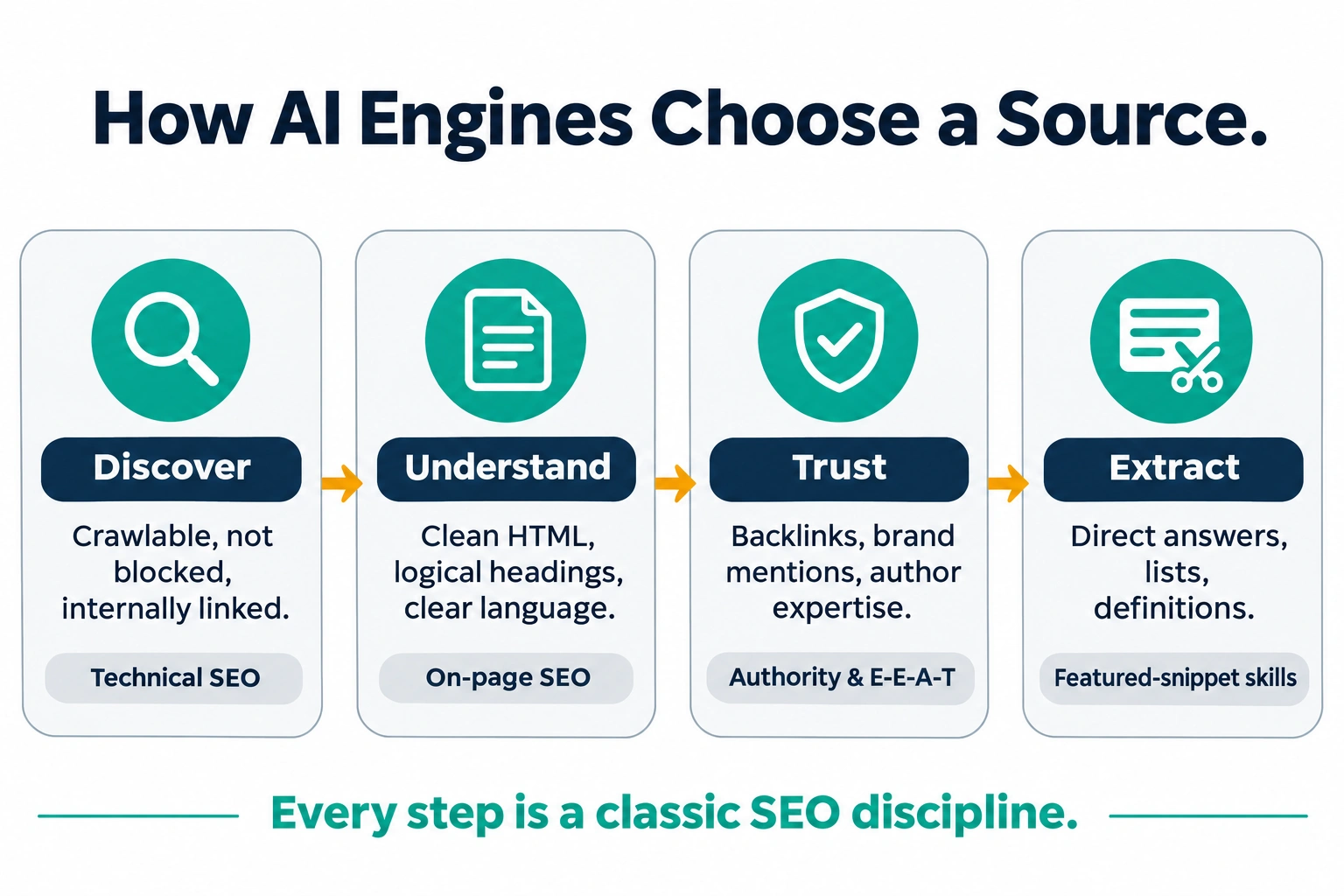
Every one of those requirements is a classic SEO discipline. Discovery is technical SEO. Understanding is on-page SEO and content structure. Trust is authority and E-E-A-T, Google’s shorthand for experience, expertise, authoritativeness, and trustworthiness. Extraction is the same skill that has won featured snippets for years.
There’s a simple way to sanity-check this. Pick a question in your niche and ask it in Google, then in ChatGPT or Perplexity. Look at the sources cited. More often than not, you’ll see familiar names: the sites that already rank well, are referenced often, and explain things clearly. AI didn’t invent a new class of winners. It mostly rewarded the existing ones.
That’s encouraging news if you’ve been investing in SEO. Your work hasn’t been wasted. And if you haven’t, it’s a clear signal about where to start. Not with gimmicks, but with fundamentals.
1. Answer the Question Fast: Lead with the Answer, Then Explain
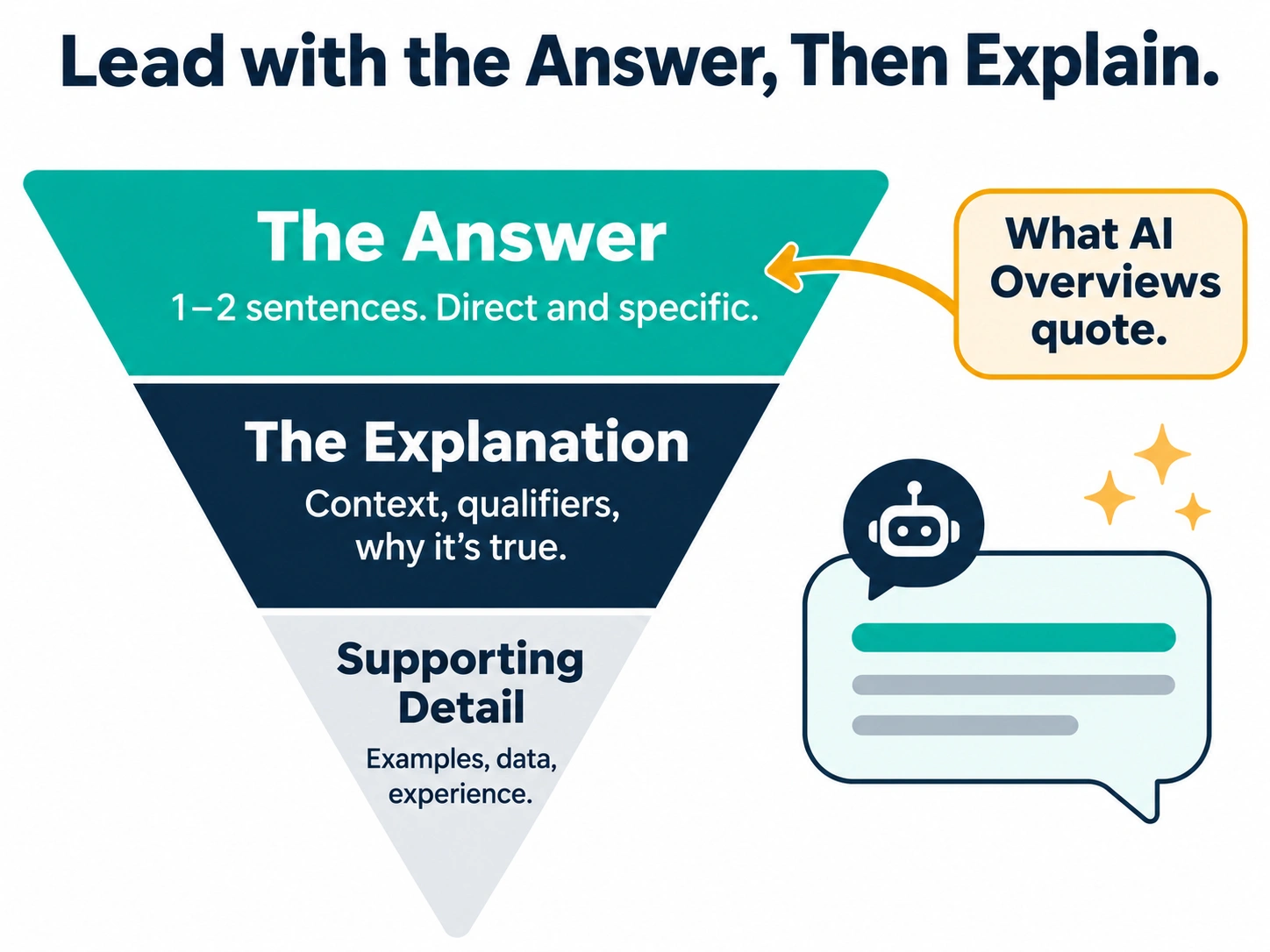
The single most useful habit for both SEO and GEO is putting the answer first. State it plainly in the opening sentence or two, then use the rest of the section to explain, qualify, and add depth.
Journalists call this the inverted pyramid. Most important information at the top, supporting detail below. It works because readers are impatient, and so are machines. An AI model scanning dozens of pages for the best passage to summarise will favour the one that answers cleanly over the one that warms up for three paragraphs first.
Compare these two openings for the question “How long does it take for SEO to work?”
Weak opening: “SEO is a fascinating and ever-evolving field. Many business owners wonder about timelines, and the truth is that there are many factors involved. Before we answer, let’s look at the history of search engines…”
Strong opening: “Most websites start seeing meaningful SEO results in four to twelve months. New sites in competitive niches usually sit at the longer end, while established sites fixing technical issues can see gains within weeks.”
The second version can be quoted almost word for word in an AI Overview. The first can’t be used at all.
How to apply answer-first writing
- Write a summary box at the top of long posts. Two to four sentences that answer the core question directly. You’ll see one at the top of this article.
- Open every H2 with its point. Treat each section as if a reader might land on it alone, because an AI engine might extract it alone.
- Use question-style subheadings where natural. “What is schema markup?” followed immediately by a one-sentence definition is a near-perfect extractable unit.
- Give concrete numbers and specifics. “Four to twelve months” beats “it varies.” Specific claims are more useful and more citable.
- Cut throat-clearing. Phrases like “In today’s digital landscape” add nothing for humans and actively get in the way for machines.
One caution. Answer-first doesn’t mean answer-only. If your page gives away the headline and offers nothing else, readers have no reason to stay and AI systems have no reason to see you as an authority. Lead with the answer, then earn the visit with context, examples, nuance, and experience that a summary can’t fully capture.
2. Structure Your Content for People and Machines
Well-structured content is easier for humans to scan and easier for machines to parse. Clear headings, short paragraphs, lists, tables, and FAQs turn a wall of text into a set of clearly labelled answers.
Here’s why structure matters so much for GEO in particular. AI systems often don’t use your page as a whole. They break it into chunks, evaluate which chunk best answers the question, and pull from that. If your best insight is buried in the middle of a 300-word paragraph about three different things, it’s hard to isolate. If it sits under a descriptive heading in a tight, focused paragraph, it practically volunteers itself.

The building blocks of well-structured content
- One H1, then a logical hierarchy of H2s and H3s. Headings should read like a table of contents. Someone skimming only the headings should understand the article’s argument.
- Descriptive headings, not clever ones. “How to Fix Slow Page Speed” tells both readers and machines exactly what follows. “Need for Speed” doesn’t.
- Short paragraphs. Two to four sentences, one idea each. On mobile, long paragraphs look like homework.
- Bulleted and numbered lists. Use bullets for parallel items and numbered lists for sequences and steps. Both are among the easiest formats for AI to extract.
- Tables for comparisons. When you’re comparing options across features, prices, or attributes, a table is clearer than prose and is highly reusable in AI answers.
- FAQ sections. Real questions your audience asks, each followed by a direct answer. These map neatly onto the conversational way people query AI tools.
- Definitions up front. When introducing a term, define it in one clear sentence. “X is…” statements are gold for answer engines.
Think in self-contained sections
A useful mental model: write every section so it would still make sense if someone read only that section. Avoid relying on “as mentioned above” or vague pronouns that point back three paragraphs. Restate the subject when you need to. This feels slightly repetitive to write, but it makes each passage independently useful, which is exactly what retrieval systems reward.
Don’t structure for the sake of it
Structure is there to serve clarity, not to tick a box. Turning every sentence into a bullet makes content choppy and shallow. A good article mixes formats: prose for explanation and nuance, lists for steps and options, tables for comparisons. Use the shape that fits the information. When you do that consistently, your content becomes pleasant to read and effortless to cite.
3. Fix Your Technical Basics: Crawlable, Fast, Clean, and Marked Up
No amount of brilliant writing helps if machines can’t reach or read your page. Technical SEO is the plumbing of visibility, and AI search depends on the same plumbing.
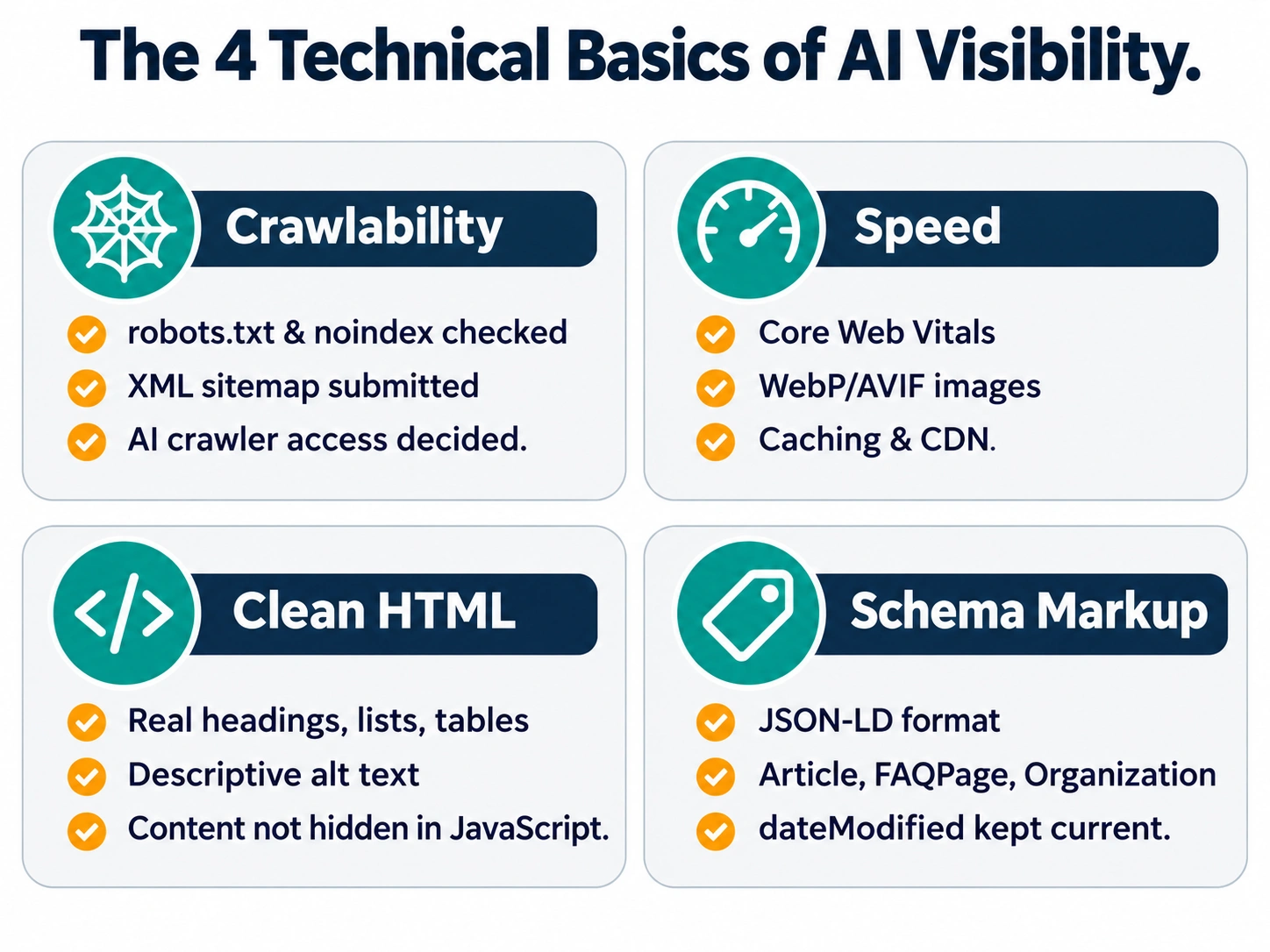
The four technical basics that matter most are crawlability, speed, clean HTML, and schema markup.
Crawlability
If a crawler can’t access a page, that page doesn’t exist as far as search and AI are concerned. Check the essentials:
- Your robots.txt isn’t accidentally blocking important sections.
- Important pages aren’t tagged noindex by mistake.
- Every key page is linked internally, so it isn’t an orphan.
- Your XML sitemap is current and submitted in Google Search Console and Bing Webmaster Tools.
AI adds one new consideration here. Several AI companies run their own crawlers, such as OpenAI’s GPTBot and OAI-SearchBot, PerplexityBot, and Google’s Google-Extended control token. Decide deliberately which of these you allow in robots.txt. Blocking them all may protect your content from model training, but it can also keep you out of AI search results. There’s no single right answer. The mistake is not making a choice at all.
Speed and Core Web Vitals
Slow pages frustrate users and waste crawl resources. Aim for fast loading, stable layouts, and quick interactivity, which Google measures through Core Web Vitals. Compress images, serve modern formats like WebP or AVIF, lazy-load below-the-fold media, reduce heavy scripts, and use caching and a CDN.
Clean, semantic HTML
This is where fundamentals really shine. Use proper heading tags rather than bold text styled to look like headings. Use real lists, real tables, and descriptive alt text on images. Keep your main content in the HTML rather than hiding it behind heavy JavaScript that some crawlers struggle to render. Many AI crawlers are less capable than Googlebot at executing JavaScript, so content that only appears after scripts run may simply be invisible to them.
Schema markup
Structured data in JSON-LD format tells machines explicitly what your content is. Common, useful types include Article, FAQPage, HowTo, Product, Organization, Person, Review, and BreadcrumbList. Schema doesn’t guarantee a citation, but it removes ambiguity. It tells systems who wrote the page, what organisation stands behind it, when it was updated, and what kind of content it contains.
A quick technical audit with a crawler or site-audit tool will surface most of these issues in an afternoon. Fixing them is one of the highest-return tasks in all of search, old or new.
4. Build Real Authority: Backlinks, Mentions, and Consistent Expertise
Authority is the reason one source gets trusted over another that says roughly the same thing. In traditional SEO, it shows up largely through backlinks. In GEO, it shows up through backlinks plus something broader: how often, and how consistently, your brand is associated with a topic across the web.
Language models learn associations. If your brand keeps appearing alongside a subject in reputable places, such as industry publications, expert roundups, podcasts, conference talks, review sites, and community discussions, that connection gets reinforced. When the model later answers a question on that subject, your name is more likely to surface, and your pages are more likely to be retrieved and cited.

Quality backlinks still matter
A link from a respected site remains one of the strongest trust signals in search. Focus on earning links rather than buying them:
- Publish original data. Surveys, benchmarks, and proprietary research attract links because others need a source to cite.
- Create genuinely useful resources. Calculators, templates, glossaries, and definitive guides keep earning links for years.
- Do digital PR. Offer expert commentary to journalists and contribute insight to industry stories.
- Fix broken and unlinked mentions. When someone mentions your brand without a link, a polite request often converts it.
Unlinked mentions matter more than they used to
For AI visibility, even mentions without links carry weight. A respected newsletter discussing your product, a thoughtful thread on a professional forum, or a podcast host recommending your guide all help shape how AI systems understand your brand. Be present where your audience already talks.
Consistent expertise builds topical authority
One great article doesn’t make you an authority. A deep, connected body of work does. Cover your core topics thoroughly, link related articles together, and stay in your lane rather than chasing every trending keyword. A site that has published fifty careful pieces on one subject looks far more credible than a site with one piece each on fifty subjects.
Show the humans behind the content
Trust is personal. Add real author bylines with credentials and relevant experience. Build out author bio pages, an honest About page, clear contact details, and editorial standards. Share first-hand experience: what you tested, what you saw, what went wrong. This is exactly the kind of signal that separates trustworthy content from the flood of generic, mass-produced pages, and it’s something AI systems are increasingly built to look for.
5. Match Search Intent: Write for What People Actually Want
Search intent is the reason behind a query, the job the person is trying to get done. Matching it means giving people the type of content they want, not just a page that contains the right keywords.
This has always mattered for SEO. It matters even more for GEO, because people talk to AI tools differently. Instead of typing “best CRM small business,” they ask, “What’s the best CRM for a five-person sales team that already uses Gmail and doesn’t want to spend more than $50 a month?” The query is longer, more specific, and full of context. AI engines try to match that full intent, so content that only targets the head keyword often misses.
The four classic intent types
| Intent | What the person wants | Content that fits |
|---|---|---|
| Informational | To learn or understand something | Guides, explainers, definitions, how-tos |
| Navigational | To reach a specific brand or page | Clear brand pages, login and product pages |
| Commercial | To compare and evaluate options | Comparisons, reviews, “best of” lists, alternatives |
| Transactional | To buy, sign up, or download | Product pages, pricing pages, landing pages |
How to match intent in the AI era
- Study what already ranks and gets cited. Search your target question in Google and in an AI tool. Note the format of the winning answers. Are they lists, step-by-step guides, comparison tables, or short definitions?
- Cover the follow-up questions. AI conversations rarely stop at one question. If someone asks what schema markup is, their next question is probably how to add it. Answer the natural follow-ups on the same page or link to them clearly.
- Address specific scenarios. Content that speaks to particular use cases, such as budget, team size, industry, or skill level, matches the detailed, conversational queries people now type.
- Use the language your audience uses. Mine customer emails, sales calls, community forums, and “People also ask” boxes for real phrasing.
- Don’t force one page to serve every intent. A pricing page shouldn’t try to be a beginner’s guide. Build separate, focused pages and connect them with internal links.
Keywords are still useful. They tell you what topics people care about and how much demand exists. But treat them as signposts toward a human need, not as phrases to repeat. Write for the person, and the keywords tend to take care of themselves.
6. Keep Content Fresh: Outdated Pages Get Ignored
Stale content loses trust with readers, search engines, and AI systems alike. If your “complete guide” still references tools that no longer exist or statistics from five years ago, both humans and machines have good reason to prefer a newer source.
AI answer engines are especially sensitive to freshness for questions where the answer changes: pricing, tool comparisons, regulations, platform features, and anything with “best” or a year in the query. When a user asks about the best options for 2027, a page last meaningfully updated in 2023 is unlikely to be the source an assistant leans on.
What a real content refresh looks like
Updating the date at the top of an article isn’t a refresh. A genuine update improves the page:
- Replace outdated facts and figures with current, verifiable ones.
- Remove or update dead examples, discontinued products, and broken links.
- Add new sections covering developments since the original publish date.
- Tighten and clarify sections that underperform or confuse readers.
- Refresh screenshots and visuals so they match current interfaces.
- Update the visible “last updated” date and the dateModified field in your Article schema, so the change is clear to people and machines.
Build a refresh routine
Freshness works best as a habit, not an emergency. A simple system:
- Audit quarterly. Use Google Search Console to find pages with declining impressions or clicks.
- Prioritise by value. Start with pages that drive traffic, leads, or revenue, and pages targeting time-sensitive topics.
- Set review cycles by topic type. Fast-moving topics like AI tools or pricing might need a review every three months. Evergreen explainers might need one every twelve.
- Consolidate weak content. If you have several thin articles on overlapping topics, merge them into one strong, up-to-date page and redirect the old URLs.
There’s an underrated bonus here too. Refreshing existing content is often faster and more effective than writing something new, because the page already has history, links, and some authority. You’re improving an asset rather than starting from zero. As AI engines keep raising the bar on recency, a disciplined refresh routine is one of the most reliable advantages a small team can build.
What Genuinely Changes with GEO
The foundation stays the same, but a few things really do shift in AI search. Being honest about them helps you adapt without overreacting.
Clicks are no longer the only measure of success. When an AI answer cites your brand, the user may get what they need without visiting your site. That can feel like a loss. But being named as the trusted source still builds awareness and recall, and the visitors who do click through tend to arrive better informed and more ready to act. Track brand mentions, citations, and referral traffic from AI platforms alongside your usual rankings.
Passages compete, not just pages. In traditional search, the whole page ranks. In AI search, a single well-written paragraph or table can be what earns the citation. That raises the value of every section being clear and self-contained.
Brand presence beyond your website counts more. Reviews, forum discussions, social posts, video transcripts, and third-party articles all feed into how AI systems perceive you. Your website is the hub, but the web around it shapes the story.
Queries are longer and more conversational. People ask full questions and follow up. Content that anticipates the next question has an edge.
Originality is a stronger differentiator. If your article just rephrases what ten others already say, an AI can summarise all eleven without needing you. Original data, first-hand testing, expert opinion, and real case studies give an engine a reason to cite you specifically.
You’ll also hear about newer ideas, such as an llms.txt file that points AI systems to your key content. These may become useful, but none of them replaces the fundamentals, and support across AI platforms is still inconsistent. Treat them as optional extras to experiment with, not as the strategy itself.
Notice that every genuine change above still rewards the same core behaviour: clear, credible, useful content on a technically sound site. GEO refines how you measure and package the work. It doesn’t change what the work is.
The Tools and Free Resources That Make This Easier
You don’t need a huge budget to get the fundamentals right, but the right tools save enormous amounts of time. A big thank you to the tools and teams that make learning and doing this work easier.
Semrush: keyword research, competitor insights, and site audits
Semrush is a strong all-round platform for understanding what your audience searches for and where you stand. Use it to find keyword opportunities and the questions people ask, see which pages drive your competitors’ traffic, and run site audits that flag crawl errors, broken links, slow pages, and missing metadata. It also offers features for tracking brand visibility in AI search, which is useful as GEO measurement matures.
Ahrefs: backlink analysis and content gap research
Ahrefs is widely respected for its backlink data. Use it to see who links to you and your competitors, discover link-building opportunities, and spot lost links worth recovering. Its content gap analysis shows topics and keywords your competitors cover that you don’t, a fast way to find the holes in your topical authority. Ahrefs has also been adding tools for monitoring brand mentions in AI answers.
W3Schools: free tutorials on HTML, CSS, and web basics
W3Schools is one of the best free places to learn the web fundamentals that clean, crawlable pages depend on. If you want to understand semantic HTML, heading structure, how to write proper lists and tables, or the basics of JSON for structured data, its tutorials are clear and beginner-friendly. Knowing these basics yourself means you can spot technical issues instead of relying entirely on someone else.
A few more worth knowing
- Google Search Console: free, essential data on how Google crawls, indexes, and shows your pages.
- Bing Webmaster Tools: free, and worth setting up since Bing’s index supports several AI experiences.
- PageSpeed Insights: free Core Web Vitals and performance diagnostics.
- Google’s Rich Results Test and the Schema.org validator: to check your structured data.
Tools don’t do the work for you. They show you where to look. Great tools, free learning, and solid fundamentals beat chasing every new acronym.
A 30-Day Plan to Make Your Site AI-Search Ready
If you want a practical starting point, this four-week plan covers the fundamentals in a sensible order. It’s designed for a small team or a solo marketer.
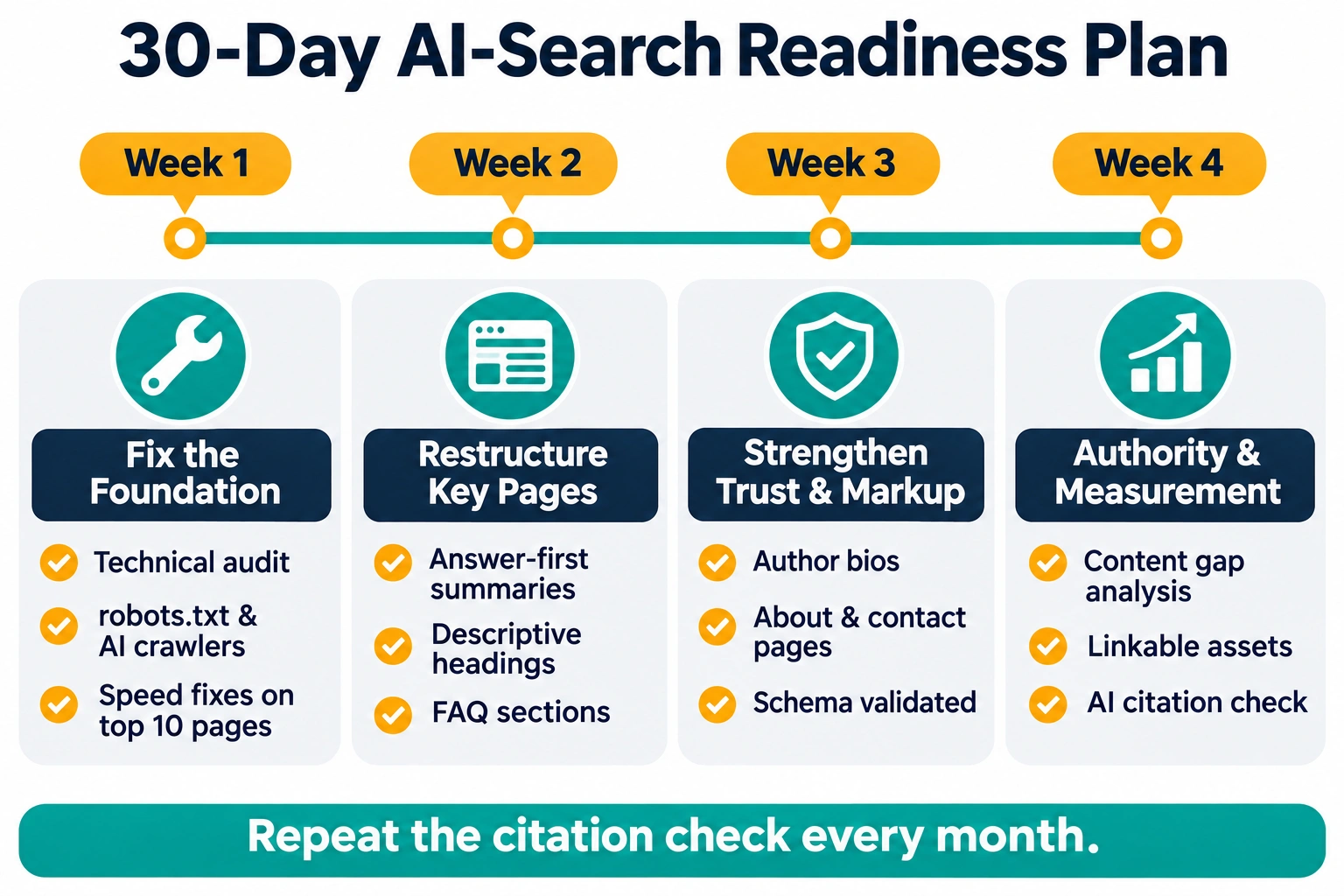
Days 1–7: Fix the foundation
- Run a full technical site audit and list critical errors.
- Check robots.txt, noindex tags, and your XML sitemap.
- Decide which AI crawlers you will allow, and update robots.txt accordingly.
- Test your top 10 pages in PageSpeed Insights and fix the biggest performance issues.
- Confirm Google Search Console and Bing Webmaster Tools are set up and verified.
Week 2: Restructure your most important pages
- Identify your 10 highest-value pages by traffic, leads, or revenue.
- Add a short, direct answer or summary at the top of each.
- Rewrite headings so they’re descriptive and form a logical outline.
- Break long paragraphs into focused ones, and add lists or tables where they help.
- Add an FAQ section built from real customer questions.
Days 15–21: Strengthen trust and markup
- Add or improve author bylines and author bio pages.
- Update your About and contact pages.
- Implement Article, Organization, and FAQPage schema where relevant, then validate it.
- Add first-hand experience, original examples, or data to your key pages.
Final week: Build authority and set up measurement
- Run a content gap analysis against two or three competitors.
- Plan three linkable assets, such as original research, a template, or a definitive guide.
- Reach out about unlinked brand mentions.
- Ask your core questions in ChatGPT, Gemini, Perplexity, and Google, and record which sources get cited.
- Set a recurring calendar reminder for quarterly content refreshes.
Repeat the citation check every month. Over time, you’ll see which pages AI engines favour and which topics need more depth. That feedback loop is where SEO and GEO become one ongoing process rather than two separate projects.
Common GEO Mistakes to Avoid
Most GEO mistakes come from treating AI search as a trick to game rather than an audience to serve. Here are the ones I see most often.
Chasing hacks instead of fundamentals. Hidden prompts, invisible text aimed at AI crawlers, and keyword-stuffed “AI-optimised” pages are the new versions of old black-hat tactics. They may work briefly, if at all, and they put your credibility at risk when platforms catch up.
Mass-producing thin AI content. Publishing hundreds of generic, lightly edited AI articles is tempting. But if your content adds nothing an AI couldn’t generate itself, there’s no reason for that AI to cite you. Use AI to speed up research and drafting, then add real expertise, editing, and originality.
Abandoning SEO for GEO. Traditional search still drives a large share of discovery, and the work overlaps almost entirely. Treating them as competing priorities splits your effort for no gain.
Blocking AI crawlers without thinking it through. If you block every AI bot by default, you may also block your chance to appear in AI answers. Make an informed choice based on your business model.
Hiding key content behind JavaScript or logins. If your best material only appears after scripts run or behind a gate, many crawlers won’t see it.
Ignoring your off-site reputation. Outdated directory listings, unanswered negative reviews, and inconsistent brand information across the web all feed into how AI describes you.
Measuring only rankings. In an AI-first world, a page can lose clicks while gaining influence. Watch citations, brand mentions, and AI referral traffic, not just positions.
Frequently Asked Questions About SEO and GEO
Is GEO replacing SEO?
No. GEO builds on SEO rather than replacing it. AI answer engines rely on the same signals search engines use, including crawlability, clear structure, authority, and relevance. Strong SEO is the foundation that makes GEO possible.
What is the difference between SEO and GEO?
SEO focuses on ranking pages in traditional search results to earn clicks. GEO focuses on getting your content cited or mentioned inside AI-generated answers from tools like ChatGPT, Gemini, Perplexity, and Google AI Overviews. The methods overlap heavily.
How do I get my website cited in ChatGPT and Perplexity?
Make sure AI crawlers can access your site, answer questions directly near the top of your pages, structure content with clear headings and lists, build authority through backlinks and mentions, and keep your content current. Original data and first-hand expertise make citations more likely.
How do I appear in Google AI Overviews?
AI Overviews draw on pages in Google’s index, so standard SEO best practice applies. Focus on helpful, accurate content that answers specific questions clearly, demonstrates expertise, and is technically sound. Pages that already rank well for a query have a strong chance of being included.
Does schema markup help with AI search?
Schema markup helps machines understand what your content is, who created it, and when it was updated. It doesn’t guarantee a citation, but it reduces ambiguity and supports rich results in traditional search, which makes it a worthwhile investment.
Should I block AI crawlers from my website?
It depends on your goals. Blocking AI crawlers can limit use of your content for training, but it can also prevent you from appearing in AI search answers. Many businesses allow search-focused AI crawlers while reviewing training crawlers case by case.
How do I measure GEO success?
Track how often your brand and pages are cited in AI answers for your key questions, monitor referral traffic from AI platforms in your analytics, and watch branded search volume. Several SEO platforms now offer AI visibility tracking to help.
How often should I update my content for AI search?
Review fast-changing topics like tools, pricing, and regulations every three months, and evergreen content at least once a year. Make real improvements, not just date changes, and update the modified date in your schema.
Final Thoughts: GEO Is SEO’s Next Chapter
The rise of AI search is real, and it’s changing how people discover information. But the sites winning in ChatGPT, Gemini, Perplexity, and AI Overviews aren’t using secret formulas. They’re doing the fundamentals well.
They answer questions fast. Their content is structured so it’s easy to read and easy to extract. Technically, their house is in order. Authority comes from quality links, genuine mentions, and consistent expertise.