
May 9th, 2018 | Updated on October 14th, 2026
The best classic movies to watch aren’t homework. They’re thrillers that still make you jump, comedies funnier than most of what came out last year, and love stories people have been quoting for 80 years.
This guide rounds up 100 of them. They’re grouped by genre, so you can skip straight to whatever you’re in the mood for, and every entry gives you the year, the director and a spoiler-free reason to press play. New to older films? Start with the ten quick picks just below.
At a glance
- What’s here: 100 films released between 1920 and 2002. All but two came out before 1976.
- How it’s organized: 11 sections covering Hollywood dramas, comedies, musicals, film noir, thrillers, horror and sci-fi, war epics, westerns, silent films, world cinema and the 1970s.
- Best first watch: Casablanca.
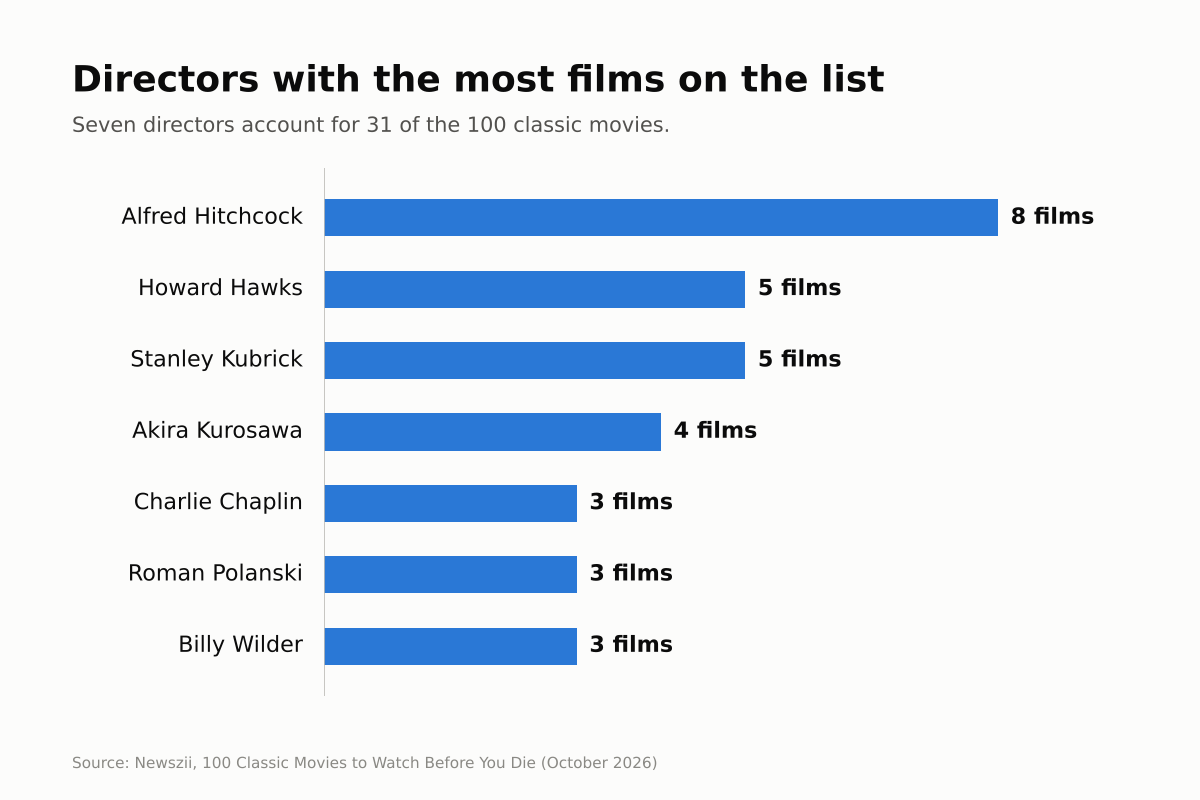
- Most featured director: Alfred Hitchcock, with eight films.
- Oldest film: The Cabinet of Dr. Caligari (1920).
- Last updated: October 2026. First published in May 2018.
In this guide
- Quick Picks: 10 Classic Movies to Watch First
- What Makes a Movie a Classic?
- How to Pick Your Next Classic Movie
- Golden-Age Hollywood Dramas
- Classic Comedies and Romance
- Musicals, Family Films and Animation
- Film Noir, Crime and Courtroom Dramas
- Hitchcock and Classic Thrillers
- Classic Horror and Science Fiction
- War Films and Historical Epics
- Westerns and Adventure Films
- Silent-Era Landmarks
- World Cinema Essentials
- The 1970s and Beyond
- Where to Watch Classic Movies Today
- Tips for First-Time Classic Movie Viewers
- Classic Movies FAQ
Quick Picks: 10 Classic Movies to Watch First
If you’ve never really watched old movies, begin here. These ten are easy to get into, and between them they cover most of what classic cinema does well.
| Movie | Year | Why start here |
|---|---|---|
| Casablanca | 1942 | Romance, wisecracks and one of the best endings in movies |
| Singin’ in the Rain | 1952 | A musical that’s hard to watch in a bad mood |
| 12 Angry Men | 1957 | One room, twelve jurors and 96 minutes of rising tension |
| Some Like It Hot | 1959 | Still laugh-out-loud funny |
| Rear Window | 1954 | Suspense that tightens with every scene |
| Psycho | 1960 | A thriller that can still shock you |
| The Wizard of Oz | 1939 | Works for every age in the room |
| Seven Samurai | 1954 | An action epic that earns its full evening |
| It’s a Wonderful Life | 1946 | A holiday movie with real emotional weight |
| Citizen Kane | 1941 | The one critics most often call the greatest ever made |
What Makes a Movie a Classic?
A classic movie is one that people keep watching, quoting and stealing from long after it left theaters. Age alone doesn’t earn the label. Plenty of old movies are simply old. A classic still works on someone who wasn’t born when it came out.
There’s no official cutoff. In practice, “classic cinema” usually means films made between the silent era and the mid-1970s, and 98 of the 100 picks here fall inside that window. It takes in the silent years, Hollywood’s Golden Age (roughly the late 1920s to the early 1960s) and the bolder American filmmaking that followed. The two exceptions are Ran (1985) and The Lord of the Rings: The Two Towers (2002), included as modern classics.
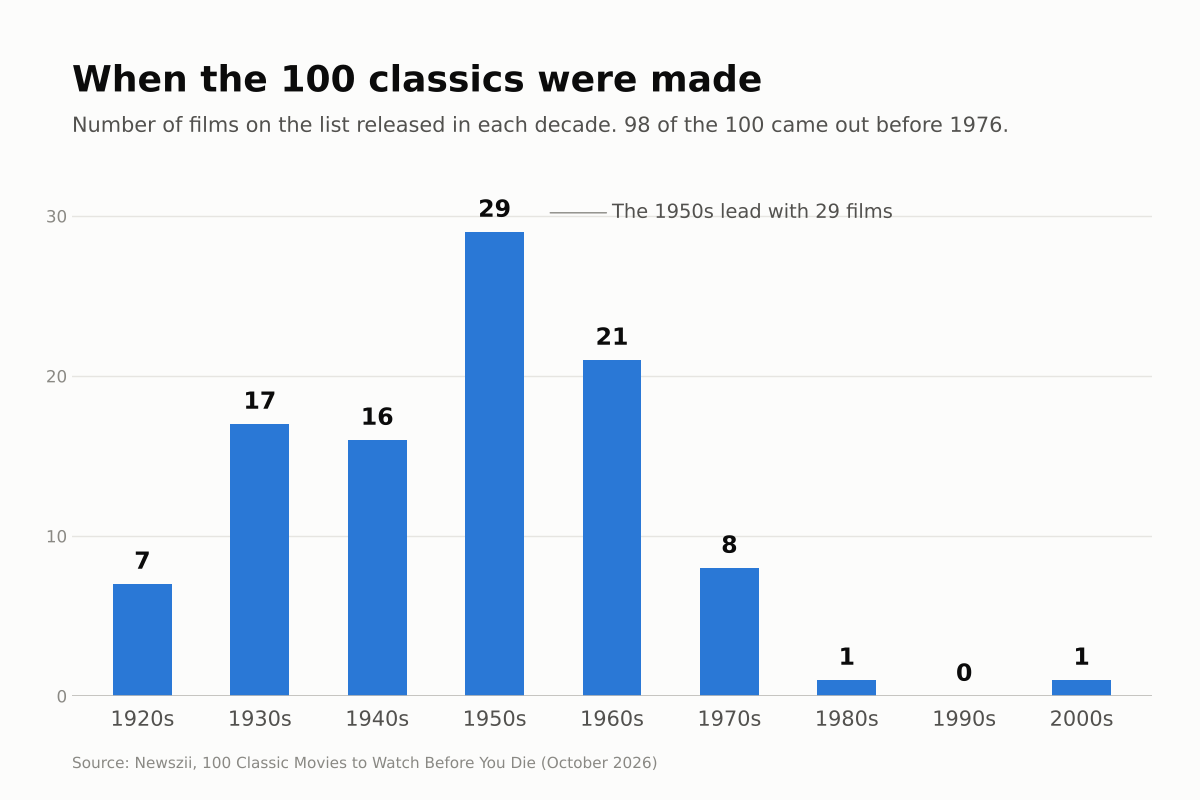
A few things to know about this list:
- The numbers are a counter, not a ranking. Film 87 isn’t worse than film 3.
- Years are original release dates.
- Every description is spoiler-free.
- Most of the films are American or British. The rest come from Japan, France, Germany, Italy and the Soviet Union.
How to Pick Your Next Classic Movie
The fastest way into old movies is through a genre you already love. Find your mood in the left column and go from there.
| If you want | Start with | Then try |
|---|---|---|
| To laugh | Some Like It Hot | Duck Soup, Bringing Up Baby |
| Edge-of-your-seat suspense | Rear Window | North by Northwest, The Third Man |
| A proper scare | Psycho | Night of the Living Dead, Rosemary’s Baby |
| Romance | Casablanca | Roman Holiday, The Apartment |
| A family movie night | The Wizard of Oz | Mary Poppins, Singin’ in the Rain |
| A big, sweeping epic | Lawrence of Arabia | Seven Samurai, Spartacus |
| Something under 90 minutes | Duck Soup | Rashomon, The 39 Steps, Frankenstein |
| Your first silent film | City Lights | The Gold Rush, Metropolis |
| Your first subtitled film | Seven Samurai | The 400 Blows, Rashomon |
| A courtroom drama | 12 Angry Men | Anatomy of a Murder, Paths of Glory |
| Science fiction | The Day the Earth Stood Still | Forbidden Planet, 2001: A Space Odyssey |
Golden-Age Hollywood Dramas
Start here if you’re not sure where to start. These are the films people usually mean when they say “they don’t make them like that anymore.”
1. Citizen Kane (1941)
Directed by Orson Welles. A newspaper tycoon dies with a single word on his lips, and a reporter sets out to learn what it meant. Welles was 25 when he made it. The jigsaw structure and deep-focus photography still look modern, which is a big part of why critics keep putting it near the top of their all-time lists.
2. Casablanca (1942)
Directed by Michael Curtiz. Humphrey Bogart runs a nightclub in wartime Morocco and wants no part of anyone’s cause. Then Ingrid Bergman walks in with her husband. You get romance, wisecracks and a genuinely hard choice in well under two hours. If you only watch one film on this list, make it this one.
3. The Grapes of Wrath (1940)
Directed by John Ford. The Joads lose their Oklahoma farm in the Dust Bowl and drive west looking for work that barely exists. Henry Fonda leads this adaptation of John Steinbeck’s novel, and its anger at how poor families get treated hasn’t dated at all.
4. It’s a Wonderful Life (1946)
Directed by Frank Capra. George Bailey (James Stewart) has spent his whole life putting his small town first. One terrible Christmas Eve, he gets to see what the place would look like if he’d never been born. It’s a holiday tradition, and a much darker film than its cozy reputation suggests.
5. All About Eve (1950)
Directed by Joseph L. Mankiewicz. Bette Davis plays an aging Broadway star. Anne Baxter plays the devoted young fan who’d quite like her life. The insults are some of the sharpest ever written for the screen, and the film picked up 14 Oscar nominations and Best Picture.
6. A Streetcar Named Desire (1951)
Directed by Elia Kazan. Fragile, proud Blanche DuBois (Vivien Leigh) moves into her sister’s cramped New Orleans apartment and collides with her brother-in-law, Stanley. Marlon Brando’s performance as Stanley changed what screen acting looked like. Almost everyone who came after owes him something.
7. On the Waterfront (1954)
Directed by Elia Kazan. Brando again, this time as a washed-up boxer working the docks, who has to decide whether to testify against the mob-run union that owns him. It won eight Oscars, including Best Picture, and the scene in the back of the cab is as good as its reputation.
8. Rebel Without a Cause (1955)
Directed by Nicholas Ray. James Dean plays the new kid in town, already in trouble and desperate for a parent who’ll just listen. The film opened about a month after Dean died in a car crash, and it has shaped how movies show teenagers ever since.
9. Cool Hand Luke (1967)
Directed by Stuart Rosenberg. Paul Newman is a prisoner on a Southern chain gang who simply won’t do what he’s told. It starts out funny and ends somewhere much sadder. George Kennedy won an Oscar as the inmate who goes from rival to biggest fan.
Classic Comedies and Romance
Old comedies hold up better than almost anyone expects. The American Film Institute’s list of the 100 funniest American movies puts Some Like It Hot at number one, and four more films from this section sit in its top 15. You’ll also find several of them among these 20 essential comedies ranked by Rotten Tomatoes.
10. Duck Soup (1933)
Directed by Leo McCarey. Groucho Marx is put in charge of the bankrupt nation of Freedonia and has it at war within days. The Marx Brothers cram more jokes into 68 minutes than most comedies manage in two hours. Not all of them make sense. That’s the point.
11. It Happened One Night (1934)
Directed by Frank Capra. A runaway heiress (Claudette Colbert) and a newly fired reporter (Clark Gable) get stuck traveling north together, bickering the whole way. Every road-trip romantic comedy since has borrowed from it. It was also the first film to win all five top Oscars.
12. Bringing Up Baby (1938)
Directed by Howard Hawks. Cary Grant is a buttoned-up paleontologist. Katharine Hepburn is the heiress who wrecks his week. Baby is a leopard. It moves at a sprint and makes very little sense, in the best way.
13. The Philadelphia Story (1940)
Directed by George Cukor. A wealthy socialite (Katharine Hepburn) is about to remarry when her ex-husband (Cary Grant) and a tabloid reporter (James Stewart) show up at the house. Three huge stars, one chaotic wedding weekend. Stewart won his only competitive Oscar for it.
14. His Girl Friday (1940)
Directed by Howard Hawks. A newspaper editor (Cary Grant) will try anything to stop his best reporter, who is also his ex-wife, from quitting to get remarried. The actors talk so fast they overlap, so you may want subtitles on.
15. To Be or Not to Be (1942)
Directed by Ernst Lubitsch. A company of Polish actors uses its stagecraft to fool the Nazis occupying Warsaw. Making a comedy about that while the war was still on was a real gamble. It was also Carole Lombard’s last film.
16. Roman Holiday (1953)
Directed by William Wyler. A princess gives her minders the slip and spends one day loose in Rome with an American reporter (Gregory Peck) who knows exactly who she is. Audrey Hepburn won an Oscar in her first major role. The ending is braver than you’d expect.
17. Gentlemen Prefer Blondes (1953)
Directed by Howard Hawks. Marilyn Monroe and Jane Russell play showgirl best friends crossing the Atlantic on an ocean liner. Come for the musical numbers, including the famous one about diamonds. Stay for the friendship, which is the real love story.
18. Some Like It Hot (1959)
Directed by Billy Wilder. Two musicians (Tony Curtis and Jack Lemmon) witness a mob hit and hide out in an all-women band, where they meet the singer, played by Marilyn Monroe. It tops the AFI’s list of the funniest American films, and it has one of the great closing lines.
19. The Apartment (1960)
Directed by Billy Wilder. An office worker (Jack Lemmon) lends his apartment to his bosses for their affairs, hoping for a promotion, then falls for the elevator operator (Shirley MacLaine). It’s billed as a comedy, but there’s real loneliness in it. It won Best Picture.
20. Dr. Strangelove (1964)
Directed by Stanley Kubrick. A rogue general orders a nuclear strike, and the men in the War Room turn out to be exactly the wrong people to stop it. Peter Sellers plays three of the characters. It’s the darkest comedy here, and it somehow gets more believable every year.
Musicals, Family Films and Animation
These are the safest picks for a mixed crowd. Most of them work for kids, and none of them will bore the adults.
21. Snow White and the Seven Dwarfs (1937)
Produced by Walt Disney. Disney’s first animated feature proved a cartoon could hold an audience for more than 80 minutes, at a time when plenty of people in Hollywood doubted it. The Queen’s transformation scene is still properly scary.
22. The Wizard of Oz (1939)
Directed by Victor Fleming. A tornado carries Dorothy (Judy Garland) out of Kansas and into Oz. The moment the film shifts from sepia to Technicolor is still one of the great reveals in movies, and you already know most of the songs.
23. Fantasia (1940)
Produced by Walt Disney. A series of animated pieces set to classical music, the best known starring Mickey Mouse as the Sorcerer’s Apprentice. There’s no dialogue and no single story, so it’s fine to watch in pieces.
24. Miracle on 34th Street (1947)
Directed by George Seaton. A department-store Santa insists he’s the real one and ends up in court to prove he’s sane. Edmund Gwenn won an Oscar for playing him. It’s a regular on lists of the best Christmas movies of all time.
25. The Red Shoes (1948)
Directed by Michael Powell and Emeric Pressburger. A young ballerina has to choose between dancing and the man she loves, and the film doesn’t pretend that’s an easy choice. The long ballet at its center, shot in saturated Technicolor, is the reason people still talk about it.
26. An American in Paris (1951)
Directed by Vincente Minnelli. Gene Kelly plays a former GI trying to make it as a painter in Paris, to the music of George Gershwin. It closes with a long, wordless ballet, and it won Best Picture.
27. Singin’ in the Rain (1952)
Directed by Gene Kelly and Stanley Donen. Hollywood’s panicked switch from silent films to talkies, played as a musical comedy. It’s funny even if you don’t like musicals, and the title number is every bit as good as you’ve heard.
28. One Hundred and One Dalmatians (1961)
Produced by Walt Disney. Two London dogs set off to rescue their stolen puppies from Cruella de Vil, who wants them for a fur coat. The sketchier, more modern drawing style gave Disney animation a new look, and Cruella is one of its best villains.
29. Mary Poppins (1964)
Directed by Robert Stevenson. A magical nanny blows in on the wind and sorts out a London family, mostly by sorting out the father. Julie Andrews won an Oscar in her first film role. The scenes that mix live actors with animation still charm.
30. A Hard Day’s Night (1964)
Directed by Richard Lester. A day and a half with the Beatles at the peak of Beatlemania, fictional but not by much. The quick cutting and loose, playful camerawork became the template for the music video.
31. The Young Girls of Rochefort (1967)
Directed by Jacques Demy. Twin sisters in a French seaside town dream of love and of getting to Paris. Real-life sisters Catherine Deneuve and Françoise Dorléac star, Michel Legrand wrote the music, and the whole town seems to have been painted pastel for the occasion.
Film Noir, Crime and Courtroom Dramas
If you like modern crime shows, you’ll feel at home here. Nobody is entirely innocent, and the endings rarely tie up neatly.
32. Laura (1944)
Directed by Otto Preminger. A detective investigating a murder starts falling for the victim, based on nothing but her portrait and what people say about her. It’s elegant and a little twisted, and it’s over in 88 minutes.
33. The Big Sleep (1946)
Directed by Howard Hawks. Humphrey Bogart is private eye Philip Marlowe, and Lauren Bacall is the client’s daughter who may or may not be on his side. Don’t try too hard to follow the plot. Watch it for the two of them trading lines.
34. The Third Man (1949)
Directed by Carol Reed. An American writer arrives in bombed-out postwar Vienna to find that the friend who invited him has just died, and nobody’s account of the death quite matches. The tilted camera angles and zither score give it a mood no other film has.
35. Sunset Boulevard (1950)
Directed by Billy Wilder. A broke screenwriter hides out in the mansion of a forgotten silent-film star who’s planning her comeback. Gloria Swanson is unforgettable as Norma Desmond. Hollywood has never been harder on itself.
36. 12 Angry Men (1957)
Directed by Sidney Lumet. Eleven jurors are ready to convict and go home. One (Henry Fonda) isn’t so sure. The film barely leaves the jury room, and it’s more gripping than most thrillers with ten times the budget.
37. Sweet Smell of Success (1957)
Directed by Alexander Mackendrick. A hungry press agent (Tony Curtis) does the dirty work for an all-powerful newspaper columnist (Burt Lancaster). The dialogue is pure acid, and nighttime New York has rarely looked this good.
38. Touch of Evil (1958)
Directed by Orson Welles. A car bomb goes off on the US-Mexico border, pitting a Mexican investigator (Charlton Heston) against a corrupt American police captain, played by Welles himself. The opening shot runs more than three minutes without a cut. Film students still take it apart.
39. Anatomy of a Murder (1959)
Directed by Otto Preminger. A small-town lawyer (James Stewart) defends an army officer who admits to the killing. The only question is why he did it. It was startlingly frank for 1959, and Duke Ellington wrote the score.
40. The Manchurian Candidate (1962)
Directed by John Frankenheimer. A decorated Korean War hero comes home, and the men who served with him all start having the same nightmare about him. Frank Sinatra stars in a Cold War thriller that runs on pure paranoia.
Hitchcock and Classic Thrillers
Alfred Hitchcock has eight films on this list, more than any other director. Begin with Rear Window or North by Northwest, then work your way toward the darker ones.
41. The 39 Steps (1935)
Directed by Alfred Hitchcock. An innocent man goes on the run across Scotland, at one point handcuffed to a woman who’s sure he’s a killer. Hitchcock liked the wrong-man chase so much that he kept returning to it for the next two decades.
42. The Lady Vanishes (1938)
Directed by Alfred Hitchcock. An elderly passenger disappears from a moving train, and everyone on board insists she was never there. It’s the lightest and funniest film in this section.
43. Rebecca (1940)
Directed by Alfred Hitchcock. A shy young bride arrives at her husband’s grand estate and finds his dead first wife still running the place, at least in everyone’s minds. It was Hitchcock’s first American film and the only one of his to win Best Picture.
44. Rear Window (1954)
Directed by Alfred Hitchcock. A photographer laid up with a broken leg (James Stewart) kills time watching the neighbors across the courtyard, until he becomes convinced one of them has murdered his wife. Grace Kelly co-stars. If you’ve never seen a Hitchcock film, this is the one to start with.
45. Vertigo (1958)
Directed by Alfred Hitchcock. A former detective with a fear of heights agrees to follow an old friend’s wife and becomes obsessed with her. It’s slow and strange, and it isn’t the one to start with. Critics love it, though: it placed second in Sight and Sound’s 2022 poll of the greatest films ever made.
46. North by Northwest (1959)
Directed by Alfred Hitchcock. An ad man (Cary Grant) is mistaken for a spy and chased across America, from an empty cornfield to the faces of Mount Rushmore. This is Hitchcock just having fun, and it’s basically the blueprint for the modern action thriller.
47. Psycho (1960)
Directed by Alfred Hitchcock. A secretary steals $40,000, drives into a storm and checks in at the Bates Motel. Go in knowing as little as you can. The shrieking string score is as famous as the film itself.
48. Peeping Tom (1960)
Directed by Michael Powell. A shy cameraman films the women he kills. British critics tore it apart on release, and the backlash all but ended Powell’s career at home. It’s now considered a landmark of psychological horror.
49. The Birds (1963)
Directed by Alfred Hitchcock. Birds start attacking a quiet California coastal town, and nobody ever finds out why. Instead of a traditional score, it relies on bird sounds and long silences, which make the quiet stretches worse.
50. Repulsion (1965)
Directed by Roman Polanski. A young woman (Catherine Deneuve) is left alone in a London apartment for a few days and slowly comes apart. Few films put you this completely inside someone else’s fear.
51. Don’t Look Now (1973)
Directed by Nicolas Roeg. A grieving couple (Donald Sutherland and Julie Christie) travel to Venice, where a psychic says their dead daughter is trying to reach them. The fractured editing makes the whole film feel like a warning you can’t quite read.
Classic Horror and Science Fiction
The monsters, robots and zombies in this section wrote the rules later movies still follow. Most of the older ones are short enough to watch two in a night.
52. Frankenstein (1931)
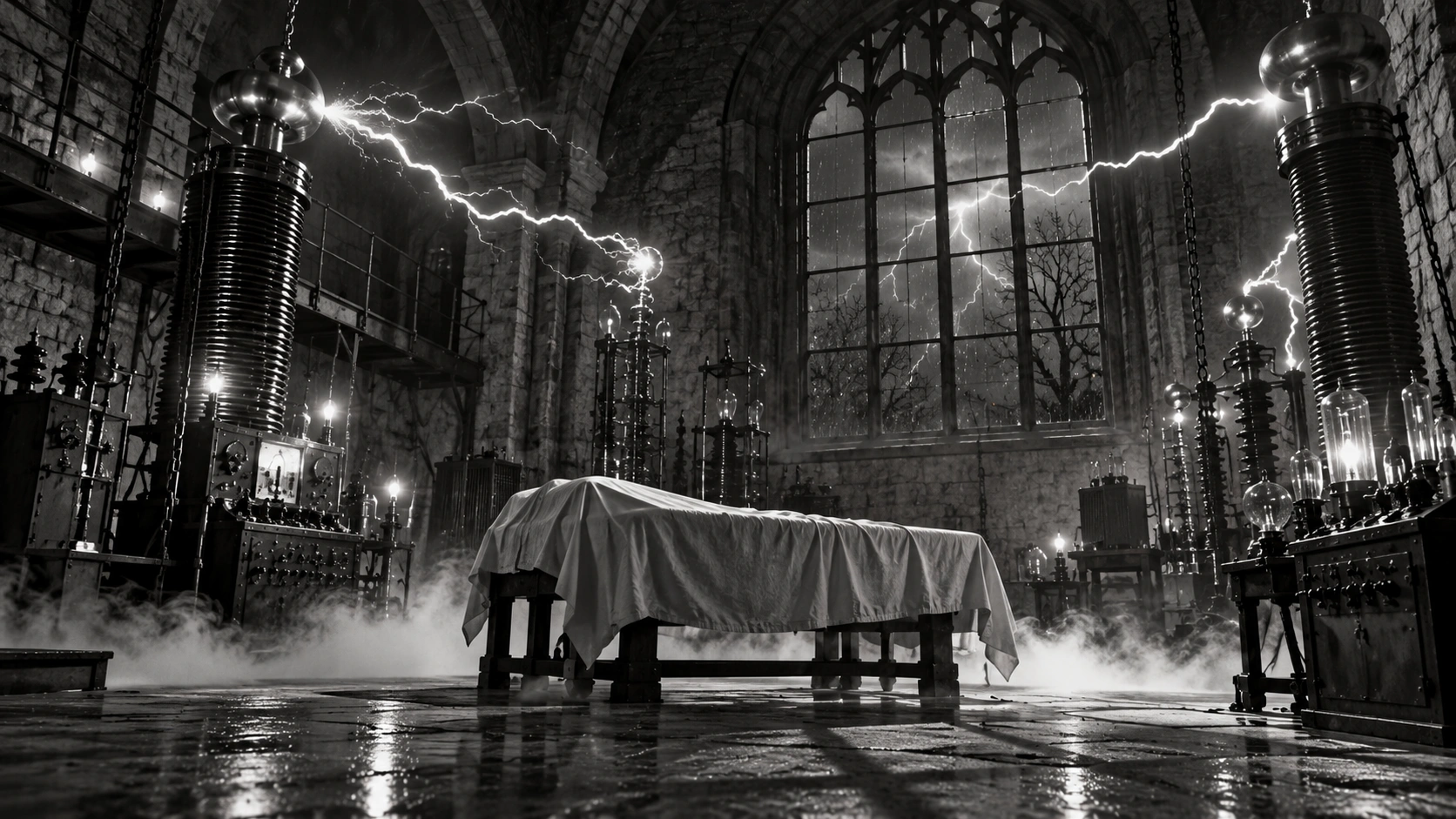
Directed by James Whale. A scientist builds a man out of dead bodies and loses control of him almost immediately. Boris Karloff makes the Monster frightening and strangely gentle at once. The whole thing is done in about 70 minutes.
53. Freaks (1932)
Directed by Tod Browning. A trapeze artist schemes to marry a fellow circus performer for his inheritance, and his friends notice. Browning cast real sideshow performers, which caused outrage at the time. Britain banned the film for decades.
54. King Kong (1933)
Directed by Merian C. Cooper and Ernest B. Schoedsack. A film crew sails to an uncharted island and brings a giant ape back to New York, which goes about as well as you’d guess. The stop-motion effects stunned audiences in 1933. Kong is still the most sympathetic character in the movie.
55. The Bride of Frankenstein (1935)
Directed by James Whale. The Monster survived, and now he wants a companion. This is the rare sequel that beats the original. It’s funnier, weirder and a good deal sadder.
56. The Day the Earth Stood Still (1951)
Directed by Robert Wise. A calm, polite alien lands a flying saucer in Washington, with a giant robot at his side and a warning for the human race. It’s Cold War science fiction with more ideas than explosions.
57. Forbidden Planet (1956)
Directed by Fred M. Wilcox. A rescue mission reaches a distant planet and finds only a scientist, his daughter and their robot, Robby. The plot borrows loosely from Shakespeare’s The Tempest, and the all-electronic score still sounds like nothing else.
58. Invasion of the Body Snatchers (1956)
Directed by Don Siegel. A small-town doctor realizes his neighbors are being swapped, one by one, for copies with no emotions. It runs 80 minutes and wastes none of them.
59. Night of the Living Dead (1968)
Directed by George A. Romero. A handful of strangers barricade themselves in a farmhouse as the dead start walking. Shot in black and white on a tiny budget, it invented the modern zombie movie