Published on October 29th, 2026
As a senior engineer who has spent over two decades on manufacturing floors, I have seen my fair share of product launches. Some go smoothly and achieve massive profitability. Others end in costly disasters, regulatory headaches, and damaged reputations. The difference between a successful product and a catastrophic failure usually comes down to one fundamental element. That element is rigorous quality control.
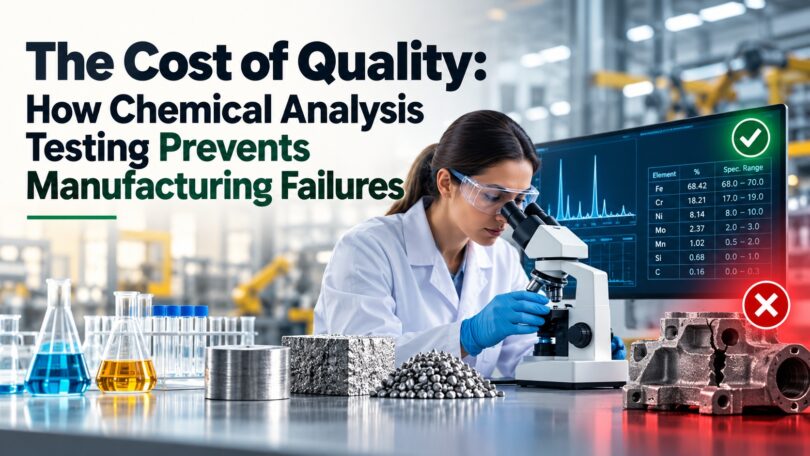
Many business owners and plant managers look at the operating budget and see material testing as an extra expense. They ask if it is really necessary to test every batch of raw materials. They wonder if they can skip a few steps to save money, trim lead times, and speed up production. My answer is always a firm no. The cost of skipping these steps is always significantly higher than the cost of doing them right. This core concept is known in industrial engineering as the cost of quality. In the modern manufacturing world, the most effective way to manage and minimize this cost is through comprehensive chemical analysis testing.
In this article, I want to share how chemical testing works on a practical level, why it is a non-negotiable part of modern manufacturing, and how it protects your bottom line from preventable failure.
Understanding the True Cost of Quality
Before we look at the testing processes themselves, we need to understand what the cost of quality actually means. In engineering and operations management, this term does not simply refer to the salary of your quality assurance team or the price of laboratory equipment. It actually covers two distinct categories: the cost of good quality and the cost of poor quality.
1. The Cost of Good Quality
This represents the proactive investment you make to ensure products meet specifications from day one. It includes two sub-categories:
- Prevention Costs: Money spent on equipment maintenance, employee training, vendor audits, and process design.
- Appraisal Costs: Money spent on incoming material inspection, in-line process monitoring, quality audits, and lab testing.
2. The Cost of Poor Quality
This represents the financial drain when materials or finished products fail to meet standards. It includes:
- Internal Failure Costs: Scrapped raw materials, wasted energy, machine downtime, rework hours, and delayed shipments discovered before leaving the factory.
- External Failure Costs: The worst nightmare for any manufacturer. These involve full-scale product recalls, warranty claims, regulatory fines, customer lawsuits, and permanent damage to your brand reputation.
Spending a small amount on the cost of good quality almost always prevents the astronomical expenses associated with external failures. This is precisely where targeted chemical analysis comes into play.
What is Chemical Analysis Testing?
Chemical analysis testing is the scientific process of breaking down a material to understand its exact elemental and molecular composition. In a manufacturing setting, we use this form of testing to determine precisely what a raw material, alloy, chemical bath, or finished component is made of.
When you order a specific grade of stainless steel, a specialized plastic polymer, or a custom industrial lubricant, you rely on vendor certificates of analysis. But supply chains are complex and mistakes happen frequently. Suppliers might inadvertently send the wrong heat batch. Raw materials can suffer contamination during oceanic shipping. In worst-case scenarios, lower-grade substitutes are fraudulently mixed into shipments.
Chemical analysis serves as an objective truth serum for engineers. Scientists use sophisticated analytical techniques such as Optical Emission Spectroscopy (OES), Fourier-Transform Infrared Spectroscopy (FTIR), Gas Chromatography-Mass Spectrometry (GC-MS), and X-ray Fluorescence (XRF) to evaluate samples at the molecular level. These tools allow us to confirm whether a substance matches required engineering specifications down to parts per million. If a material falls outside the acceptable tolerance window, we catch it before it ever touches the production line.
How Chemical Testing Prevents Manufacturing Failures
Throughout my engineering career, I have relied on analytical material testing to solve complex root-cause mysteries and halt disasters before they reach the market. Here are the primary ways this process safeguards manufacturing operations.
1. Verifying Raw Material Integrity
The most common point of failure in any production process occurs at the receiving dock. If you feed sub-standard raw materials into your machines, you will inevitably produce sub-standard finished goods.
For example, imagine you are manufacturing high-strength structural brackets for the automotive industry. These brackets are designed to withstand specific mechanical loads. If a supplier delivers a batch of steel containing an improper balance of carbon or sulfur, the metal may become excessively brittle. If you bypass incoming material testing, you will proceed to stamp thousands of defective brackets. Those brackets will eventually crack under stress once installed in consumer vehicles.
By conducting chemical composition analysis on incoming stock, you identify the variance immediately. You isolate the bad shipment, return it to the vendor, and keep your production line aligned with strict safety standards.
2. Identifying Hidden Contaminants
Contamination is a subtle hazard in industrial manufacturing. Microscopic quantities of an unwanted chemical can ruin an entire production run. This vulnerability is especially critical in industries such as medical device manufacturing, aerospace components, food contact packaging, and microelectronics.
In one past project, an assembly line produced electronic circuit boards that experienced unexpected electrical shorting during final testing. Visually, the boards appeared flawless. Their physical dimensions were exact. Standard continuity checks revealed no obvious mechanical bridge. We sent sample boards to an analytical lab for surface contamination testing.
The laboratory detected trace residue from an industrial cleaning solvent used in an upstream process. The solvent had not fully evaporated and was slightly conductive under operating voltages. Thanks to chemical analysis, we identified the exact cause, adjusted the board washing parameters, and eliminated the defect. Without chemical testing, hundreds of thousands of dollars in circuit boards would have been written off as scrap.
3. Preventing Corrosion and Premature Degradation
Industrial products must endure real-world environmental exposure over long service lives. They face humidity, salt spray, extreme temperature shifts, UV radiation, and aggressive chemicals.
Chemical analysis helps engineers evaluate how materials will behave when exposed to these elements over time. We perform accelerated environmental testing, salt fog exposure, and alloy verification to confirm that protective coatings, anodization layers, and anti-corrosion additives meet design specifications. If testing reveals that a protective finish lacks the required chemical density, we can correct the formulation prior to commercial release. This diligence eliminates field failures, minimizes warranty expenses, and protects long-term customer trust.
4. Failure Analysis and Reverse Engineering
When a part fails during stress testing or field operation, engineers need to understand precisely why it failed so they can prevent a recurrence. Chemical analysis is an essential component of formal failure analysis.
By examining the fracture surface or material structure of a failed component, metallurgists and chemists can detect micro-segregation, hydrogen embrittlement, unexpected oxidation, or material degradation. Furthermore, chemical testing allows manufacturers to reverse engineer high-performing market alternatives. By analyzing the precise chemical makeup of a benchmark component, you can refine your own material formulations to enhance product durability and remain competitive.
The Value of Partnering with an Accredited Laboratory
Modern manufacturing facilities require speed, efficiency, and focus. While basic dimensional checks and hardness testing can be performed on the shop floor, deep chemical characterization requires specialized instrumentation, controlled environments, and experienced chemists.
Attempting to guess material composition or relying solely on unverified supplier paperwork introduces unneeded financial risk. To establish total confidence in your material quality, it is essential to collaborate with a qualified chemical analysis testing lab.
An accredited independent testing facility brings specialized analytical equipment, certified calibration standards, and unbiased third-party verification to your quality management system. Whether you require trace metal detection, polymer identification, volatile organic compound profiling, or formal failure investigation, an experienced lab provides actionable data to drive your engineering decisions.
Conclusion: Making Quality a Strategic Investment
The pressure to reduce manufacturing expenses and shorten time-to-market is continuous. Operational leaders are routinely challenged to reduce overhead. However, compromising on quality assurance is a short-sighted strategy that carries immense financial risk.
The cost of quality is an inescapable reality in modern engineering. Investing in routine chemical analysis testing may appear as an added operational line item today. However, when measured against the catastrophic expense of a product recall, factory shutdown, or loss of customer confidence, systematic testing delivers an unmistakable return on investment.
Successful manufacturers treat quality control not as a burden, but as a core competitive advantage. They verify their raw materials, monitor process chemistry, and base their operational choices on rigorous scientific evidence. By integrating chemical analysis into your quality framework, you protect your supply chain, safeguard your brand, and deliver products that stand the test of time.