
Published on August 20th, 2026
Moving across the country is not the same as moving across town. A long distance relocation involves state lines, federal regulations, multi-day transit, and a price tag that can climb into the thousands.
One weak link in the chain, from a shaky estimate to a mover without proper licensing, can turn an exciting fresh start into a stressful, expensive mess.
There is no single “best” moving company that fits everyone. The right choice depends on the size of the household, the distance, the budget, and how much of the work someone wants to hand off.
A retiree downsizing into a two-bedroom apartment has very different needs from a family relocating a five-bedroom house across the country.
What does exist is a clear, repeatable way to identify the best moving company for long distance moves in a specific situation.
This guide walks through how licensing works, what drives the cost, how to read an estimate without getting burned, and the questions that separate a reputable carrier from a broker chasing a quick deposit. The goal is simple: give anyone planning an interstate move the tools to choose with confidence.
What Is the Best Moving Company for Long Distance Moves?
The best moving company for long distance moves is a properly licensed interstate carrier with an active USDOT number, transparent written estimates, and coverage that matches the value of the shipment. No single company is best for every move.
For most cross-country moves, the strongest choice is a federally registered carrier (not just a broker) that provides an in-home or video survey, issues a binding or not-to-exceed estimate, offers Full Value Protection, and has a verifiable track record. Full-service movers suit those who want convenience; moving containers suit budget-conscious movers who can pack themselves; and truck rental suits the most hands-on, lowest-cost movers.
Before booking, verify the company’s credentials in the FMCSA SAFER database, compare at least three written estimates, and read the contract terms on delivery windows, deposits, and claims.
What Makes a Moving Company Good for Long Distance Moves?
Long distance moves generally cover more than roughly 400 miles, and most cross state lines. Crossing a state line brings a move under federal oversight, and that single fact changes what “good” means. A company that handles local moves smoothly may not carry the credentials or infrastructure to move a household across the country.
A few qualities consistently separate strong interstate movers from the rest.
Proper federal licensing. Any company that transports household goods across state lines must be registered with the Federal Motor Carrier Safety Administration (FMCSA) and carry a USDOT number. Companies operating for hire also need a Motor Carrier (MC) number. This is not optional, and it is the first thing worth verifying.
A real survey before the quote. Reputable long distance movers base their estimates on an actual inventory, gathered through an in-home walkthrough or a video survey. A firm number quoted over the phone before anyone has seen the belongings is a warning sign, not a convenience.
Transparent, written estimates. Good carriers put the price and its terms in writing and explain whether the estimate is binding, non-binding, or not-to-exceed. Vague or verbal-only quotes leave too much room for surprises on delivery day.
Adequate coverage. The best movers explain valuation clearly and offer Full Value Protection, not just the federal minimum. More on that below.
A verifiable track record. Reviews, complaint history, and years in business all matter. A company that has moved thousands of households and stands behind a clear claims process offers something a brand-new operation with no record cannot.
Clear communication. Long distance moves involve delivery windows measured in days, not hours. A good mover sets realistic expectations about timing and stays reachable throughout.
How to Choose the Best Moving Company
Choosing well is less about finding a famous brand and more about running a consistent check on every company under consideration. The steps below apply whether the shortlist has national van lines or regional carriers.
Start with licensing. Confirm the USDOT and MC numbers on the FMCSA SAFER website (safer.fmcsa.dot.gov). The record shows operating authority, insurance on file, and complaint history. If a company cannot or will not provide its USDOT number, remove it from the list.
Confirm carrier vs. broker status. A carrier owns the trucks and moves the goods. A broker arranges the move but hands the actual transport to a third party. Brokers are legal and regulated, but they must disclose their broker status. Knowing which one is being hired matters, because it affects accountability if something goes wrong.
Get at least three estimates. Comparing quotes reveals the market rate and flags outliers. A bid dramatically lower than the rest is not a bargain to celebrate; it often signals a lowball figure that balloons later.
Insist on a survey. Accept quotes only from companies willing to inventory the household by video or in person. Estimates built on guesswork tend to fall apart.
Read reviews across multiple platforms. Patterns matter more than any single review. Repeated complaints about the same issue, such as inflated final bills or damaged goods, tell a clearer story than star ratings alone.
Check the contract terms. Delivery windows, deposit requirements, cancellation policies, and the claims process should all be spelled out before signing.
Use the evaluation checklist below to score each company on the same criteria.
Moving Company Evaluation Checklist
| Criteria | What to Verify | Why It Matters |
|---|---|---|
| USDOT & MC number | Active status in FMCSA SAFER database | Confirms legal authority for interstate moves |
| Carrier or broker | Company discloses its role | Determines who is accountable for the shipment |
| Written estimate | Binding, non-binding, or not-to-exceed, in writing | Protects against surprise charges at delivery |
| Survey method | In-home or video inventory offered | Produces a realistic, defensible quote |
| Valuation options | Released Value and Full Value Protection explained | Sets the mover’s liability for loss or damage |
| Insurance on file | Active coverage shown in FMCSA record | Indicates a compliant, established operation |
| Deposit policy | Amount and refund terms disclosed | Large upfront cash demands are a red flag |
| Reviews & complaints | Consistent history across platforms | Reveals patterns in service quality |
| Delivery window | Estimated spread of days, in writing | Long distance delivery takes time; clarity avoids disputes |
| Claims process | Written procedure and time limits | Determines how damage is resolved |
Types of Long Distance Moving Services
Long distance moving is not one product. It is a range of services at different price points and effort levels. Understanding the options makes it easier to match a service to a budget and a comfort level.
Full-service movers handle everything: packing, loading, driving, unloading, and sometimes unpacking. This is the highest-cost, lowest-effort option, well suited to large households, tight timelines, or anyone who would rather not touch a box.
Self-service or hybrid movers split the work. A common version has the customer pack and load while the company handles the long-haul driving. This trims cost while still removing the hardest part of a cross-country move: the drive.
Moving containers are dropped at the home, filled by the customer at their own pace, then transported to the destination. Portable container services occupy a middle ground between full-service and pure DIY, offering flexibility on timing without requiring anyone to drive a large truck.
Truck rental (DIY) puts the customer in the driver’s seat, literally. Renting a truck and doing all the work is typically the cheapest route, but it demands the most time, physical labor, and comfort with driving a large vehicle over long distances.
Specialty services cover items that need extra care, such as pianos, fine art, vehicles, or climate-sensitive goods. These are often add-ons rather than standalone services.

Moving Service Comparison
| Service Type | Effort Required | Relative Cost | Best For |
|---|---|---|---|
| Full-service movers | Low | Highest | Large homes, tight timelines, minimal hands-on work |
| Hybrid (you pack, they drive) | Medium | Moderate | Cost savings without driving cross-country |
| Moving containers | Medium–High | Lower–Moderate | Flexible timing, self-packing, no truck driving |
| Truck rental (DIY) | High | Lowest | Small moves, tight budgets, hands-on movers |
| Specialty services | Varies | Add-on | Pianos, art, vehicles, fragile or high-value items |
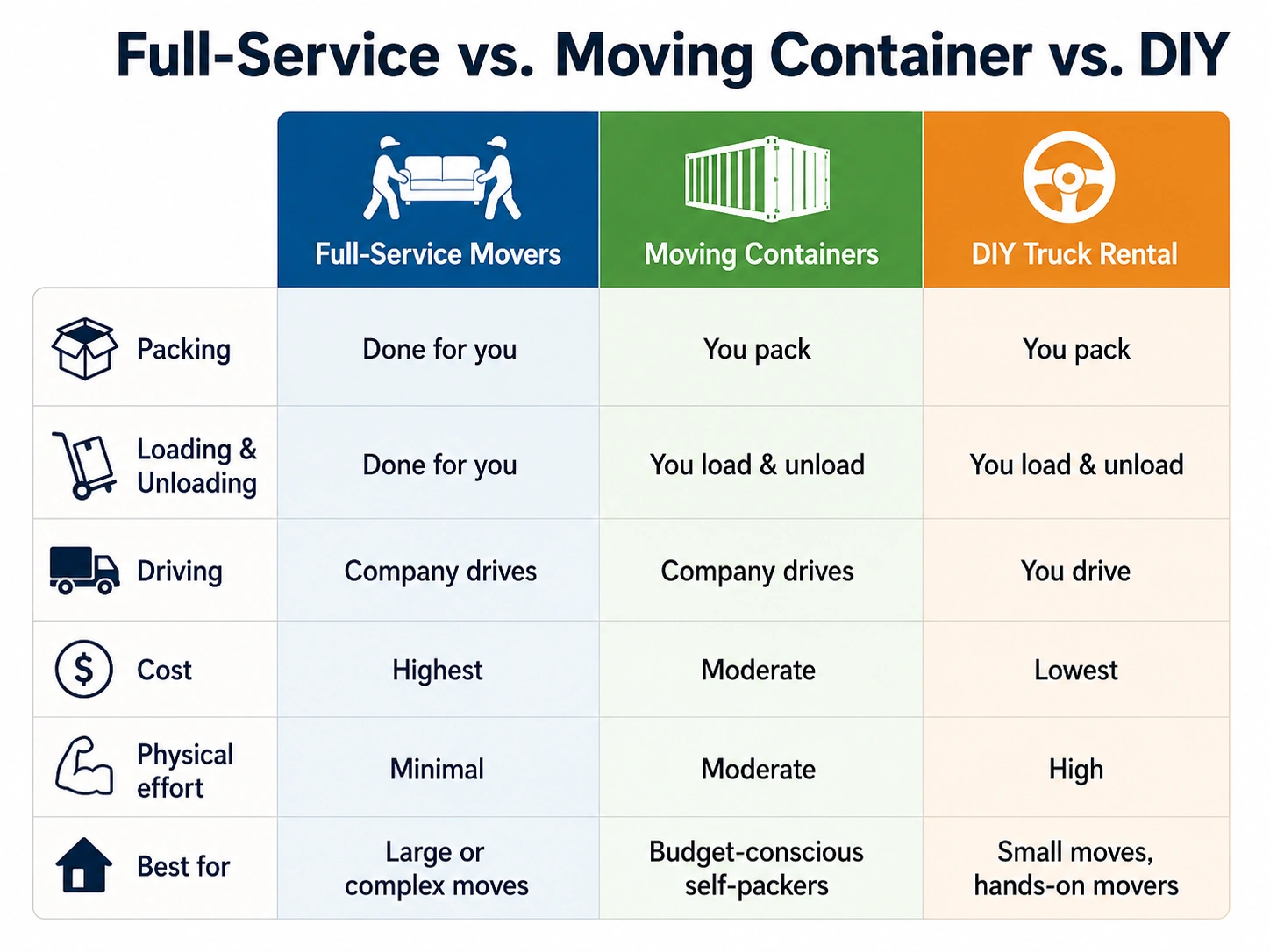
Full-Service Movers vs. Moving Containers vs. DIY
The choice among these three approaches shapes nearly everything else about a move: the cost, the timeline, and how much of the labor lands on the customer. Each has a clear profile.
Full-service movers trade money for convenience. A crew shows up, and the household ends up at the new address with little effort from the customer beyond decisions and supervision. The trade-off is cost and less control over exact timing, since long distance delivery happens within a window.
Moving containers trade some effort for savings and flexibility. The container sits at the home for days, allowing packing on a personal schedule. The customer supplies the labor to load and unload; the company handles transport. This suits organized movers who want a middle path.
DIY truck rental trades effort for the lowest price. Everything falls to the customer, from packing to loading to a multi-day drive. For small households and confident drivers, the savings can be significant. For larger homes or long routes, the physical and logistical demands add up fast.
Full-Service vs. Container vs. DIY
| Factor | Full-Service Movers | Moving Containers | DIY Truck Rental |
|---|---|---|---|
| Packing | Done for you (optional add-on) | You pack | You pack |
| Loading/unloading | Done for you | You load and unload | You load and unload |
| Driving | Company drives | Company drives | You drive |
| Cost | Highest | Moderate | Lowest |
| Timeline control | Delivery window | Flexible loading, set transit | Full control |
| Physical effort | Minimal | Moderate | High |
| Best suited to | Large or complex moves | Budget-conscious self-packers | Small moves, hands-on movers |
There is no universally correct pick here. The right option is the one that fits the household size, budget, and how much labor the customer is willing and able to do.
Long Distance Moving Costs and Pricing Factors
Long distance moving costs vary widely, and any honest guide has to say so plainly. A cross-country move for a small apartment sits at one end of the range; a large household moving several thousand miles with packing and storage sits at the far other end. The only reliable number is the one on a written estimate built from an actual survey.
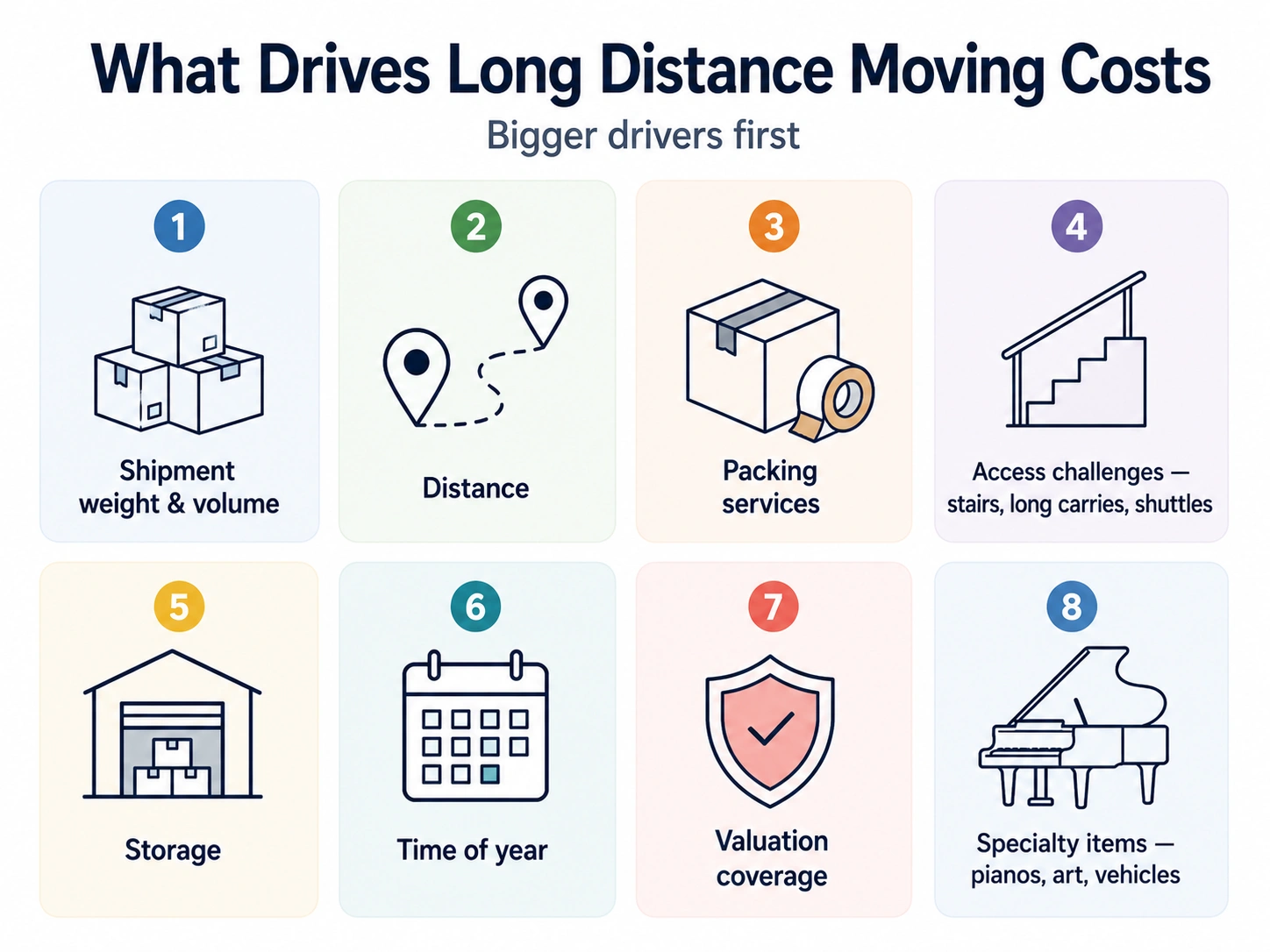
That said, understanding what drives the price helps anyone read a quote critically and spot when a number seems off.
Weight and volume are the biggest cost drivers for full-service interstate moves. More belongings mean more weight or cubic footage, and pricing scales accordingly.
Distance matters, though not always in a straight line. Fuel, driver time, and routing all factor in.
Packing services add cost when the mover boxes up the household. Full packing is convenient but raises the bill; partial packing (fragile items only) is a middle option.
Add-on services stack up: bulky-item handling, long carries from door to truck, stair or elevator fees, shuttle service when a large truck cannot reach the home, and storage between pickup and delivery.
Time of year influences price. Summer months and the beginning and end of each month tend to be busier and pricier than mid-week, mid-month moves in the off-season.
Valuation coverage adds cost when upgrading beyond the free federal minimum, which is money well spent for valuable shipments.
Watch for hidden fees. Reputable movers disclose potential extra charges up front. Fees for long carries, shuttles, stairs, and bulky items should appear in the estimate, not as a surprise at delivery.
Long Distance Moving Cost Factors
| Cost Factor | How It Affects Price | Notes |
|---|---|---|
| Shipment weight/volume | Primary driver for full-service moves | Larger households cost more |
| Distance | Longer hauls raise fuel and labor costs | Routing and access also matter |
| Packing services | Full or partial packing adds cost | Convenient but optional |
| Access challenges | Stairs, long carries, shuttles add fees | Should be disclosed in the estimate |
| Storage | In-transit or extended storage adds cost | Useful when move-in is delayed |
| Time of year | Peak season and month-end cost more | Off-peak scheduling can save money |
| Valuation coverage | Full Value Protection costs extra | Worth it for high-value shipments |
| Specialty items | Pianos, art, vehicles add charges | Often billed separately |
Treat published averages as rough context, not a promise. The figure that matters is the binding or not-to-exceed estimate from a licensed carrier that has actually surveyed the household.
How to Compare Moving Estimates
An estimate is only as good as its terms. Two quotes with the same dollar amount can mean very different things depending on the type of estimate attached. For interstate moves, federal rules define three main types.
Binding estimate. The price is locked. The mover cannot collect more than 100 percent of the stated amount at delivery, even if the shipment turns out heavier than expected. Changes only apply if services are added after the fact.
Non-binding estimate. The final price depends on the actual weight of the shipment. Under federal rules, a mover cannot require payment of more than 110 percent of a non-binding estimate at the time of delivery. Any balance above that gets billed later, typically at least 30 days after delivery.
Not-to-exceed estimate. Sometimes called a guaranteed-price or price-protection estimate, this caps the price at the quoted figure but can come in lower if the shipment weighs less. For customers, it combines predictability with potential savings.
When comparing estimates, line them up on the same terms. Confirm each quote reflects the same inventory, the same services, and the same valuation coverage. A cheaper quote that assumes less coverage or excludes packing is not actually cheaper.
Be cautious with any estimate produced without a survey. A firm price offered sight unseen, especially a low one, often shifts dramatically once the truck is loaded. Reputable interstate movers survey the household first and provide the required consumer documents, including the FMCSA “Your Rights and Responsibilities When You Move” booklet.
A practical way to compare:
- Verify each company’s license before weighing its price.
- Match the inventory and services across all quotes.
- Note the estimate type on each (binding, non-binding, not-to-exceed).
- Check what valuation coverage is included.
- Read the deposit and cancellation terms.
- Treat the lowest outlier with suspicion, not excitement.
Moving Insurance and Valuation Coverage
One of the most misunderstood parts of a long distance move is coverage. What most people call “moving insurance” is technically valuation, and the difference is worth understanding before signing anything.
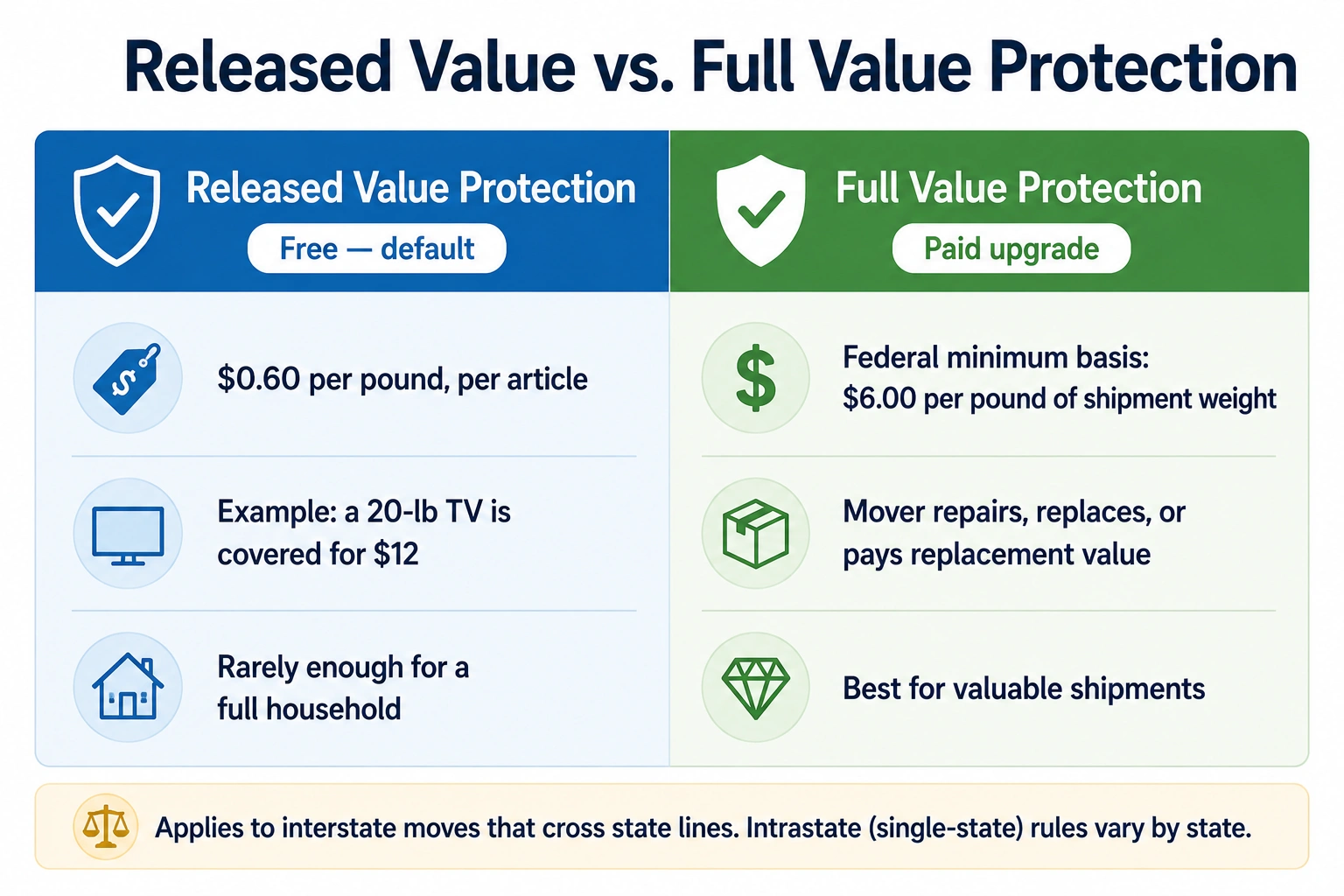
For interstate moves, federal rules require carriers to offer two levels of liability, known as valuation.
Released Value Protection is the free, default option. It caps the mover’s liability at $0.60 per pound per article, regardless of what an item is actually worth. Under this level, a 20-pound television damaged in transit would be covered for about $12. That is rarely enough for a household of any real value, and it applies automatically unless a customer chooses otherwise in writing.
Full Value Protection is the upgraded option, and the mover charges for it. Under this level, the mover is responsible for the replacement value of damaged or lost items, up to the declared value of the shipment. The carrier may repair the item, replace it, or offer a cash settlement. The federal minimum valuation basis for this option is generally $6.00 per pound of the shipment’s weight, and carriers price the coverage based on the declared value.
A key distinction: valuation is the mover’s liability, not a true insurance policy. For high-value shipments, some movers offer, or customers can buy separately, third-party moving insurance that works more like traditional coverage. Anyone with valuable belongings should ask about both.
A few points worth remembering:
- Released Value Protection is free but minimal. It is almost never adequate for a full household.
- Full Value Protection costs more but offers meaningful protection.
- Coverage terms, deductibles, and exclusions appear on the bill of lading. Read them before signing.
- Rules described here apply to interstate moves. A move entirely within one state is regulated by that state, and the coverage requirements can differ.
Document the shipment before it leaves. Photos and a written inventory make any future claim far easier to support.
How to Hire a Long Distance Moving Company
Once the research is done, hiring comes down to a clear sequence. Following it in order reduces the odds of a costly mistake.
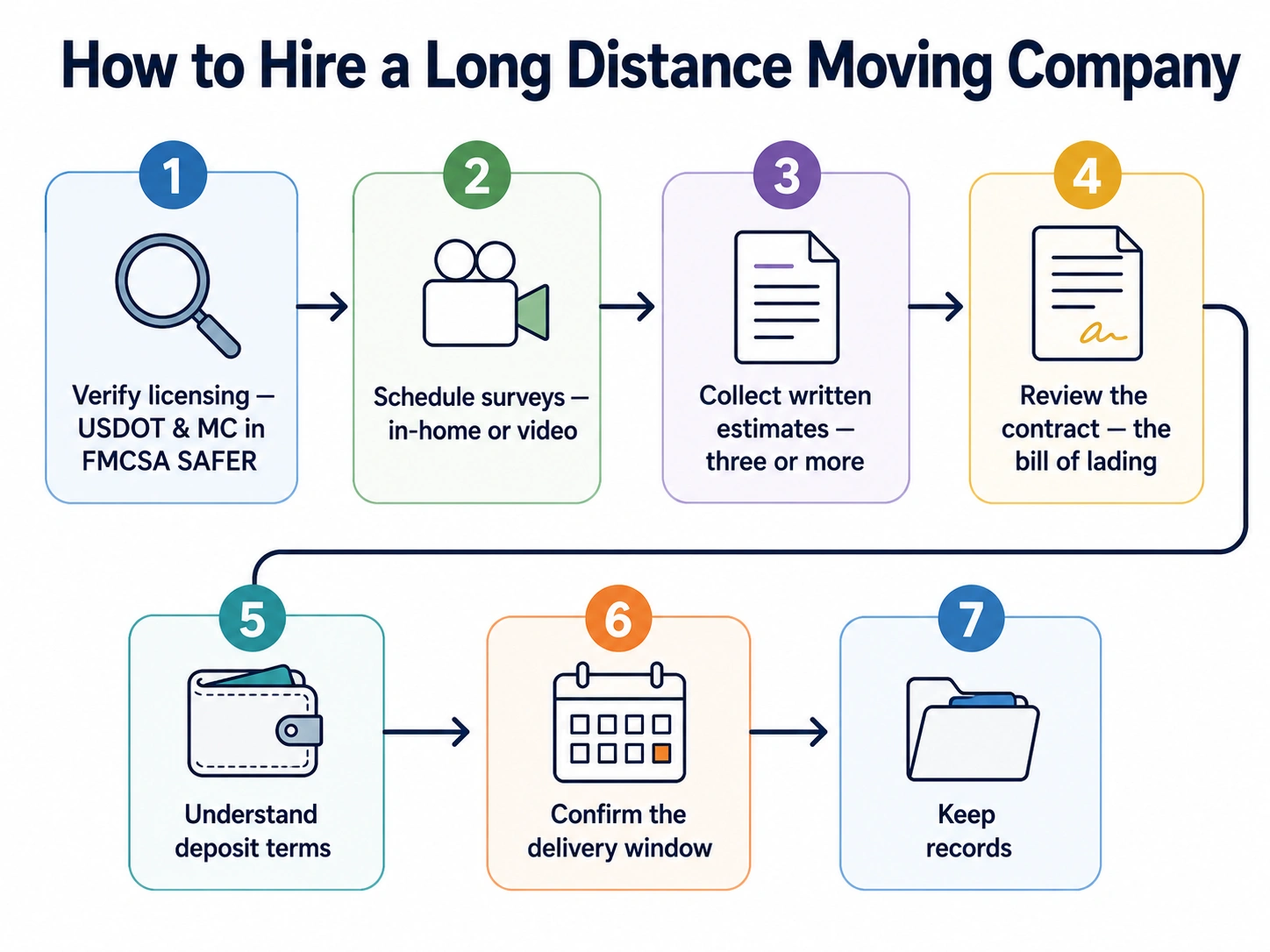
Step 1: Verify licensing first. Look up the USDOT and MC numbers in the FMCSA SAFER database. Confirm active operating authority and insurance before spending time on anything else.
Step 2: Schedule surveys. Book in-home or video surveys with at least three carriers. This produces comparable, realistic estimates.
Step 3: Collect written estimates. Get each quote in writing, with the estimate type clearly labeled and the same inventory and services across all three.
Step 4: Review the contract carefully. The bill of lading is the binding contract. Read the delivery window, deposit terms, cancellation policy, valuation coverage, and claims procedure before signing anything.
Step 5: Understand the deposit terms. A modest deposit is common. A demand for a large cash deposit, especially before a survey, is a warning sign. Reputable movers typically accept credit cards and disclose refund terms.
Step 6: Confirm the delivery window. Long distance delivery happens over a spread of days, not a single hour. Get that window in writing and understand what happens if it slips.
Step 7: Keep records. Save every document, estimate, and communication. If a dispute arises later, this paper trail is the strongest tool available.
Understanding the broker-versus-carrier distinction matters most at this stage. A broker may offer a tidy quote, but the company that shows up on moving day could be different. If working with a broker, confirm which carrier will actually perform the move and verify that carrier’s credentials too.
Questions to Ask Before Hiring
The right questions surface problems before they become expensive. Ask each shortlisted company the following, and pay attention not just to the answers but to how willingly they answer.
- What is your USDOT number, and are you a carrier or a broker?
- Will the estimate be binding, non-binding, or not-to-exceed?
- Do you perform an in-home or video survey before quoting?
- Will your own crew and truck handle the move, or a partner carrier?
- What valuation options do you offer, and what does Full Value Protection cost?
- What is the estimated delivery window for this route?
- What deposit do you require, and what are the refund and cancellation terms?
- What extra fees could apply, such as stairs, long carries, or shuttle service?
- Do you offer storage if the delivery date needs to shift?
- How does your claims process work, and what is the deadline to file?
A trustworthy company answers these plainly and puts the important pieces in writing. Evasive answers, pressure to sign immediately, or reluctance to share a USDOT number all point toward walking away.
Best Movers for Different Needs

No single company wins for every move, so the smarter question is which type of mover fits a given situation.
The categories below describe what to prioritize, along with examples of well-known companies that operate in each space.
These are illustrative, not endorsements. Verify current licensing, reviews, and quotes for any company before booking, since service quality and pricing change over time and by location.
For large, full-service coast-to-coast moves. National van lines are built for this. They offer packing, loading, transport, and often storage, with established networks across the country. Long-standing van line brands such as United Van Lines, Mayflower, Allied, North American, and Atlas operate in this category through networks of local agents. Prioritize carrier status, Full Value Protection, and a documented claims process.
For budget-conscious movers who can pack themselves. Moving container services let customers load at their own pace while the company handles transport. Providers such as PODS, U-Pack, 1-800-PACK-RAT, and U-Haul’s U-Box operate in this space. Prioritize clear pricing on container size, transit time, and storage.
For the lowest-cost, hands-on move. Truck rental puts everything in the customer’s hands. Companies such as U-Haul, Penske, and Budget rent trucks for one-way long distance moves. Prioritize truck availability on the moving dates, mileage and fuel terms, and insurance options.
For small or studio moves. Container services and truck rental usually beat full-service pricing when there is not much to move. A hybrid option, where the customer packs and the company drives, can also work well.
For high-value or specialty items. Look for carriers with specific experience in fine art, pianos, or antiques, and confirm they offer adequate valuation or third-party insurance. Ask directly about custom crating and handling.
For flexible or uncertain timelines. Container services shine here, since the container can sit at the home for days, and many providers offer storage if the destination is not ready.
Match the mover to the move, then run every candidate through the same licensing and estimate checks described earlier.
Common Moving Mistakes
Most long distance moving problems trace back to a handful of avoidable mistakes. Knowing them in advance is half the battle.
Skipping the license check. Hiring without verifying a USDOT number invites trouble. Unlicensed operators are a frequent source of moving complaints and scams.
Accepting a quote without a survey. A phone quote given sight unseen is a guess. It often rises sharply once the truck is loaded.
Choosing on price alone. The lowest bid frequently signals a lowball estimate, a broker with no accountability, or a company cutting corners. Value matters more than the sticker price.
Paying a large cash deposit. Legitimate movers do not demand big cash sums upfront. This is a classic red flag for a scam.
Ignoring valuation coverage. Defaulting to the free $0.60-per-pound protection leaves valuable belongings badly underinsured.
Not reading the bill of lading. This document is the contract. Signing without reading it means agreeing to terms sight unseen.
Confusing brokers with carriers. Assuming the company that quoted the move will perform it can lead to surprises when a different, unvetted carrier arrives.
Underestimating the delivery window. Expecting same-day or next-day delivery on a cross-country move sets up disappointment. Interstate delivery takes days.
Failing to document belongings. Without photos and an inventory, filing a successful damage claim becomes much harder.
Avoiding these mistakes does not require expertise, just a willingness to slow down, verify, and read the paperwork.
Long Distance Moving Checklist
A staged checklist keeps a long distance move from becoming chaotic. Adjust the timeline to fit the situation, but the sequence holds for most interstate moves.
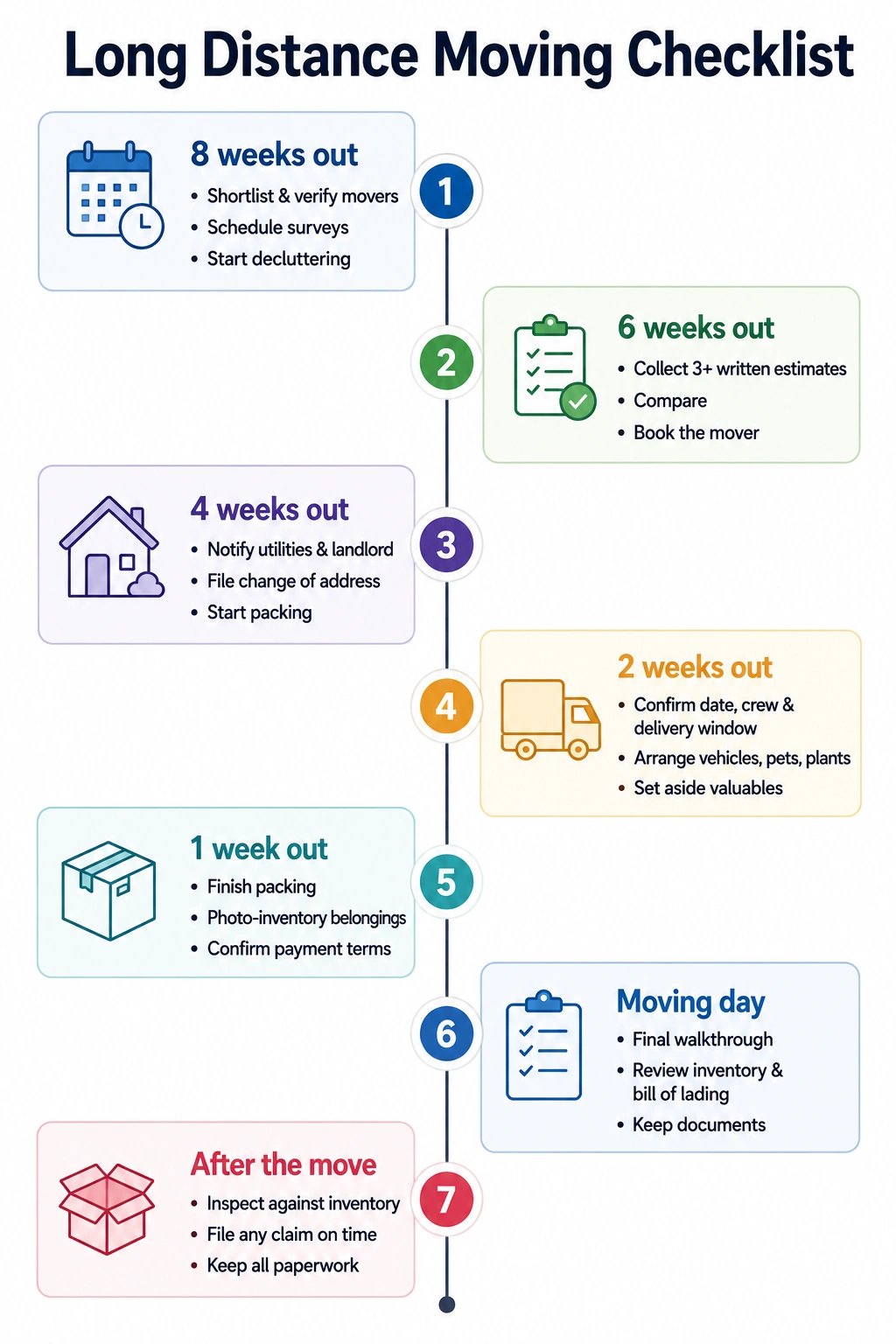
8 weeks out
- Research and shortlist movers; verify USDOT and MC numbers.
- Schedule in-home or video surveys.
- Start decluttering to reduce shipment weight.
6 weeks out
- Collect at least three written estimates.
- Compare estimate types and valuation options.
- Book the chosen mover and confirm the date.
4 weeks out
- Notify landlords, utilities, and service providers.
- File a change of address.
- Begin packing non-essential items if self-packing.
2 weeks out
- Confirm the moving date, crew, and delivery window in writing.
- Arrange transport for vehicles, pets, and plants if needed.
- Set aside essentials and valuables to keep personally.
1 week out
- Finish packing except daily essentials.
- Photograph and inventory belongings for coverage records.
- Confirm payment method and deposit terms.
Moving day
- Do a final walkthrough of the home.
- Review the inventory and bill of lading before signing.
- Keep copies of all documents and the mover’s contact details.
After the move
- Inspect belongings against the inventory promptly.
- File any damage claim within the required window.
- Keep all paperwork until the move is fully settled.
FAQs
1. What is the best moving company for long distance moves? There is no single best company for everyone. The best choice is a properly licensed interstate carrier with an active USDOT number, transparent written estimates, coverage that matches the shipment’s value, and a solid track record. The right fit depends on the household size, distance, and budget.
2. How do I verify a moving company is licensed? Look up the company’s USDOT number in the FMCSA SAFER database at safer.fmcsa.dot.gov. The record shows operating authority, insurance status, and complaint history. Any interstate mover should provide its USDOT number on request.
3. What is the difference between a broker and a carrier? A carrier owns the trucks and physically moves the shipment. A broker arranges the move but hands the transport to a third-party carrier. Both are regulated, but brokers must disclose their status. Knowing which one is being hired affects accountability if problems arise.
4. How much does a long distance move cost? Costs vary widely based on shipment weight, distance, services, and timing, so no fixed figure applies. The only reliable number is a written estimate from a licensed carrier that has surveyed the household. Get at least three quotes to understand the range.
5. What does moving valuation coverage include? Interstate movers must offer Released Value Protection (free, but only $0.60 per pound per item) and Full Value Protection (paid, covering replacement value up to the shipment’s declared value). Valuation is the mover’s liability, not full insurance, so those with valuable items may also consider separate coverage.
6. What is the difference between a binding and non-binding estimate? A binding estimate locks the price; the mover cannot charge more than the stated amount. A non-binding estimate can change with actual weight, though the mover cannot require more than 110 percent of it at delivery. A not-to-exceed estimate caps the price but can come in lower.
7. How far in advance should I book a long distance mover? Booking six to eight weeks ahead is a common guideline, and more lead time helps during peak summer months. Early booking allows time to compare estimates, verify licensing, and secure a preferred date.
8. Are moving containers cheaper than full-service movers? Often, yes, because the customer supplies the packing and loading labor. Containers suit budget-conscious movers who can pack themselves and want flexible timing. Full-service movers cost more but handle nearly all the work.
9. How long does a long distance move take to deliver? Interstate delivery happens within a window of days, not hours, depending on distance and routing. Ask for the estimated delivery window in writing and understand the terms if it shifts.
10. What should I do if my belongings are damaged? Document the damage right away, compare it against the inventory, and file a claim within the required window. Keep all paperwork, including the bill of lading and estimate. The claims process and deadlines should be spelled out in the contract before signing.
Conclusion
The best moving company for long distance moves is not a name on a list. It is the licensed, transparent carrier whose service, coverage, and price fit a specific move. That company looks different for a studio apartment heading two states over than it does for a family relocating across the country.
The path to finding it is consistent, though. Verify federal licensing first. Insist on a real survey and a written estimate. Understand valuation coverage and choose enough of it. Read the contract, ask direct questions, and treat suspiciously low bids with caution rather than excitement.
Long distance moving involves real money and real risk, but it is not a gamble when approached methodically. A few hours spent verifying credentials and comparing estimates protects both the budget and the belongings. Anyone who follows the steps in this guide can move across the country with far more confidence and far fewer surprises.
This guide provides general information about long distance moving and is not legal, financial, or insurance advice. Federal rules described here apply to interstate moves regulated by the FMCSA; requirements for moves within a single state vary by location. Verify current licensing, coverage, and pricing directly with any moving company before booking. Author byline, editorial review, and affiliate disclosure to be added per site policy.

Team Newszii is composed of individuals with professional backgrounds in content writing. We specialize in writing on a variety of topics including Lifestyle, Entertainment, Humor, Women, Food, Travel, Technology, and Blockchain Technology. Our team is driven by a passion for creating unique, accurate, and engaging content.