Published on August 21st, 2026
When a business borrows against its assets, a record is often created in a public database. That record is a UCC filing, and for sales and marketing teams it can be one of the most practical sources of business intent data available.
UCC filings tell you which companies recently secured financing, who lent them money, and what type of assets were used as collateral. For lenders, equipment vendors, and B2B service providers, that information points toward businesses that are actively investing, expanding, or managing cash flow.
This guide explains what UCC filing data is, what it can and cannot tell you, and how to turn it into a usable lead list. It also covers data accuracy, cost, and the compliance rules that apply once you start reaching out. The goal is a clear, honest picture you can act on, without hype or shortcuts.
A note on scope: UCC law is adopted state by state, and the details differ across jurisdictions. This article gives general guidance and flags where rules vary. It is not legal advice. For decisions that carry legal or regulatory weight, consult a qualified attorney or compliance professional in the relevant state.
What Is UCC Filing Data for Lead Generation?
UCC filing data is public record information from Uniform Commercial Code financing statements, which lenders file to formally claim an interest in a borrower’s assets. Each filing names the borrower (debtor), the lender (secured party), the filing date, and a description of the collateral.
For lead generation, that data acts as an intent signal. A recent filing suggests a business took on financing, which often means it is growing, buying equipment, or seeking working capital. Sales teams use these signals to build targeted prospect lists and time their outreach around real business activity, rather than cold, untargeted contact.
The data is public and generally legal to use, but the outreach that follows it is still governed by telemarketing, email, and privacy laws. Accuracy and compliance matter as much as the data itself.
What Is UCC Filing Data?
The Uniform Commercial Code (UCC) is a standardized set of laws governing commercial transactions in the United States. Every state has adopted a version of it, though the wording and some procedures vary. Article 9 of the code covers secured transactions, which is the part relevant to lead generation.
A secured transaction is a loan or credit arrangement backed by collateral. When a business pledges assets, such as equipment, inventory, or receivables, to obtain financing, the lender usually wants a public record of that claim. That record protects the lender’s priority if the borrower defaults or goes bankrupt.
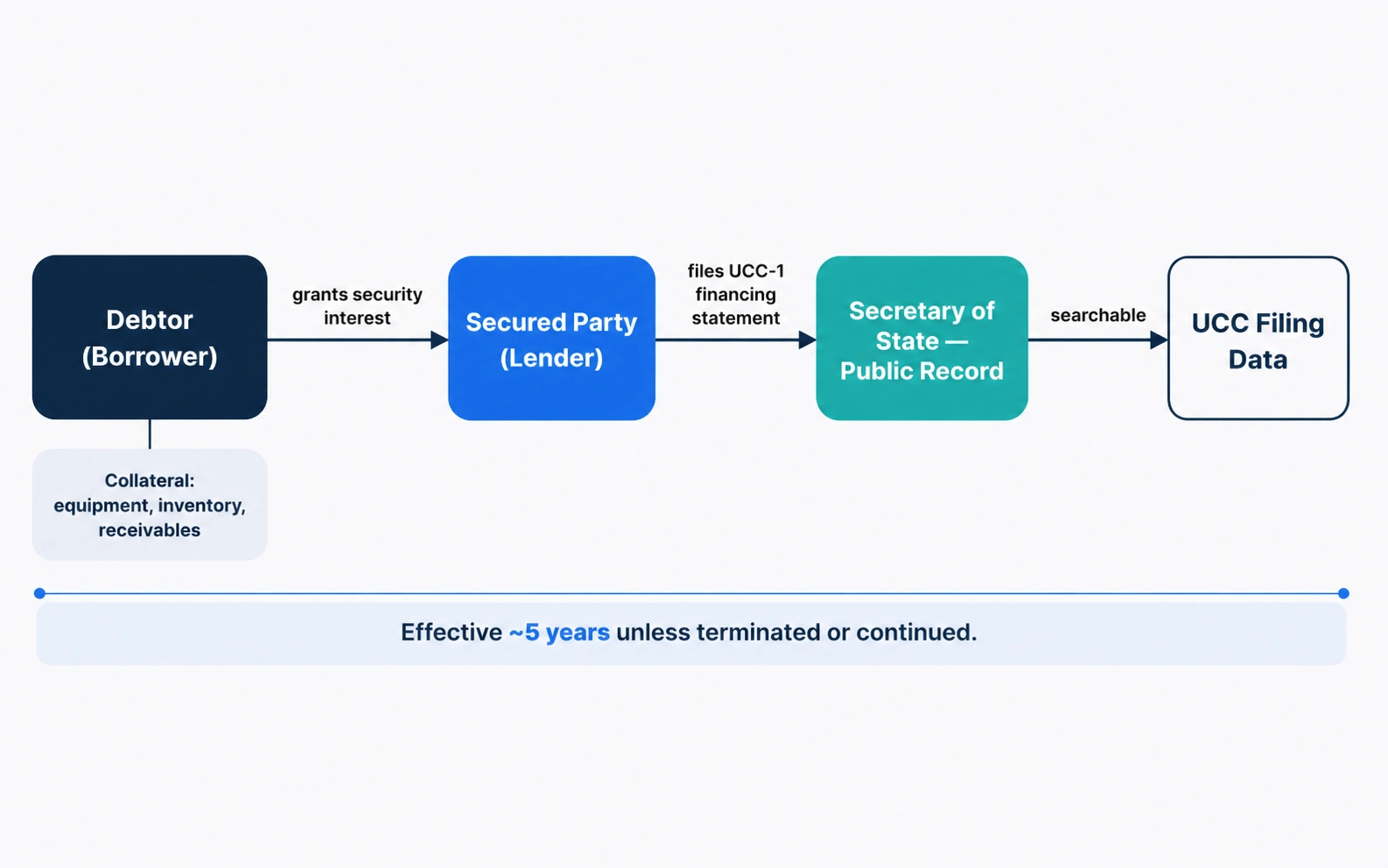
To create that record, the lender files a document called a UCC-1 financing statement. It is filed in most cases with the state’s filing office, typically the Secretary of State. The act of filing is often described as “perfecting” the security interest, which simply means giving public notice so other creditors know the claim exists.
Because these filings are public records, anyone can search them. “UCC filing data” refers to the structured information pulled from these records: who borrowed, who lent, when, and against what collateral. UCC filing searches are the process of querying that data, whether one company at a time or in bulk.
Two roles appear in every filing, and it helps to be clear on the plain-language meaning:
- Debtor — the borrower. This is the business (or occasionally an individual) that pledged assets to get financing.
- Secured party — the lender or creditor that provided financing and holds a claim on the collateral.
A few other document types round out the system:
| Document | Common name | What it does |
|---|---|---|
| UCC-1 | Financing statement | Creates the initial public record of a lender’s security interest in a debtor’s assets. |
| UCC-3 | Amendment | Modifies an existing filing. Used for continuations (extending the record), terminations (ending the claim, often when a loan is paid off), assignments (transferring the claim), and party or collateral changes. |
| UCC-5 | Information statement | Primarily used by a debtor to dispute a filing believed to be inaccurate or wrongful. It does not change or remove the original record. |
| UCC-11 | Search/information request | A formal request to search records or obtain copies of filed statements. |
A UCC-1 financing statement generally stays effective for five years from the filing date, unless it is terminated earlier or continued before it lapses. A continuation, filed as a UCC-3 in the window before expiration, extends the record for another five-year term.
This five-year cycle is a widely used standard, but confirm the exact rule in the state that applies, since procedures and windows can differ.
How UCC Filing Data Supports Lead Generation
The value of UCC data for lead generation comes down to one idea: a filing is a signal that a business recently did something meaningful with its money.
Most B2B prospecting relies on firmographics, such as industry, company size, and location. Those tell you who a business is, but not what it is doing right now. UCC filings add a timing layer. A new filing often means the business just financed equipment, took on working capital, or entered a new lending relationship. That is a moment of activity worth paying attention to.
Here is how that plays out as an intent signal:
- A new filing suggests active investment or a recent capital need. The business is spending or borrowing, which can indicate growth or a cash-flow need.
- The secured party tells you who the business already works with. That is useful for competitive positioning and for understanding the type of financing involved.
- The collateral description hints at what was financed, such as equipment, vehicles, or general business assets.
- A filing approaching its five-year expiration can signal a refinancing or renewal opportunity, since the underlying financing may be maturing.
- A recent termination can indicate a loan was paid off, which may mean the business is now unencumbered and open to new financing.
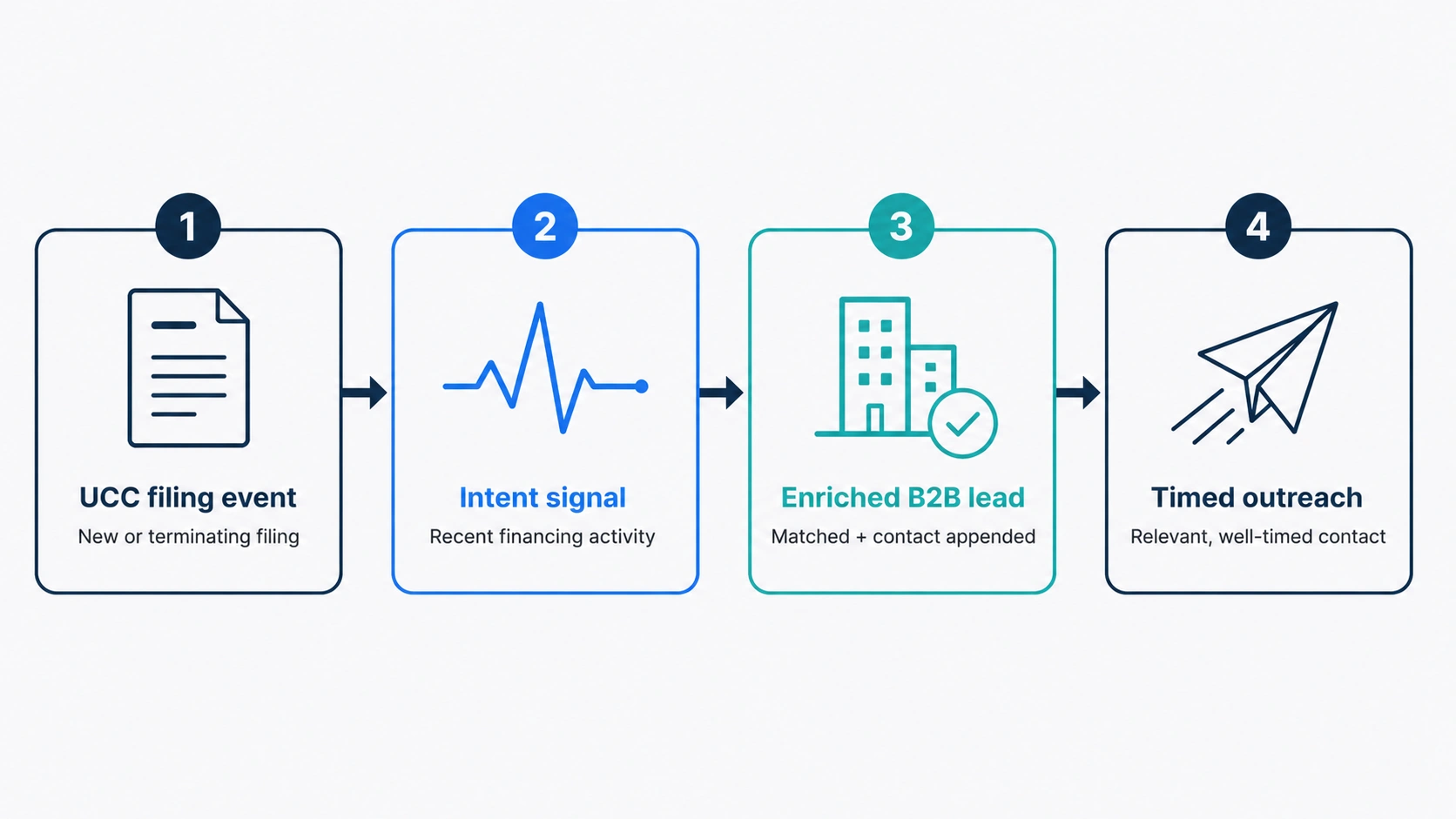
None of these signals is proof of anything specific. A filing does not tell you a company is thriving or struggling. It tells you financing activity occurred. The skill in using UCC data well is treating it as a prioritization signal, then combining it with other context before you reach out.
Used this way, UCC data helps sales teams focus on businesses showing real activity instead of working through generic lists. That usually means better-timed outreach and more relevant conversations.
What Information UCC Filings Can Provide
Being precise about what a filing contains matters, because assumptions here lead to wasted effort and awkward outreach.
A typical UCC-1 record includes:
| Field | Usually included? | Notes |
|---|---|---|
| Debtor name | Yes | The borrower’s legal name. For organizations, this must match the exact registered name. |
| Debtor address | Usually | Mailing or business address as filed. |
| Secured party name | Yes | The lender or creditor holding the claim. |
| Secured party address | Usually | Address for the lender. |
| Filing date | Yes | When the record was created. |
| Filing number | Yes | Unique identifier assigned by the filing office. |
| Jurisdiction | Yes | The state (and sometimes county) where the filing was made. |
| Collateral description | Yes | What secures the loan. Can be specific (named equipment) or broad (“all assets”). |
| Filing status | Yes | Active, lapsed, terminated, or amended. |
Now the equally important part, what filings generally do not include:
- Loan amount, interest rate, or payment terms. UCC-1 financing statements are notices of a security interest, not the underlying loan contract. Dollar figures are usually absent.
- Decision-maker contact details. Filings rarely include a direct phone number or email for the person you want to reach. This is why contact enrichment, appending phone and email data from other sources, is almost always a separate step.
- The reason for the financing. Collateral hints at what was financed, but not why.
- The debtor’s financial health. A filing says a security interest exists. It says nothing about revenue, profitability, or whether the business is doing well.
Understanding these limits keeps your messaging honest. UCC data tells you a financing event happened. Everything beyond that, including who to call and what to say, comes from enrichment and research you layer on top.
How to Find and Use UCC Filing Data
There are two main ways to access UCC filing data: directly through state filing offices, or through commercial data providers that aggregate and enhance it.
Searching state filing offices
Because filings are public records, most states let you search UCC records online through the Secretary of State’s website, often for free or for a small per-copy fee. This is the most authoritative source, since it comes straight from the office that holds the record.
State search tools typically let you search by:
- Debtor name — the most common approach for research.
- Secured party name — useful for seeing a lender’s portfolio.
- Filing number — for pulling a specific record.
State portals are excellent for verifying an individual business or checking a specific filing. They are less practical for building large lead lists, because you generally search one record at a time and the raw output is not formatted for outreach.
A jurisdiction note: under Revised Article 9, the correct place to file usually depends on the debtor’s location, not the collateral’s.
For a registered organization, that is generally the state where it is organized. For an individual debtor, it is generally the state of their principal residence.
Certain collateral tied to real estate, such as fixtures or timber to be cut, may be filed in local county records instead of at the state level. If you are searching comprehensively, account for these differences rather than assuming a single state covers everything.
Using commercial UCC data providers
Commercial providers pull filings from many states, standardize the data, remove duplicates, and often append contact information. This is the practical route for lead generation at scale.
A good provider workflow generally offers:
- Bulk or filtered records rather than one-at-a-time lookups.
- Filtering by state, industry, collateral type, filing date, or secured party.
- Contact enrichment to add phone, email, and decision-maker details.
- Regular refreshes so the data reflects recent filings and terminations.
The trade-off is cost and a dependency on the provider’s accuracy. State data is authoritative but hard to scale. Commercial data scales but should be verified, since aggregation can introduce errors or lag.
For most teams, a combined approach works best: use commercial data to build and prioritize lists, and use state portals to verify specific high-value records before acting on them.
UCC Data for B2B Prospecting and Sales
UCC data is most valuable to businesses whose customers are, by definition, companies that finance assets or need capital. If your ideal customer recently took on financing, a UCC filing is a direct route to finding them at the right time.
Common users and use cases include:
| Who uses it | Why it works |
|---|---|
| Equipment finance and leasing companies | Filings reveal businesses financing equipment, and those nearing term may be candidates for new equipment or refinancing. |
| Working capital and business lenders | Financing activity can signal a business that uses external capital and may need more. |
| Merchant cash advance (MCA) providers and brokers | UCC data is widely used to identify businesses with prior financing activity for offers, renewals, and refinancing. |
| Invoice factoring and receivables finance firms | Collateral tied to receivables can indicate a fit for factoring services. |
| Equipment vendors and dealers | Businesses financing similar assets are natural prospects for related products and upgrades. |
| Insurance and business services providers | Companies investing in assets often need related coverage or services. |
| Competitive and portfolio intelligence teams | Watching a competitor’s filings shows who they are lending to and how their book is changing. |
The MCA and alternative-finance space deserves a specific caution. UCC-based outreach is heavily used there, which means many businesses receive frequent, sometimes aggressive, contact. Standing out requires relevance and restraint, not volume. Over-contacting saturated prospects tends to hurt results and reputation.
Across all these uses, the pattern is the same. UCC data narrows a wide market down to businesses showing recent, relevant activity. That focus is what makes prospecting more efficient. It does not replace good targeting, qualification, and messaging; it makes them sharper.
UCC Filing Data Providers and Costs
Cost depends heavily on how you access the data, how much you need, how fresh it is, and whether contact details are included. There is no single market price, and anyone quoting one specific number for “UCC data” is oversimplifying.
Here is how the main access options generally compare:
| Access method | Typical cost model | Best for |
|---|---|---|
| State Secretary of State portals | Often free to search; small per-copy or certified-copy fees for documents | Verifying specific records; authoritative lookups |
| UCC copy/search requests (e.g., UCC-11) | Modest per-request fees set by each state | Obtaining official copies of specific filings |
| Commercial data providers (subscription) | Recurring fee for ongoing access and refreshes | Continuous prospecting and list building |
| Commercial data providers (per-lead or per-record) | Priced per record, often with enrichment included | Targeted campaigns and smaller volumes |
| Bulk data licensing | Negotiated pricing for large datasets or API access | Integrating UCC data into internal systems |
A few honest points on cost:
- State fees vary by state. Some states charge a few dollars for a copy of a filing; others differ. Always check the specific state’s fee schedule rather than assuming a national rate.
- Fresh data usually costs more than aged data. “Real-time” or recent filings are priced higher than older “aged” leads, which have often been contacted many times already.
- Enrichment adds cost. Because filings lack contact details, providers that append verified phone and email data typically charge more, and that added data is often what makes the list usable.
- Cheaper is not better if it is inaccurate. A low per-record price loses its value quickly if the data is stale, mismatched, or non-compliant to use.
When comparing providers, ask how often data is refreshed, where it is sourced, how terminated filings are handled, how contact data is verified, and what compliance support they offer.
Those factors affect real-world value far more than headline price. Because provider offerings and pricing change, confirm current terms directly with any vendor before committing.
Data Accuracy, Privacy, and Compliance
Responsible use of UCC data comes down to accuracy and compliance. The fact that records are public does not mean any use is acceptable.
Data accuracy
UCC filings are self-reported by the filer, so errors happen. Common accuracy issues include:
- Name mismatches. Filings use exact legal names, which may differ from the trade name a business is known by. Matching filings to the right company takes care.
- Stale records. A filing may be terminated or lapsed, but a poorly maintained dataset may still show it as active. Always filter out terminated and expired filings unless you have a specific reason to include them.
- Duplicates. The same business can appear across multiple filings and states. Deduplication is essential before outreach.
- Missing context. As noted earlier, filings lack loan amounts and contact details, so any dataset is only as good as the enrichment layered on top.
Verify high-value records against the authoritative state source before acting on them. Treat aggregated data as a strong starting point, not the final word.
Privacy and compliance
UCC records are public, and using public business data for prospecting is generally permissible. The compliance obligations attach mostly to what you do next, the outreach.
Key areas to understand and manage:
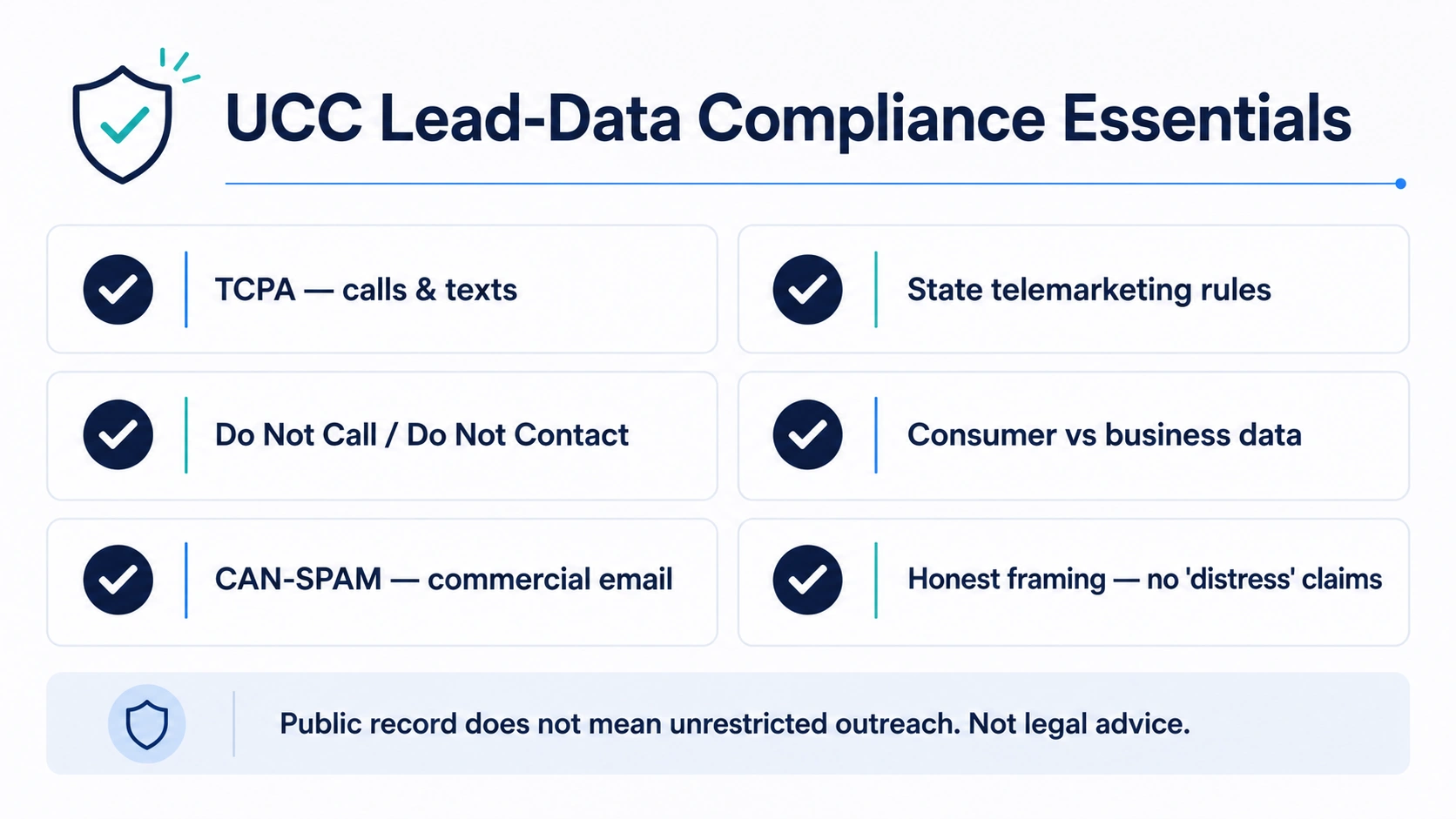
- Phone and text outreach. Calling and texting is regulated, including under the Telephone Consumer Protection Act (TCPA) and applicable Do Not Call rules. State telemarketing laws add further requirements, and some are stricter than federal rules.
- Email outreach. Commercial email is subject to the CAN-SPAM Act, which sets rules on accurate headers, honest subject lines, identification, and honoring opt-outs.
- State-specific rules. Telemarketing, consent, and data-use requirements vary by state, and the applicable rules can depend on where the recipient is located.
- Consumer versus business data. UCC filings on businesses are business records. However, filings involving individuals, such as sole proprietors, can blur the line. Be cautious about assuming business-data rules apply when an individual is involved.
- Framing. Do not present a UCC filing as evidence that a business is in financial trouble or in debt distress. A filing indicates a secured interest exists, nothing more. Messaging that implies distress can be misleading and damaging.
A specific note on credit-related rules: UCC filing data on businesses is generally not a “consumer report,” so the Fair Credit Reporting Act (FCRA) typically does not apply to ordinary marketing use. But if UCC data is combined with other information and used to make decisions about credit or similar eligibility, additional rules can come into play. Where financial decisioning is involved, get professional guidance.
Compliance rules change and vary by jurisdiction. The safe practice is to build outreach processes that honor opt-outs, respect Do Not Call and Do Not Contact requests, keep records of consent where required, and involve legal or compliance review before launching campaigns at scale.
How to Build a Lead List Using UCC Data
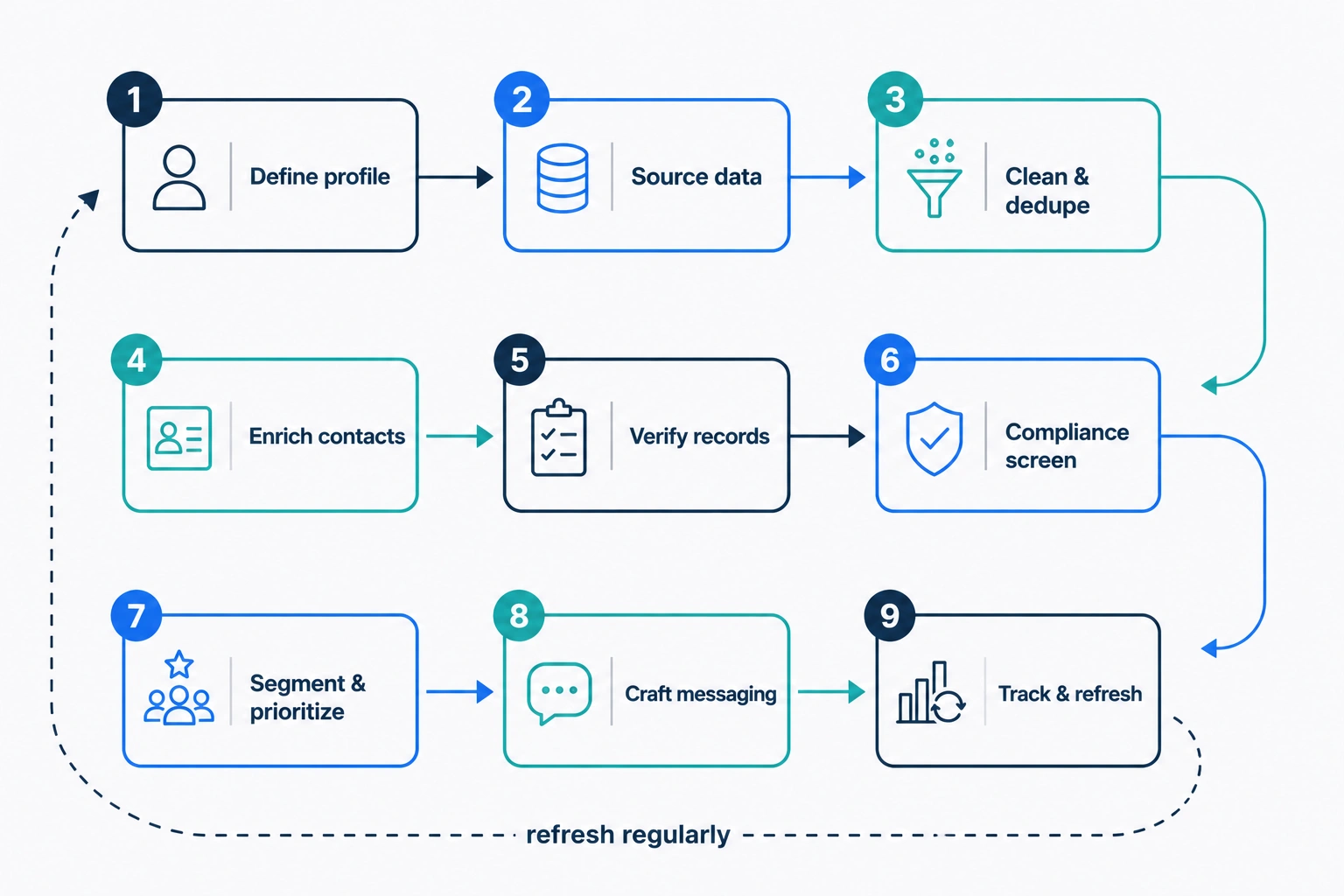
Here is a practical, step-by-step approach for turning UCC data into a usable, compliant lead list.
Step 1: Define your ideal filing profile. Decide what a good lead looks like in UCC terms. Which states? What collateral types? How recent should the filing be? Which secured parties are relevant or worth excluding? A clear profile keeps the list focused and prevents wasted spend.
Step 2: Source the data. Pull records from a commercial provider for scale, or from state portals for specific verification. Filter to your defined profile from the start rather than buying broad and cleaning later.
Step 3: Clean and deduplicate. Remove terminated, lapsed, and duplicate filings. Standardize business names so the same company is not counted multiple times. This step alone often improves list quality dramatically.
Step 4: Enrich with contact data. Filings rarely include direct contact details, so append verified phone numbers, emails, and decision-maker names. Use reputable enrichment sources and expect to verify a sample for accuracy.
Step 5: Verify high-value records. For your most promising leads, confirm the filing details against the authoritative state source. This protects you from acting on stale or mismatched data.
Step 6: Apply compliance screening. Scrub the list against Do Not Call and Do Not Contact records where applicable, confirm your outreach method fits the relevant rules, and document your process. Do this before the first contact, not after.
Step 7: Segment and prioritize. Group leads by signal strength and fit. Recent filings, relevant collateral, and strong firmographic match should rise to the top. Prioritize outreach accordingly.
Step 8: Craft relevant messaging. Reference the business activity in a respectful, accurate way. Focus on how you can help, not on assumptions about their finances. Relevance and restraint outperform volume.
Step 9: Track, measure, and refresh. Monitor response and conversion by segment, and refresh the data regularly. UCC data ages quickly as filings are added and terminated, so a stale list loses value fast.
Common Mistakes to Avoid
Most problems with UCC-based lead generation come from a handful of avoidable errors:
- Treating a filing as proof of distress. A UCC filing signals financing activity, not financial trouble. Messaging that assumes otherwise is inaccurate and off-putting.
- Ignoring name matching. Legal names differ from trade names. Poor matching links filings to the wrong companies and wastes outreach.
- Not filtering out terminated or lapsed filings. Acting on inactive records signals sloppy data and undercuts credibility.
- Skipping deduplication. The same business across multiple filings inflates counts and leads to repeat contact.
- Forgetting that filings lack contact details. Without enrichment, a UCC record is not an outreach-ready lead.
- Overlooking compliance. Ignoring TCPA, Do Not Call rules, CAN-SPAM, and state laws creates real legal risk regardless of how the data was obtained.
- Buying aged data and treating it as fresh. Older leads have often been contacted repeatedly. Know what you are buying.
- Over-contacting saturated markets. In spaces like MCA, aggressive volume tactics tend to backfire. Relevance wins.
- Relying on a single state. National campaigns need multi-state coverage, and some collateral is filed at the county level.
- Verifying nothing. Aggregated data should be treated as a lead, not a fact. Verify what matters before you act on it.
Avoiding these keeps campaigns efficient, credible, and defensible.
FAQs
1. What is UCC filing data? It is public record information from Uniform Commercial Code financing statements, which lenders file to claim an interest in a borrower’s assets. Each record names the borrower, the lender, the filing date, and the collateral.
2. Is UCC filing data public, and is it legal to use for lead generation? Yes, UCC filings are public records, and using public business data for prospecting is generally permissible. The outreach that follows, however, must comply with telemarketing, email, and privacy laws.
3. What does a UCC filing tell you about a business? It tells you the business recently entered a secured financing arrangement, who the lender is, when it happened, and what type of assets were pledged. It does not reveal loan amounts or financial health.
4. Does a UCC filing include the loan amount or contact details? Generally no. Financing statements are notices of a security interest, not loan contracts, so dollar figures and direct contact details are usually absent. Contact data must be appended separately.
5. How current is UCC filing data, and how often should you refresh it? Filings are added and terminated continuously, so data ages quickly. Refresh frequently, ideally on a regular schedule, and always remove terminated or lapsed records.
6. Who uses UCC data for sales leads? Equipment finance companies, business and working capital lenders, MCA providers and brokers, factoring firms, equipment vendors, and related business-services providers are among the most common users.
7. How much does UCC filing data cost? It varies widely. State searches are often free or low-cost per copy, while commercial providers charge by subscription, per record, or through bulk licensing. Fresh, enriched data costs more than aged data. Confirm current pricing with any provider.
8. What is the difference between a secured party and a debtor? The debtor is the borrower that pledged assets. The secured party is the lender or creditor holding a claim on those assets.
9. How long does a UCC filing stay active? A UCC-1 financing statement is typically effective for five years unless terminated earlier or continued before it lapses. A continuation extends it for another five-year term. Confirm the exact rule in the relevant state.
10. Can I search UCC filings for free? Often yes. Many states offer free or low-cost online UCC searches through the Secretary of State. Free searches suit individual lookups; large-scale list building usually calls for a commercial provider.
Conclusion
UCC filing data is a useful source of B2B intent, because it captures a real moment of business activity: a company financing its assets. For lenders, vendors, and service providers whose customers do exactly that, it offers a direct way to find and prioritize prospects showing recent, relevant behavior.
The value depends on using it honestly and carefully. A filing signals financing activity, not distress, and not everything you need to reach a decision-maker. Success comes from clean, current data, thoughtful enrichment, verification of what matters, and outreach that respects both the recipient and the law.
Handled that way, UCC data gives you a timing advantage. It helps you focus effort on businesses that are in motion, with messaging relevant enough to earn a response.
Because UCC procedures, provider offerings, and compliance rules vary by state and change over time, treat this guide as a practical foundation and confirm jurisdiction-specific requirements with qualified professionals before you act.

Team Newszii is composed of individuals with professional backgrounds in content writing. We specialize in writing on a variety of topics including Lifestyle, Entertainment, Humor, Women, Food, Travel, Technology, and Blockchain Technology. Our team is driven by a passion for creating unique, accurate, and engaging content.