Published on June 25th, 2026
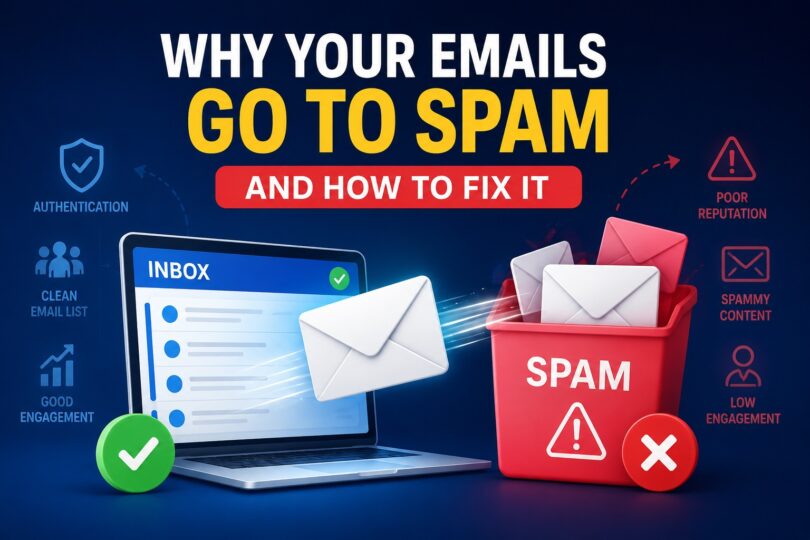
It takes effort to write an email. From a perfect offer to a sharp subject line, you covered everything sincerely and sent. And what happens? Your email lands in spam. No open, no click and no replies.
So disturbing, right? But let me tell you that it did not fail because of your email. The reason could be your email marketing strategy.
As of December 2024, almost 46.8% of all email traffic worldwide was spam. It states that almost one in two emails sent never reaches a real inbox because email providers filter them out.
So if we talk about small and medium-sized businesses that are building their online presence, it is highly important to know why emails land in spam and how we can fix it.
The good news? Most of the reasons your emails land in spam are completely fixable. You just need to know “How?”
What are the reasons your emails are landing in spam?
Take a look at why emails generally can land in spam instead of the inbox. Here we have discussed some solid reasons and also provided how to fix spam delivery.
If your Domain Is Not Authenticated
This is the single biggest reason most of the emails go to spam. Email providers like Gmail and Outlook continuously verify that the email sender is actually the one they are claiming to be.
They do this with three technical records, which are SPF, DKIM, and DMARC. Your domain settings publish these records, and they act like a digital ID for your emails.
If any of these are missing or set up incorrectly, Gmail treats that email as suspicious and moves it straight to spam. This is a major concern for businesses investing in email marketing in Bangalore, as poor email authentication can hurt campaign performance and reduce inbox placement.
Additionally, Gmail and Yahoo made SPF, DKIM, and DMARC mandatory for bulk senders in 2025. So, marketers need to be more aware of that.
How to Fix?
- You need to log in to your domain provider, like GoDaddy, BigRock, Hostinger, wherever you bought your domain and add the SPF, DKIM, and DMARC records.
- Your email provider gives you the exact records to copy and add to your domain.
- If you’re not sure the records are working, you can use any free tool to check your domain health instantly.
Read More: Google Beefing Up Gmail’s Security
When your Email List Is Not Clean
If your email list has dead or inactive customers from the past 60 to 90 days, this can ruin your sender reputation completely. When your emails bounce repeatedly, internet service providers start to consider you a spam sender.
In case there are too many bounces, your domain gets flagged. That is why you need to keep your spam complaints below 0.1%. Otherwise, you may end up on an email blacklist.
A dirty email list does not just hurt your open rates but actively disturbs your future performance in email marketing. Even the people who genuinely want to hear from you stop receiving your emails.
How to fix?
- You should clear your email list every 60 to 90 days.
- Remove hard bounces quickly.
- You can use a double opt-in process when people subscribe, so that you only collect real, valid emails.
- Also, you can segment your inactive subscribers and run a re-engagement campaign before removing them entirely.
Your content can also be the reason.
Spam filters do not just check your domain, but they also read your content. There are things in an email marketing strategy that you need to keep in mind while writing email content.
Some words, formats, and patterns raise red flags in an email campaign. For example, when you use “FREE!!”, ” Guaranteed, “Act now”, or “Limited time offer” in your subject line can trigger filters before anyone even opens your email. Along with that, all-caps subject lines and excessive exclamation can also be problematic.
Keep in mind that sending an email that has just one big banner image with no body text looks suspicious to filters. So, avoid this. When you send image-only emails, you are making another common mistake. The best emails have a balanced mix of text and images.
How to fix?
- You should write emails in the way that you are speaking to a customer in person.
- Make sure your subject lines are under 50 characters.
- Use your brand name in the ‘From’ field, for instance, “Lena from XYZ Company” performs more effectively than a generic no-reply address.
- Do not forget to include an unsubscribe link in the footer. Since 2024, Gmail has made it compulsory for all bulk senders.
Your Sending Behaviour can hurt email deliverability
This is another reason your email can land in spam. Your email sending patterns play a vital role in email marketing.
For example, if you go quiet for two to three months and then suddenly send 40,000 emails in one day, this shows a sudden spike in volume in your domain.
An email provider notices it. If there is no recent activity, then this spike in emails is a classic sign of spam behaviour. The same applies if you are sending from a brand-new domain. You need to warm it up gradually before sending it in bulk.
How to fix?
- Make a consistent sending schedule first.
- If you are new to bulk email, start with small batches and increase volume gradually over a few weeks.
- It’s like building a credit score. You need a track record of good behaviour before the system trusts you with large sends.
You Are Not Tracking Where Your Emails Actually Land
Even if your dashboard might say “delivered”, your email could still be sitting in the spam folder. Delivery and Deliverability are two different things. Delivery means your email reached the recipient’s server.
We use Deliverability when the email lands in the inbox. You can have 100% delivery and still have 30% of those emails going to spam.
This is why your choice of email marketing platform is very important. You should select an email marketing platform that has a strong infrastructure, like one that manages IP reputation, handles authentication records, and gives you real visibility into bounce rates and engagement.
Tools like TrueSend offer Deliverability as its core feature. For businesses building a serious email marketing strategy, whether that is email marketing in Bangalore, email marketing in Pune, or managing campaigns across multiple markets, the platform you send from is as important as the content you send.
How to fix?
- You can use Google Postmaster Tools to monitor your domain reputation for free.
- Keep on tracking your open rates through the email provider.
- A sudden drop in Gmail opens while Yahoo stays steady is usually a Gmail-specific deliverability issue. You need to pay immediate attention.
When Engagement Rates Are Too Low
Your email might land in spam due to this specific reason. If your subscribers regularly ignore your email, like not opening, deleting without reading or sending them to the trash, Gmail considers it a signal that the receiver does not want emails from you anymore.
But the worst thing is – it may start routing your emails to spam for everyone on your list, even for those who are waiting for your emails, not just for those cold or inactive subscribers.
Low engagement is both a reason and an effect of poor Deliverability. It creates a cycle that is hard to break once it starts.
How to fix?
- Always use segmentation and send only relevant content to smaller groups.
- A targeted email to 500 people who actually care is more effective than sending a blast to 5,000 who do not.
- Personalise your emails. If you use a subscriber’s first name in the subject line, even this simple move can improve open rates by up to 26%.
- Remove the audience who has not opened a single email in 90 days. They will affect your entire email list.
Read more: How To Add Emoji Reactions In Gmail
Fixing needs to follow an Order, Not All at once
Most businesses try to fix their Deliverability by rewriting their subject lines. But that is the last thing to fix, not the first.
The correct order to fix spam landing is:
Start with authentication > clean your list > fix your content> address your sending patterns > Then track your results.
Email is the top channel that delivers one of the highest ROI in digital marketing. Research consistently shows that its returns are around $42 for every $1 spent. But you get that ROI only when your emails actually reach people.
A solid email marketing strategy is not just about what you write. It is about making sure what you write is actually relevant to your audience and being read.
The businesses seeing real results and managing campaigns across multiple markets treat Deliverability as a foundation, not an afterthought. Get the infrastructure right first, and you will see the results follow.