
Published on July 23rd, 2026
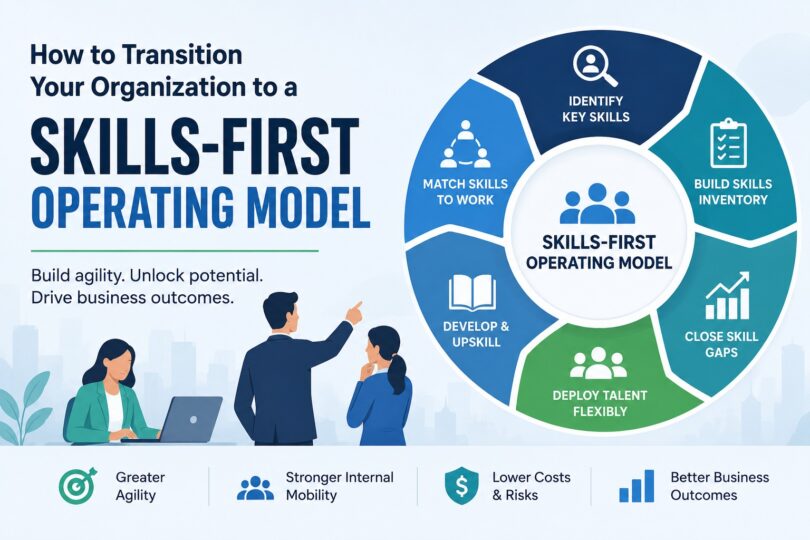
Moving from a job-based system to a skills-based one upends many traditional practices by changing the unit of work from a job to an assignment. Changing how work gets done naturally leads to changing how you define who is available to do that work.
Why the Job Description is Killing Your Agility
Most companies today still rely on a traditional job-led model which is based on job titles. Basically, you create a new role, a role comes with specific requirements, associated tasks, and responsibilities, and an employee is hired to fulfill those tasks until they decide to quit or are promoted to a different position.
This framework has been successful in the past when work was stable enough to outline all requirements beforehand. However, when business goals and strategies are changing every quarter, things get more complicated.
The issue with this approach isn’t that job titles are wrong. They’re just misused to describe capability.
When a manager is searching for a person with skills in contract analysis and risk modeling, they will request a “Senior Legal Analyst” instead of inquiring where they can find employees with experience in contract analysis and risk modeling, regardless of their job title.
This approach creates bottlenecks for skills, prevents employees from switching roles, and results in unnecessary recruitment expenses.
An alternative model, where work is prioritized before titles, operates differently. Instead of a full-time position that you hire for, you define a set of key capabilities required for achieving your business goals.
Then, you staff your projects based on the available skills and competencies within your workforce, rather than looking at who sits in a particular box in the organizational structure chart.
The Business Case Isn’t Philosophical, It’s Operational
Businesses that successfully implement these changes are not doing so because it represents the most cutting-edge HR approach. They are doing it because managing a workforce based on capabilities actually decreases costs and risks.
When a competitor emerges, technology changes, or the supply chain is interrupted, businesses that are aware of the exact skills they have on hand can easily reallocate their talent.
Businesses that are not in the know must decide between costly external hiring or working with limited staff until they can come up with a solution. Neither option is ideal.
And this is not just talk. Statistics show that businesses that prioritize skills are 57% more likely to be prepared for and respond to changes, and they are 98% more likely to retain their high-performing employees when compared to their counterparts (Deloitte). These are not human resources statistics. They are the results of operational and financial outcomes.
Audit What You Actually Have
First, you must establish a baseline before you can determine gaps. A skills inventory is not a one-time survey that you send to everyone.
It is a multi-source data collection that combines verified self-assessments, manager evaluations, and performance history.
Self-assessments are necessary but insufficient because people tend to overestimate how good they are.
They underrate skills they actively use without giving them much thought and overrate the ones they feel confident about.
Manager evaluations help to counterbalance some of the bias in one direction, but they introduce new biases.
The most reliable inventories cross-reference a variety of data sources, including how well projects turned out, records of who went through which credentials, and how many micro-credentials have been earned through company-sponsored learning programs.
Micro-credentials and digital badges become increasingly important in this phase because they are a form of verified evidence and not just self-reported experience.
Someone who has earned a certificate in data visualization has made their ability evident in a verifiable manner. That’s more actionable than a resume item that says “familiar with project management.”
When you are looking at the capabilities of an entire organization, this cannot be done by hand.
Large organizations with hundreds or thousands of employees need dedicated technology to update pooled capabilities, endorsements, and credentials across the entire workforce.
That’s why many workforce management teams are evaluating the best skills intelligence platforms to automate skills taxonomy creation, integrate with existing HR tech stacks, and generate real-time gap analysis rather than relying on quarterly spreadsheet updates.
Build Your Skills Taxonomy Before Anything Else
You can’t manage what you can’t measure. A skills taxonomy involves the organized, standardized categorization of particular abilities, behavior attributes, and knowledge components throughout the whole enterprise.
In the absence of that, individuals will apply different terminology to describe the identical skills, rendering it impossible to match those skills, plan, and monitor them.
The spreadsheet pit is a genuine obstacle. Most businesses that try to develop this sort of taxonomy initially compile an expertise master list utilizing Excel.
Within half a year, it’s out of date, inconsistently modified, and essentially useless. Skills taxonomies have to be living documents that update whenever new systems show up, as job demands alter, and as your business plan transforms.
A practical skills taxonomy consists of three tiers. The initial one is the skill on its own, explained with adequate clarity for two different supervisors to assess it in an identical manner.
The next one is the proficiency scale, demonstrating what the terms “basic,” “intermediate,” and “advanced” truly signify in real scenarios.
The third one is the skills ontology: how skills relate to each other, which ones are prerequisites for others, and which skills cluster together in ways that predict performance on specific types of work.
Achieving this requires input from management, not merely HR. The individuals who genuinely assign the work understand which abilities matter and which ones are pure jargon on a resume.
Rebuild Hiring Around Capabilities, Not Credentials
Once you’ve got your skills framework internally, you need to ensure that the way you approach external hiring is consistent with it. And that starts with how you write job postings.
Most job postings today are still based on your legacy job architecture: unnecessary degree requirements that don’t actually drive performance, years-of-experience filters that needlessly exclude qualified candidates, role titles that focus on where someone has been rather than what they’ve done or can do.
To revise job postings for a skills-first model, you first have to be specific about the work, not the role.
What are the issues or problems this role needs to address or solve? What are the specific skills required to solve them? What level of proficiency is actually necessary upon arrival as opposed to what could easily be gained in three to six months?
You also need to integrate practical skills assessments into your interview process. These are not generic aptitude tests but rather role-specific (very important) and job-sample exercises that offer you hard evidence about the capabilities that genuinely correlate to success.
Enable Internal Mobility Through Project-Based Work
A skills-first operating model puts in place an internal talent marketplace: an environment where you can place people on cross-department, cross-functional projects based on the skills and the aspirations they have, rather than having them locked in their team forever.
Some firms achieve this by allowing employees to dedicate a percentage of their time, often 10 to 20 percent, to projects outside their primary role. Those projects are matched to the employee’s existing skills and the capabilities they’re trying to build.
The result is dynamic teaming: cross-functional groups assembled for specific objectives, staffed by people whose skill profiles match the project’s requirements.
What value does this add? You can staff projects faster. People are more engaged because they are doing work that is varied and important but also connected to their development goals. And you build cross-functional know-how that doesn’t disappear when someone changes roles.
This is much easier said than done, right? The line manager is normally used to holding on to their people.
There’s a scarcity mindset where you try to keep the talent you currently have. You have to unravel that cultural trait and actively incentivize the behaviors you’re trying to foster.
One practical approach: make “skills development of direct reports” an explicit metric in manager performance reviews. If growing people’s capabilities is part of how a manager gets evaluated, the incentive structure changes.
Connect Learning to Real Gaps, Not Generic Libraries
Most learning and development programs are pre-packaged, pre-purchased offerings that are budgeted for and administered based on an employee’s role or job title.
The skills-first approach demands that we start viewing every learning and talent development experience as a unique set of interventions, optimized for the individual but also programmed to work in the aggregate (after all, most important skills are required by many employees).
The reality is, a vendor’s content library or a MOOC platform’s course catalog is comprised of a still-effective, but increasingly last-century, set of offerings, and the way they are designed and marketed is miles away from the kind of learning that can actually help your business gain a competence it currently lacks or lose one you no longer need.
That kind of learning must be designed backward from the competencies and skills where your workforce has a strategic gap.
If your competitors are gaining an edge by getting similar capabilities into their organization faster than you are, then the first question you should ask about your next potential L&D investment is “how is this going to close that gap?” and not “what’s in the catalog?”
Measuring Whether it’s Working
Changes as important as a move to a skills-first workforce require specific, measurable goals from the outset, or they risk losing momentum.
When you’re making the shift, and looking to track your progress, the most important key performance indicators aren’t about what you put in to the system (hours of training, number of skills added, etc.). They’re about what you get out of it.
Time-to-fill on internal roles is one of the most tangible measures: Are roles being filled more quickly by existing employees than they were when you posted them externally? If the internal mobility function is working, the answer should be yes.
So, too, should be the answer to the question “Are your top performers sticking around?” When your employees can see a clear route to growth and advancement without jumping ship, they’re less likely to leave.
It’s a bit tougher to measure speed-to-market, but not impossible, and the organizations that are making real change at this level have found that the business gains associated with being able to quickly staff a new project or a new product line are easily calculated.
So where to start? Somewhere small, maybe even as small as a single business unit.
Pick a high-performing internal team, a function you know you don’t have all the talent you need to support, but a team that operates more or less in a project-based structure. Run a tech-driven skills inventory. Test your internal mobility process.
Most importantly, take the time to measure what’s happening. Are you filling roles more quickly than before? Are employees satisfied with the process? Do they feel challenged and engaged?


