Published on July 27th, 2026
Cybersecurity has become one of the most sought-after career fields as organizations across industries invest heavily in protecting their digital assets.
With cyberattacks growing in both frequency and sophistication, ethical hackers are playing a critical role in identifying vulnerabilities before malicious actors can exploit them.
For aspiring cybersecurity professionals, learning ethical hacking is an excellent way to build practical skills in penetration testing, vulnerability assessment, network security, and incident response. However, with hundreds of online courses available, choosing the right program can be overwhelming.
To help you make an informed decision, we’ve compiled six of the best ethical hacking courses that offer a combination of comprehensive curriculum, hands-on labs, real-world projects, and industry-recognized certifications.
What Skills Will You Learn?
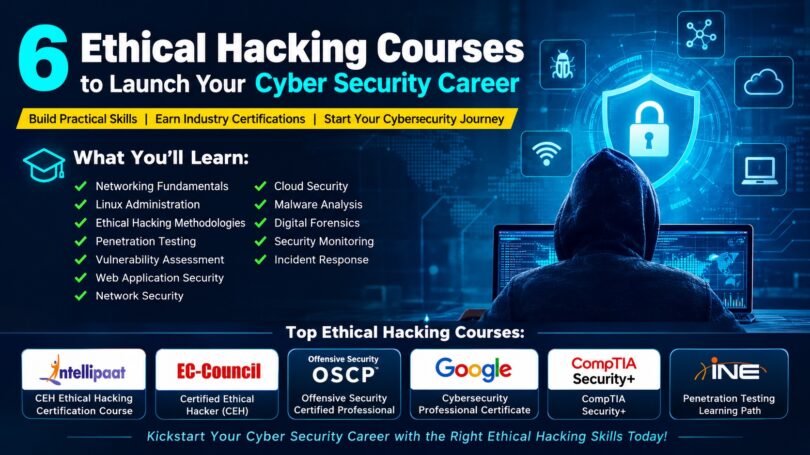
A quality ethical hacking course should help you develop expertise in:
- Networking fundamentals
- Linux administration
- Ethical hacking methodologies
- Penetration testing
- Vulnerability assessment
- Web application security
- Network security
- Cloud security
- Malware analysis
- Digital forensics
- Security monitoring
- Incident response
These practical skills are essential for building a successful cybersecurity career.
1. Intellipaat CEH Ethical Hacking Certification Course
The Intellipaat Ethical Hacking Course is an EC-Council Accredited program designed for aspiring ethical hackers, cybersecurity professionals, and IT practitioners who want to develop practical offensive security skills.
The curriculum follows the latest CEH v13 framework and covers networking fundamentals, footprinting and reconnaissance, network scanning, vulnerability analysis, system hacking, malware threats, social engineering, web application security, wireless security, cloud security, cryptography, and penetration testing. Learners also receive official preparation for the EC-Council Certified Ethical Hacker (CEH) certification exam.
The course combines 40 hours of live instructor-led training, self-paced learning modules, 15+ real-world projects, and lifetime access to VMware-based virtual labs, enabling learners to practice ethical hacking techniques in controlled environments.
Training is delivered by EC-Council Certified Instructors and experienced cybersecurity professionals, with additional benefits including one-on-one mentorship, career guidance, and dedicated learner support.
Upon successful completion, participants receive an EC-Council CEH certificate, helping them validate their ethical hacking skills for roles in penetration testing, vulnerability assessment, and cybersecurity operations.
Best For: Beginners, IT professionals, network administrators, security analysts, and individuals preparing for the EC-Council Certified Ethical Hacker (CEH) certification.
2. EC-Council Certified Ethical Hacker (CEH)
The Certified Ethical Hacker (CEH) certification remains one of the most recognized credentials in offensive cybersecurity. It introduces learners to ethical hacking methodologies, reconnaissance, vulnerability assessment, malware threats, web application security, wireless security, cryptography, and penetration testing.
Most official training providers include practical labs that allow learners to apply hacking techniques in controlled environments.
Best For: Professionals pursuing ethical hacking and penetration testing careers.
3. Offensive Security Certified Professional (OSCP)
The OSCP certification is known for its rigorous, hands-on approach to penetration testing. Rather than relying on multiple-choice examinations, learners must demonstrate their ability to identify vulnerabilities and exploit systems within dedicated lab environments.
The certification is widely respected among organizations hiring penetration testers and Red Team professionals.
Best For: Intermediate and advanced cybersecurity professionals.
4. Google Cybersecurity Professional Certificate
Google’s professional certificate provides a strong introduction to cybersecurity fundamentals, networking, Linux, Python, SQL, threat detection, security operations, and incident response.
Although the program focuses more on defensive security than offensive security, it provides an excellent foundation before progressing to specialized ethical hacking certifications.
Best For: Career changers and beginners.
5. CompTIA Security+
CompTIA Security+ is a globally recognized vendor-neutral certification that covers network security, identity management, cloud security, cryptography, compliance, and risk management.
It serves as an excellent entry point into cybersecurity and prepares learners for more advanced ethical hacking certifications.
Best For: Entry-level cybersecurity professionals.
6. INE Penetration Testing Learning Path
INE offers one of the most comprehensive penetration testing learning paths available online. The platform covers reconnaissance, exploit development, Active Directory attacks, privilege escalation, web application testing, post-exploitation, and advanced penetration testing techniques.
Its interactive labs provide learners with extensive hands-on practice using industry-standard offensive security tools.
Best For: Learners preparing for penetration testing and offensive security roles.
Comparison at a Glance
| Course | Level | Practical Labs | Ideal For |
| Intellipaat CEH Ethical Hacking Certification Course | Beginner–Intermediate | ✔ Moderate | Beginners & Working Professionals |
| EC-Council CEH | Intermediate | ✔ | Ethical Hackers |
| OSCP | Advanced | ✔ Intensive | Penetration Testers |
| Google Cybersecurity Professional Certificate | Beginner | ✔ | Career Changers |
| CompTIA Security+ | Beginner | ✔ | Entry-Level Professionals |
| INE Penetration Testing | Intermediate–Advanced | ✔ Extensive | Offensive Security Professionals |
Career Opportunities
After completing an ethical hacking course, you may qualify for roles such as:
- Ethical Hacker
- Penetration Tester
- Cybersecurity Analyst
- Security Operations Center (SOC) Analyst
- Vulnerability Assessment Analyst
- Information Security Analyst
- Security Consultant
- Network Security Engineer
As your experience grows, you can advance into specialized roles such as Red Team Operator, Security Architect, or Cybersecurity Consultant.
Frequently Asked Questions
1. Which ethical hacking course is best for beginners?
Programs such as the Intellipaat Ceh Ethical Hacking course certification, Google Cybersecurity Professional Certificate, and CompTIA Security+ provide an excellent starting point for beginners.
2. Do I need programming knowledge before learning ethical hacking?
No. Most beginner-friendly programs begin with networking, operating systems, and cybersecurity fundamentals before introducing scripting and penetration testing concepts.
3. Which certification is most recognized for ethical hacking?
The Certified Ethical Hacker (CEH) and Offensive Security Certified Professional (OSCP) are among the most respected certifications in the cybersecurity industry.
4. Is practical experience important in ethical hacking?
Absolutely. Hands-on labs, virtual environments, and real-world projects are essential for developing the technical skills required in professional ethical hacking roles.
5. Can I learn ethical hacking online?
Yes. Many leading training providers now offer live online classes, practical labs, industry projects, mentorship, and career support, making it possible to develop job-ready skills remotely.
Final Thoughts
Ethical hacking is an exciting and rewarding career path for professionals interested in cybersecurity, problem-solving, and technology.
Choosing the right course can help you develop practical skills, earn valuable certifications, and prepare for real-world security challenges.
Before enrolling, compare each course’s curriculum, practical learning opportunities, certification value, and career services to choose the program that best aligns with your long-term goals in cybersecurity.