Published on March 30th, 2026
Something significant has shifted in the digital services economy. The tools that once required six-figure developer salaries or full agency teams can now be directed by a single person with an internet connection and the right AI tools. Businesses are drowning in tasks they know AI could help with, but most of them have no idea where to start. That gap, between businesses that need AI-powered work done and the small group of people who actually know how to do it, is one of the biggest earning opportunities to emerge in years.
This is not a guide about passive income fantasies or overnight success. It is a practical breakdown of the specific service categories that are generating real revenue today, how to price them, which tools to use, and what the market actually pays. Whether the goal is to replace a job, build a side income of a few thousand dollars a month, or eventually scale into a full agency model, the framework covered here applies at every level.
The underlying principle is straightforward. Businesses do not want to learn new tools. They want outcomes delivered to them. The person who learns the tool, packages the outcome, and sells it clearly and confidently is the one who earns. That principle has worked through every technology wave, from web design in the early 2000s to social media management in the 2010s. With AI, the delivery is simply faster and the margins are higher.
The services covered below are grounded in current market data, real pricing benchmarks from platforms like Upwork and Fiverr, and the genuine demand patterns emerging across small and mid-sized businesses in 2026. Each section includes a recommended pricing range, the tools involved, a key takeaway summary, and a comparison table where relevant.
Part One: Understanding the Opportunity
Why Businesses Are Paying for AI Implementation Right Now
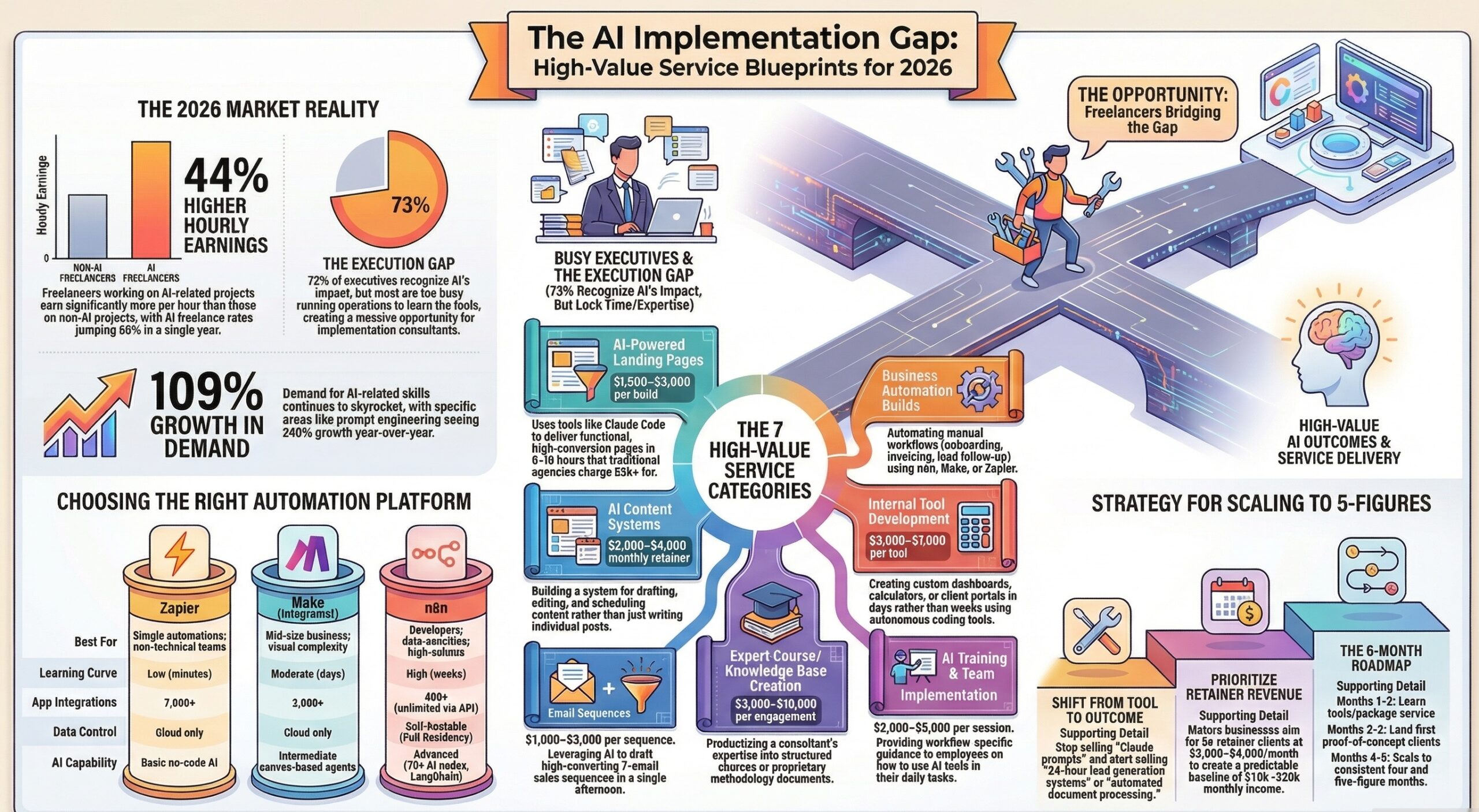
The demand for AI implementation services has outpaced the supply of people who know how to provide them. According to a widely cited 2024 Harvard Business Review survey, 73 percent of executives believe generative AI will significantly impact their businesses within two years, yet only a small fraction have a concrete implementation plan. That gap is not closing quickly. Most business owners are too busy running their operations to invest weeks learning new toolsets.
This creates a repeatable sales motion. A consultant, freelancer, or small agency that can walk into a business, identify where AI can save time or generate revenue, and then implement those changes immediately becomes invaluable. The value is not the knowledge of Claude or n8n in isolation. The value is the combination of knowing what the tool can do and knowing how to apply it to a specific business context.
The earnings data supports this. Upwork’s 2025 annual report showed that freelancers working on AI-related projects earn 44 percent more per hour than those on non-AI projects. AI freelance rates on the platform jumped 60 percent in a single year. The categories showing the strongest demand include AI workflow automation, prompt engineering, AI training and implementation, and internal tool development. These are not the kinds of services that AI itself is replacing. They require human judgment, client communication, and an understanding of business processes that goes well beyond generating text.
The important caveat is that the tool does not make the money. Business execution does. Freelancers who understand this, who pick a service, learn to deliver it consistently, and then market it through content and outreach, are the ones reaching four and five figures per month. Those who treat these tools as magic shortcuts typically earn very little. The opportunity is real, but it requires the same fundamentals as any services business: clear positioning, a trackable delivery process, and a consistent pipeline of potential clients.
Part Two: The Seven Service Categories That Convert
Service 1: AI-Powered Landing Pages and Conversion Funnels
Recommended Pricing: $1,500 to $3,000 per page, with optional maintenance retainer
Target Clients: Local businesses, e-commerce stores, coaches, consultants, SaaS founders
Businesses know they need a strong web presence, but most of them do not have the time, technical skill, or budget to hire a traditional development agency. A well-prompted session with Claude Code can produce a full, functional landing page in hours, including layout logic, conversion copy, and responsive design. The gap between what Claude Code outputs and what businesses typically pay for is enormous. Traditional agencies charge $5,000 to $20,000 for comparable work with much longer timelines.
The service to package here is not the Claude Code session. The service is the outcome: a page designed to convert visitors into leads or customers. The person offering this service needs to understand basic conversion principles, know how to prompt Claude Code to produce clean HTML and CSS, and have enough design sensibility to refine the output into something polished. None of these require a computer science degree. Many successful providers in this category come from marketing, copywriting, or sales backgrounds.
The workflow looks like this: gather client information about their target customer, their offer, and any existing branding assets; prompt Claude Code to produce the initial page structure; refine the copy and layout; deliver via a simple hosting setup. From start to finish, an experienced operator can complete a standard landing page in six to ten hours. At $2,000 per page, that is an effective hourly rate of $200 to $330 before expenses.
Scaling this service requires building a small library of prompting frameworks for different business types, which allows faster turnaround across multiple clients. Adding a monthly maintenance retainer of $300 to $500 keeps revenue predictable and clients engaged over time.
Key Takeaways:
- Claude Code can produce functional, professional landing pages from structured prompts, dramatically reducing delivery time compared to traditional development
- Package the outcome (a converting page), not the tool (Claude Code)
- Standard pricing ranges from $1,500 to $3,000 per build, with experienced operators completing projects in under ten hours
- Monthly maintenance retainers of $300 to $500 help create predictable recurring revenue alongside project income
Service 2: Business Automation Builds Using n8n, Make, and Zapier
Recommended Pricing: $2,000 to $5,000 per build, plus $500 to $1,500/month retainer for maintenance
Target Clients: Service businesses, real estate agencies, healthcare practices, e-commerce operations, marketing teams
Every business with more than five employees has workflows they repeat manually every single day. Client onboarding that requires the same sequence of emails, lead follow-up that depends on someone remembering to check a spreadsheet, invoice chasing that falls to whoever has time, and reporting that takes an hour every Friday that nobody wants to do. These are the entry points for automation services.
Claude helps an automation consultant map the logic of a workflow quickly. Feed it a description of the manual process and ask it to identify the steps, the conditional logic, and the potential failure points. Then use one of the three leading automation platforms, n8n, Make, or Zapier, to build the actual workflow. The combination of Claude for logic and a visual automation builder for implementation is significantly faster than either alone.
Choosing the right platform for a given client matters for the long-term health of the engagement. The table below summarizes the key differences across the three main options.
Automation Platform Comparison Table
| Feature | Zapier | Make (Integromat) | n8n |
|---|---|---|---|
| Best For | Non-technical teams, simple automations | Visual complexity, mid-size business | Developers, data-sensitive, high-volume |
| Learning Curve | Low (minutes to first workflow) | Moderate (days) | High (weeks for full mastery) |
| App Integrations | 7,000+ | 2,000+ | 400+ native (unlimited via API) |
| AI Capabilities | Basic AI steps, no-code AI | Intermediate, canvas-based AI agents | Advanced: 70+ AI nodes, LangChain, self-hosted LLMs |
| Pricing Model | Per task (gets expensive at scale) | Per operation (more affordable mid-scale) | Free self-hosted, ~20 EUR/month cloud |
| Data Control | Cloud only | Cloud only | Self-hostable, full data residency |
| Best Client Fit | Marketing agencies, small businesses | Growing SMBs with complex needs | Technical teams, regulated industries |
| Freelancer ROI | Fast to deliver, higher per-build cost | Good balance of speed and capability | Cheapest for complex builds, steeper setup |
For most freelance automation consultants starting out, Zapier and Make offer the fastest path to client delivery. Zapier’s integration library is the widest available, covering over 7,000 applications, which means clients are unlikely to have tools that cannot connect. Make offers deeper workflow logic for the same budget.
For clients in healthcare, finance, or legal services where data residency matters, n8n becomes the right recommendation despite its steeper learning curve. The ability to self-host means automation workflows never route sensitive data through third-party servers, which addresses compliance concerns directly.
The pricing for automation builds should be anchored to business outcomes, not hours. If a workflow saves a team member 15 hours per month, and that team member bills at $50 per hour, the automation is worth $750 per month in recovered time. Charging $3,000 to build it represents a four-month payback for the client, which is an easy sale.
Key Takeaways:
- Every business has multiple repeatable manual workflows that can be automated with Zapier, Make, or n8n
- Zapier suits non-technical clients and fast delivery; Make balances complexity and cost; n8n suits technical teams and data-sensitive industries
- Anchor pricing to business value, not hours: a $3,000 automation that saves a client $750 per month pays for itself in four months
- Monthly maintenance retainers for monitoring, updates, and adjustments convert one-time projects into recurring income
Service 3: AI Content Systems and Social Media Management
Recommended Pricing: $2,000 to $4,000 per month retainer
Target Clients: Service businesses, e-commerce brands, B2B companies, coaches, consultants
Most businesses know content marketing drives leads. Most of them do not post consistently because the process feels overwhelming. A freelancer or small agency that builds a content system, rather than just writing posts, solves a structural problem rather than a surface one.
The system works like this. Claude drafts content based on the client’s voice, offer, and target audience. The freelancer edits for quality, brand alignment, and strategic relevance. The client reviews and approves. Everything schedules automatically through a tool like Buffer, Hypefury, or Metricool. What used to require a part-time content manager can now be managed across multiple clients simultaneously by a single operator.
The key to this service being profitable is building a repeatable briefing process. The quality of AI-generated content is directly proportional to the quality of the input it receives. A detailed brief that covers the client’s ideal customer profile, core offer, common objections, preferred tone, and platform-specific requirements produces output that requires minimal editing. Without this brief, editing time balloons and margins collapse.
At a $3,000 monthly retainer, a freelancer managing four clients generates $12,000 per month. With a dialed-in system, managing five or six clients becomes feasible, pushing monthly revenue to $15,000 to $18,000 without adding staff. This is one of the most scalable of the seven services because the core of the delivery, the content production, is AI-assisted from the start.
Key Takeaways:
- Build a content system (drafting, editing, scheduling, approval) rather than just writing individual posts
- A detailed client brief dramatically reduces editing time and protects margins
- Managing four to five clients at $2,000 to $4,000 per month produces $8,000 to $20,000 in recurring monthly revenue
- Scalability comes from the system, not from working more hours
Service 4: Internal Tool Builds for Small Businesses
Recommended Pricing: $3,000 to $7,000 per tool, occasionally higher for complex builds
Target Clients: Local service businesses, professional services firms, real estate teams, healthcare practices
This is arguably the most underpriced opportunity in the list. Small businesses regularly need simple internal tools that a traditional agency would charge $10,000 to $30,000 to build: a client intake form connected to a CRM, a job cost calculator for a contractor, a dashboard that pulls numbers from multiple sources into one view, a portal where clients can access their documents and project status. Claude Code can build functional versions of all of these in a matter of hours.
The person offering this service does not need to be a developer. They need to understand what the client needs well enough to describe it precisely to Claude Code, and they need enough technical literacy to test the output and handle minor adjustments. Claude Code, according to its development team, can operate autonomously for extended sessions, producing hundreds of code files to build complete, deployable applications from a single detailed prompt. The gap between that capability and what most small businesses have access to through traditional channels is enormous.
The pitch for this service is straightforward. A local law firm paying a paralegal to manually compile weekly reports could replace that task with a dashboard tool. A plumbing company with no system for managing job quotes could gain a basic estimating calculator. A fitness studio that manually tracks membership renewals could have an automated notification system. None of these are technically complex by developer standards, but all of them represent meaningful operational improvements that business owners will pay for.
Delivery in days rather than weeks or months is a genuine competitive advantage. Traditional development projects stretch across timelines that make small business owners hesitant to engage. Presenting a working prototype within 48 hours of intake changes the dynamic entirely.
Key Takeaways:
- Small businesses need simple tools (calculators, dashboards, intake forms, portals) that traditional agencies charge $10,000+ to build
- Claude Code produces functional tools in hours, creating significant margin for the consultant even at lower price points
- Technical literacy, not a developer background, is the entry requirement
- Delivering working prototypes within 48 hours is a genuine differentiator against traditional development firms
Service 5: Email Sequences and Sales Copy
Recommended Pricing: $1,000 to $3,000 per sequence or campaign
Target Clients: Course creators, coaches, e-commerce founders, SaaS companies, B2B service businesses
AI produces excellent email copy when given precise inputs. The inputs that matter most are: a clear picture of the ideal customer profile (who they are, what they want, what stops them from buying), the specific offer being made, the primary objections the audience typically raises, the tone and voice the brand uses, and the specific action each email should drive.
The freelancer who understands how to construct this brief and interpret the output through a strong commercial lens is the one who earns at the high end of this service. Pure AI output without human editorial judgment is usually too generic to convert well. The combination of AI speed and human commercial thinking is what clients are actually paying for.
A seven-email welcome and sales sequence typically takes one focused afternoon to produce at a high quality level: one hour of client discovery and briefing, two to three hours of prompting and generation, one to two hours of editing and refinement. At $2,000 per sequence, that represents an effective rate of $250 to $400 per hour. Stacking four or five sequence clients in a month, which is entirely feasible, produces a strong full-time income.
Upsell opportunities include monthly newsletter writing, ad copy, and ongoing email calendar management as a retainer.
Key Takeaways:
- Email copy quality depends heavily on the quality of the brief given to the AI; human judgment and commercial literacy are the differentiating factors
- A seven-email sequence can be completed in a single afternoon at a high quality level with the right process
- Pricing from $1,000 to $3,000 per sequence is supported by current market rates
- Retainer upsells for ongoing email management create recurring income from single-project clients
Service 6: Course and Knowledge Base Creation for Experts
Recommended Pricing: $3,000 to $10,000 per engagement
Target Clients: Business consultants, executive coaches, professional service providers, subject matter experts, corporate trainers
Coaches and consultants accumulate years of expertise that never gets organized into a scalable format. They repeat the same frameworks in client calls, reference the same case studies, and deliver the same explanations over and over. AI makes it economically viable to productize that knowledge into a structured course, a comprehensive knowledge base, or a proprietary methodology document, without the expert having to spend weeks in front of a screen writing it themselves.
The freelancer’s role is to extract the expertise through structured conversation, feed it into Claude with the right formatting and organizational prompts, and deliver a polished product. This typically involves an initial interview session with the expert, a structured outline review, module-by-module content generation, and a final editorial pass. Claude handles the structural organization and prose drafting; the freelancer handles the extraction, quality control, and delivery.
The pricing range for this service is wide because the deliverable varies significantly. A single online course module with five lessons and a workbook might sit at the $3,000 to $5,000 range. A complete six-module signature program with supplementary resources, a comprehensive knowledge base, and a facilitation guide for live workshops could reach $8,000 to $10,000 or more. Both are legitimate services with clear client demand.
The strongest market for this service is business-to-business consultants who already know they need to productize their methodology but have been unable to prioritize the project. Their time is genuinely scarce and the cost of building this themselves is high.
Key Takeaways:
- Coaches and consultants have valuable expertise that AI can help structure into scalable products when given through proper extraction and briefing processes
- The freelancer adds value through knowledge extraction, quality control, and editorial judgment, not just AI prompting
- Pricing from $3,000 to $10,000 is supported by the clear business value of productizing expert knowledge
- B2B consultants with scarce time are the strongest buyer profile for this service
Service 7: AI Training and Implementation for Business Teams
Recommended Pricing: $2,000 to $5,000 for training sessions; $2,000 to $8,000 per month for implementation retainers
Target Clients: Professional service firms, marketing agencies, HR departments, operations teams, SMB leadership teams
This is the service with the lowest competition and the highest perceived value in the current market. Walking into a business and helping their team actually use Claude, ChatGPT, and automation tools in their real daily workflows is a service that very few people are delivering systematically. Most AI coverage is either too theoretical (conference keynotes, thought leadership articles) or too technical (developer documentation, GitHub repositories). There is a massive underserved middle: the practical, workflow-specific guidance that regular employees can act on immediately.
An AI training engagement typically begins with an audit phase. The consultant reviews the team’s existing workflows, identifies three to five high-impact areas where AI tools can reduce time or improve output quality, and designs a training session around those specific use cases. Generic “here is how ChatGPT works” trainings are becoming commoditized. Context-specific training, showing a law firm’s paralegals how to use Claude for contract review, or helping a marketing team build a prompt library for campaign briefs, commands significantly higher rates and delivers significantly better results.
The retainer component comes from ongoing implementation support. After training, teams have questions. Workflows change. New tools emerge. A monthly retainer that makes the consultant available for a set number of hours of async support or a monthly check-in call creates a service relationship that is valuable to the client and highly efficient for the consultant to maintain.
According to current market data, AI workflow automation consulting commands $75 to $200 per hour, while AI training workshops run $2,000 to $5,000 for half-day sessions. Monthly retainer support for AI implementation ranges from $5,000 to $15,000 at the enterprise level, with small business retainers typically falling between $1,000 and $3,000 per month.
Key Takeaways:
- Context-specific AI training for real business workflows is dramatically more valuable than generic tool introductions
- The audit phase, identifying specific high-impact use cases, is what separates this service from commodity training offerings
- Training upfront plus ongoing implementation retainers creates a layered revenue model from a single client relationship
- Half-day training sessions command $2,000 to $5,000; monthly retainers for ongoing support range from $1,000 to $8,000 depending on scope and business size
Part Three: The AI Freelancing Landscape at a Glance
Earnings and Market Reality
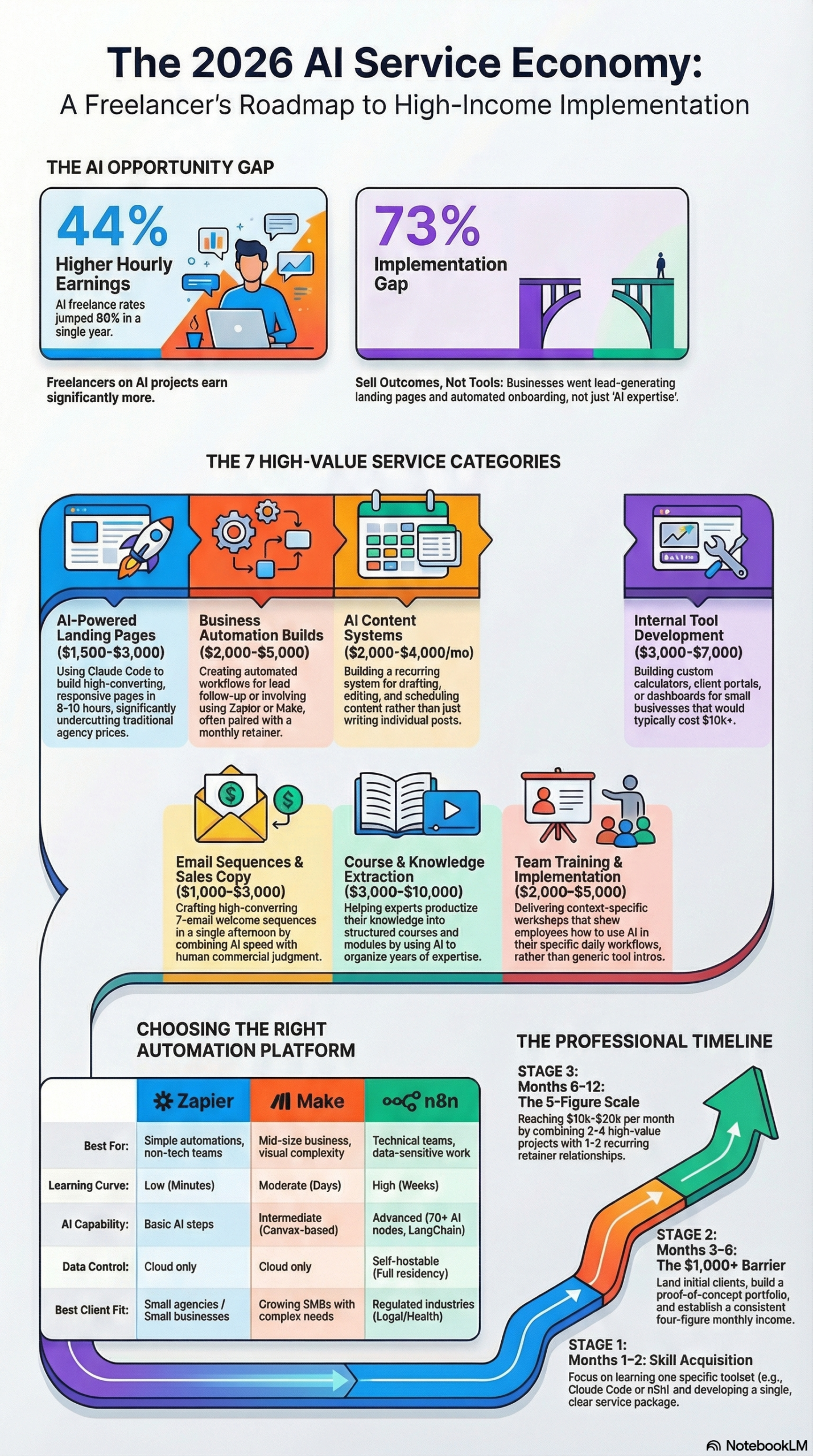
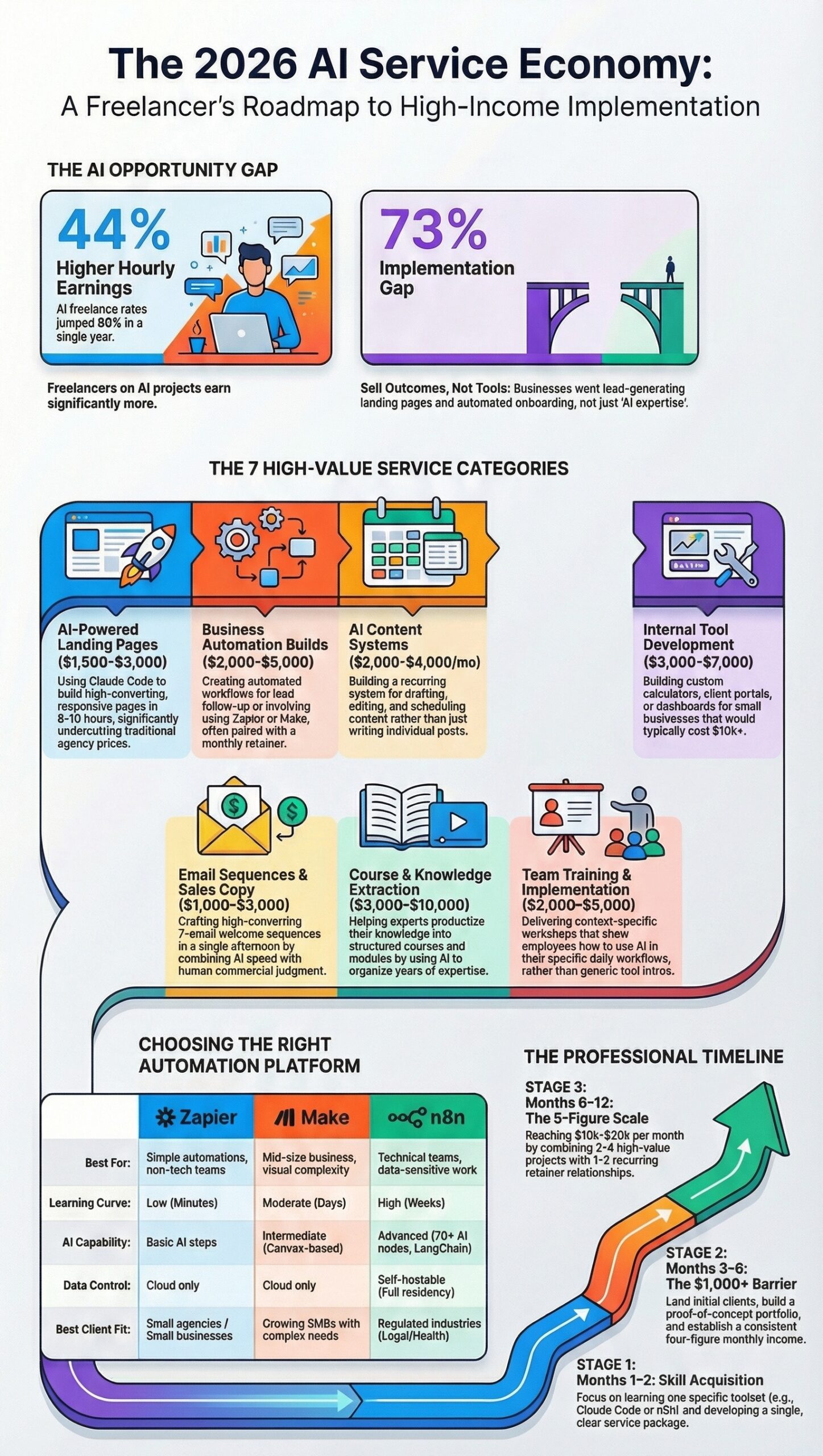
The earnings data for AI-specialized freelancers is encouraging but requires honest context. Upwork’s platform data confirms that AI-related freelance work crossed $300 million in annualized value by late 2025, and freelancers working in AI categories earn 44 percent more per hour than those in non-AI categories. Demand for AI-related skills grew 109 percent year over year, with prompt engineering growing 240 percent and AI automation searches on Fiverr jumping 136 percent.
At the same time, the market rewards execution over tool familiarity. The freelancers reaching $10,000 to $20,000 per month are typically delivering two to four high-value projects at any given time, combined with one or two retainer relationships. The bottleneck for most is not skill; it is marketing and pipeline. The people generating consistent income in this space are not necessarily the most technically advanced. They are the ones who pick a specific service, build a repeatable delivery process, and maintain consistent outreach to potential clients.
The realistic timeline for someone starting from zero looks like this: one to two months to learn the tools and develop a service package; two to three months to land initial clients (sometimes with a free or reduced-price first engagement to build proof); three to six months to reach a consistent four-figure monthly income; six to twelve months to reach five figures with a combination of project and retainer revenue. These are not guarantees. They are reasonable projections for someone treating this as a serious business rather than an experiment.
Service Comparison at a Glance
| Service | Price Range | Time to Deliver | Recurring Revenue? | Best For |
|---|---|---|---|---|
| Landing Pages | $1,500-$3,000 | 1-2 days | Optional retainer | Designers, marketers, copywriters |
| Automation Builds | $2,000-$5,000 | 3-7 days | Yes, maintenance | Tech-comfortable generalists |
| AI Content Systems | $2,000-$4,000/mo | Ongoing | Yes, core model | Content creators, marketers |
| Internal Tools | $3,000-$7,000 | 2-5 days | No (usually) | Technical consultants |
| Email Sequences | $1,000-$3,000 | 1-2 days | Optional retainer | Copywriters, marketers |
| Course Creation | $3,000-$10,000 | 1-3 weeks | No (project) | Learning designers, consultants |
| AI Training | $2,000-$5,000 + retainer | Half-day + ongoing | Yes, strong model | Consultants, educators |
Part Four: Building the Business Model
How to Package, Sell, and Scale
The most common mistake new AI service providers make is positioning their service around the tool rather than the outcome. “Claude Code landing page builds” is a tool-centered pitch. “Conversion-focused landing pages delivered in 48 hours” is an outcome-centered pitch. Buyers care about what they receive, not what software produced it.
The fastest path to a first paying client involves three components. First, pick exactly one service from the list above and commit to it. Attempting to offer everything at once produces a confusing message and a diluted skillset. Second, produce one strong proof piece, either a real client project or a self-initiated sample, that demonstrates the quality of the output. This proof functions as the portfolio and the sales asset simultaneously. Third, distribute the offer through the channels where potential clients actually spend time: LinkedIn outreach for B2B services, content marketing that demonstrates expertise, and direct referrals from existing professional contacts.
The content strategy for this kind of business does not need to be elaborate. Publishing one or two pieces per week that demonstrate practical AI application, either a case study, a process breakdown, or a specific use case, builds credibility faster than any other method. Potential clients who have seen five or ten examples of the work in action convert at significantly higher rates than cold outreach targets.
Retainer revenue is the goal of a mature version of this business. Project-based income is variable and requires constant pipeline management. A business with five retainer clients generating $2,000 to $4,000 per month each produces $10,000 to $20,000 per month in predictable revenue before adding new project work. This structure also creates the kind of deep client relationships that generate referrals consistently.
The tools available to service providers in this space have genuinely become ten times more capable in a short period. The leverage available to a single person with a clear service, a delivery process, and a consistent approach to client acquisition is unlike anything available in previous technology cycles.
Conclusion
The businesses that need these services exist in every industry and every geography. They are paying traditional agencies prices for work that takes months when AI tools can produce comparable or superior results in days. They are paying employees to do manually repetitive tasks that automated workflows could handle for a fraction of the cost. They are sitting on years of unrealized expertise that could be productized with a few weeks of structured effort.
The freelancer, consultant, or small agency that bridges this gap, that learns the tools, packages the outcomes clearly, and sells consistently, is positioned exceptionally well. The market data confirms that demand is real, that pricing is supported, and that the competition at the high end of execution is still limited.
The practical path is not complicated. Pick one service. Build one proof piece. Reach out to ten potential clients this week. Deliver exceptional work on the first engagement. Ask for a referral. Repeat the process. The people who follow this sequence, rather than spending months planning without shipping, are the ones who reach meaningful income within a realistic timeframe.
The tools have changed. The fundamentals of building a services business have not. Both of those facts are working in the favor of anyone who starts now.