November 3rd, 2025 | Updated on April 30th, 2026
You've spent an hour creating short-form video content, and now you're staring at your screen facing a very modern dilemma: Should this go on Instagram Reels or TikTok? Or both?
If you're posting on only one platform in 2025, you're leaving serious reach on the table. But uploading identical content to both without adapting it won't work either. Instagram Reels and TikTok look almost identical on the surface — vertical short-form video, music, effects, comment sections — but underneath they run on fundamentally different algorithms, serve different audiences, and reward different creator behaviors.
This guide breaks down everything you need to know: how each algorithm actually works, what the 2025 reach data really says, and a practical use-case guide so you know exactly which platform (or both) deserves your time.
Why the Instagram Reels vs TikTok Debate Matters in 2025
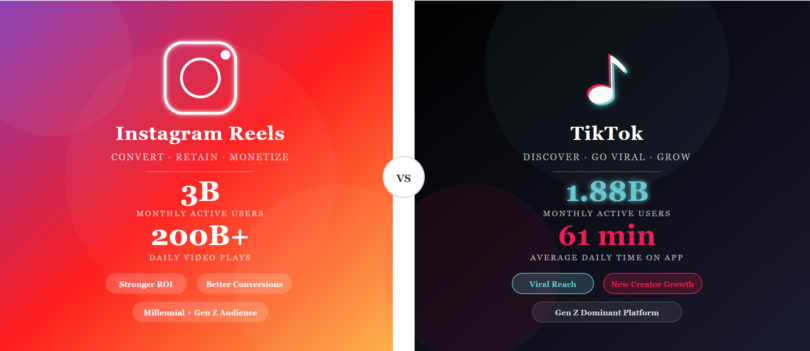
Short-form video is now the dominant content format on the internet. By 2025, Instagram Reels are played over 200 billion times per day across Meta's platforms, while the average TikTok user watches 265 videos per day — compared to 177 on Reels. These are not niche features. They are the primary growth engine for creators, brands, and businesses at every scale.
Instagram Reels now account for 35% of all time spent on the Instagram app, while TikTok users average 61 minutes per day on the platform compared to Instagram's 49 minutes. The platform you choose — and how you use it — directly shapes how fast you grow, how much money you make, and what kind of audience you attract.
The choice is not just philosophical. It is algorithmic. So let's get into exactly how each one works.
How the Instagram Reels Algorithm Works
Instagram's Reels algorithm has one job: keep people scrolling. It does that by predicting — with remarkable accuracy — which videos any given user is most likely to watch, reshare, or save.
When you post a Reel, Instagram first shows it to a small test audience made up of both your followers and non-followers the platform thinks will enjoy it. The best-performing Reels from that initial group are then pushed to a slightly wider audience, and the best of those to a wider group still. This cascading distribution model rewards engagement quality, not follower count — and it's why a creator with 500 followers can sometimes out-reach one with 500,000.
Key Signals the Instagram Reels Algorithm Weighs
⏱ Watch Time & Completion Rate
Did people watch all the way through, or swipe away in the first three seconds? Completion rate is the single most weighted signal in Instagram's ranking model.
↗ Reshares
Instagram reports that Reels are reshared more than 4.5 billion times per day across Instagram and Facebook combined. The algorithm treats reshares as the strongest possible endorsement of content.
🔖 Saves
Saving a Reel signals lasting value. It tells Instagram the viewer wants to return to it, which pushes it further into recommendation queues.
💬 Comments & Likes
Standard engagement signals, though they carry significantly less algorithmic weight than watch time and reshares.
♪ Audio Usage
Instagram's algorithm measures how likely viewers are to use your audio in their own Reels. Content with high "audio use intent" gets a meaningful distribution boost.
What "Recommendation-Friendly" Means
Instagram explicitly advises creators to post "recommendation-friendly content" — meaning content that avoids low-quality, objectionable, or sensitive material that could restrict distribution. Content that crosses those lines may still be published, but it will only be shown to your existing followers, which effectively caps your reach at a fraction of its potential.
Where Instagram Reels Can Appear
A single Reel has four separate distribution surfaces: the dedicated Reels tab (continuous full-screen scroll), the Explore page (trending and interest-based discovery), your followers' main feed (home feed recommendations), and Stories (when shared cross-format). This multi-surface exposure is a key structural advantage over static posts, which typically appear only in the feed and on the Explore page.
How the TikTok Algorithm Works
TikTok's For You Page (FYP) algorithm is widely regarded as the most powerful content discovery engine in social media — and it operates on fundamentally different principles than Instagram's approach.
On TikTok, your follower count is nearly irrelevant. A brand-new account posting its first video has the same distribution potential as an account with 10 million followers. The algorithm surfaces content based almost entirely on content quality and early engagement signals, not account authority or existing audience size.
Key Signals the TikTok Algorithm Weighs
📊 Watch Depth
TikTok tracks precisely how far into a video viewers get before dropping off. Videos watched to near-completion receive dramatically more distribution.
🔁 Completion Rate & Rewatches
TikTok rewards loops. A 15-second video watched three times generates stronger algorithmic signal than a 60-second video watched once.
↗ Shares
TikTok users share content at roughly 4× the rate of Instagram users (170 shares per post vs. 41 on Instagram). Shares are the most powerful single signal for going viral on TikTok.
💬 Comments & Likes
TikTok's average comments per post grew by 73.7% between 2023 and 2024, reflecting a highly interactive community the algorithm actively rewards.
🧠 User Interaction History
The FYP learns preferences at a granular level: which sounds you engage with, which creators you rewatch, which topics cause you to pause mid-scroll.
TikTok's Initial Distribution Model
TikTok reportedly surfaces new videos to approximately 300 initial viewers as a test cohort. Content that earns strong early signals gets pushed to a broader audience in escalating waves. Creators report 50% higher reach when posting during peak algorithm-trigger windows — periods when engagement signals accumulate fastest and the escalation cycle fires most aggressively.
TikTok's recommendation engine drives approximately 85% of total video views on the platform. By comparison, Instagram's algorithmic surfaces (Explore + Reels recommendations) contribute around 57% of Reels views — a meaningful gap that explains why new creators on TikTok so often grow faster than new creators on Instagram.
Instagram Reels vs TikTok: Reach & Engagement Data (2025)
Here is what the 2025 numbers actually say about both platforms:
| Metric | Instagram Reels | TikTok |
|---|---|---|
| Monthly active users | ~3 billion (Instagram total) | ~1.88 billion |
| Daily video views | 200B+ across Meta platforms | Not publicly disclosed |
| Avg. time per user/day | 49 minutes | 61 minutes |
| % of app time on short video | 35% (Reels share of Instagram) | ~70%+ (video-first app) |
| Avg. engagement rate (100K–500K) | ~6.59% | ~9.74% |
| Avg. engagement rate (10M+ followers) | ~8.77% | ~10.52% |
| Average shares per post | ~41 | ~170 |
| % of views from non-followers | ~57–65% via algorithm | ~85% via FYP |
| Reach vs. follower count (strong performer) | 100–500% of followers | Effectively unlimited |
| E-commerce conversion rate | 1.3× higher than TikTok | Strong for Gen Z impulse buys |
| Best for new creators (0 followers) | Harder — follower signals matter | Significantly easier |
| Cross-posted TikTok content on IG | ~32% worse without optimization | Native content baseline |
The bottom line: TikTok delivers higher raw engagement rates and faster organic reach for new accounts. Instagram Reels delivers stronger conversion rates, deeper monetization infrastructure, and more stability — especially for creators and brands that already have an established audience.
How to Get Your Reels Recommended
Instagram's recommendation engine has measurably leveled the playing field for smaller creators — but only for those who understand how it works. When you post a Reel, Instagram first shows it to a small test audience of both followers and non-followers. Based on engagement from that initial group, strong-performing Reels cascade outward to progressively wider audiences — which is why a creator with 500 followers can sometimes out-reach one with 500,000. Here are the specific behaviors that dramatically increase your chances of being recommended to non-followers:
- 1 Create "recommendation-friendly" content. Instagram distinguishes between content that is allowed and content that is recommendation-eligible. Even content that does not violate Community Standards can be restricted from the Reels tab, Explore page, and home feed if flagged as sensitive — meaning it only ever reaches your existing followers.
- 2 Make every Reel stand alone. Because Reels reach people who have never seen your account, your content must be fully self-contained. Do not reference previous posts, assume existing context, or use insider language. Every Reel is a potential first impression.
- 3 Hook within the first second. Completion rate is the single most weighted signal in Instagram's ranking model, and 3-second retention is the core early-pass filter. A pattern interrupt — a surprising visual, bold on-screen text, or a direct question — is not optional. It is the entry fee for algorithmic distribution.
- 4 Optimize for reshares, not just likes. Instagram has confirmed that Reels are reshared more than 4.5 billion times per day across Instagram and Facebook combined, and it treats reshares as the most powerful possible endorsement signal. Content that makes people say "you have to see this" — funny, surprising, educational, or deeply relatable — gets pushed furthest into the recommendation cascade.
- 5 Optimize for saves, too. Saving a Reel signals lasting value. It tells Instagram the viewer wants to return to it, which pushes it further into recommendation queues in a way that a quick like does not.
- 6 Use audio with intent. Instagram tracks audio engagement signals, including how many viewers click through to the audio page and how many subsequently use that audio in their own Reels. Content with high "audio use intent" receives a meaningful distribution boost. Using trending audio — when it genuinely fits your content, not as a box-tick — can meaningfully expand your reach beyond your existing audience.
- 7 Post consistently. Since every Reel reaches non-followers, each new post is a fresh growth opportunity. The algorithm rewards active creators with more frequent inclusion in recommendation queues.
- 8 Use trial Reels to test before committing. Instagram's trial Reel feature lets you test content with non-followers before sharing it with your followers — a low-risk way to pressure-test new formats and identify what earns strong completion and reshare signals before publishing to your profile.
- 9 Monitor your algorithm profile. Instagram is rolling out a "Your Algorithm" feature that shows creators which topics Instagram associates with their content. Reviewing these topics can help you calibrate your posting strategy to the signals Instagram has already read from your account.
- 10 Track your analytics weekly. Instagram Insights shows watch time, reach sources (followers vs. non-followers), and profile visits generated by each Reel. The algorithm signals what it wants to reward — reading those signals is how you replicate and improve on your best-performing content.
What "Recommendation-Friendly" Really Means
Instagram explicitly distinguishes between content that is allowed and content that is recommendation-eligible. Content that falls into sensitive categories — even if it does not violate Community Standards — may still be restricted from recommendation surfaces, which effectively caps your reach at your existing followers only. Recommendation-friendly content avoids anything that would limit its distribution across the Reels tab, Explore page, and home feed.
Real-World Example: How the Algorithm Rewarded Consistency
@pov_husband, a home cooking account that launched in April 2024, accumulated over 1.2 billion views across Reels and grew from 0 to 2 million followers in under a year — driven entirely by Instagram's recommendation system rewarding strong completion rates and reshares on standalone, self-contained videos. It is one of the clearest demonstrations of what consistent, recommendation-friendly content can achieve regardless of starting follower count.
For a deeper tactical breakdown, see our guide: How to Grow Instagram Followers Organically Without Ads →
Creator Use-Case Guide: Which Platform Should You Use?
The most accurate answer is: both, used strategically. But if you need to prioritize one, here is how to think through the decision. Work through the flowchart below, then read the detailed breakdowns underneath.
→ Choose TikTok First If…
- You're starting from zero. TikTok's FYP gives new accounts the same distribution potential as established creators. New TikTok accounts consistently achieve 2–3× more views per video than new Instagram accounts posting comparable content.
- Your audience is Gen Z. TikTok remains dominant for the 16–24 age group. Fashion, gaming, music, humor, social commentary — this is where they discover and share.
- You want viral brand awareness. TikTok's FYP is engineered for explosiveness. Viral content spreads globally within hours. If maximum impressions are the goal, TikTok's distribution mechanics are unmatched.
- You want to catch trends early. Trends are almost always born on TikTok before migrating to Reels. Being early on TikTok is worth dramatically more than being first on Instagram.
→ Choose Instagram Reels First If…
- You already have an Instagram following. Instagram's algorithm does factor early follower engagement into distribution. If you've built an audience here, Reels can leverage that head start.
- You're selling products or services. Reels integrate with Instagram Shopping, link stickers, and Meta Ads. Instagram delivers a 1.3× higher e-commerce conversion rate than TikTok.
- Your audience is Millennial or older. Instagram's demographic skews broader and slightly older. If you're targeting 25–45-year-olds with higher disposable income, Instagram is the stronger commercial platform.
- You're building a long-term brand ecosystem. Instagram's suite — Reels, Stories, Feed, DMs, Highlights, Broadcast Channels, Shopping — gives far more tools to nurture a community after attracting them via short-form video.
→ Use Both If You Want Sustainable Long-Term Growth
- The most effective 2025 strategy: test on TikTok, convert on Instagram. Around 78% of top-performing TikTok videos also perform well as Reels when properly optimized.
- Post natively on both — and critically, remove the TikTok watermark before posting to Instagram. Watermarked content performs ~32% worse on Reels.
- Platform risk is real. TikTok has faced regulatory pressure in multiple markets. Diversifying across both platforms is the only genuinely durable growth strategy.
The Algorithm Showdown: Key Differences Summarized
| Factor | Instagram Reels | TikTok |
|---|---|---|
| Discovery model | Follower-influenced + interest signals | Pure interest-based (FYP) |
| Best for new creators | Harder — follower count matters | Significantly easier |
| Where trends originate | Adopts TikTok trends | Trend birthplace |
| Viral reach ceiling | High (especially in niche communities) | Higher (global FYP) |
| Monetization strength | Stronger (brand deals, Shopping, Meta Ads) | Growing (TikTok Shop, Creator Fund) |
| Content permanence | Permanent on profile | Shorter FYP cycle |
| Watermarked cross-posts | Algorithm penalty (~32% worse) | Not applicable |
| Audience demographics | Broad — Millennial-skewed | Younger — Gen Z-dominated |
| E-commerce conversion | 1.3× higher than TikTok | Strong for impulse / Gen Z buys |
| % of views from algorithm | ~57–65% | ~85% |
Common Mistakes That Kill Performance on Both Platforms
Mistake 1: Cross-posting without optimization
Posting the same video with the same caption, same hashtags, and the TikTok watermark visible is the fastest way to underperform on both platforms simultaneously. Each platform needs platform-native content with different hooks, different CTAs, and a different caption style.
Mistake 2: Prioritizing production over authenticity
Both algorithms — but especially TikTok's — reward content that feels native to the platform. Over-produced videos that feel like advertisements get skipped. Raw, authentic, value-dense content wins.
Mistake 3: Ignoring audio on Reels
Instagram's algorithm tracks audio engagement signals. Using trending audio — when it genuinely fits your content — meaningfully expands your distribution to users who interact with that sound. Creators who ignore audio are voluntarily forfeiting a ranking signal.
Mistake 4: Chasing follower count instead of content quality
On TikTok especially, follower count has almost no relationship to distribution. One exceptional video from a zero-follower account can outperform a mediocre video from a million-follower account. Content quality is the only metric that matters to the algorithm.
Mistake 5: Not checking analytics regularly
Instagram Insights shows watch time, reach sources (followers vs. non-followers), and profile visits generated by Reels. TikTok Analytics shows similar data plus watch-depth curves. These metrics tell you precisely which content the algorithm is amplifying. Not reading them is like driving without a dashboard.
Frequently Asked Questions
Which gets more organic reach — Instagram Reels or TikTok? +
For new creators starting from zero, TikTok typically delivers significantly more organic reach. TikTok's FYP drives about 85% of video views, compared to approximately 57% for Instagram's algorithmic surfaces. However, for creators who already have an established Instagram following, Reels can deliver strong reach within and well beyond that existing community.
Should I post the same video on both platforms? +
Yes, but you need to optimize for each. Remove the TikTok watermark before posting to Instagram — the algorithm penalizes watermarked content, which performs approximately 32% worse. Rewrite your caption with platform-appropriate language and keywords. Test on TikTok first, then post your best-performing content to Reels.
Which platform pays creators more? +
Instagram currently has a more mature monetization ecosystem for most creators. Brand partnerships on Instagram pay significantly more per 10,000 followers than TikTok's Creator Fund pays per 1,000 views. However, TikTok Shop is growing fast and is particularly lucrative for creators with Gen Z audiences selling trend-driven, affordable products.
Is TikTok's reach advantage real, or is it overstated? +
The data backs it up. TikTok surfaces new content to a test cohort of around 300 viewers and escalates distribution based on engagement signals, with follower count carrying almost no weight. Instagram's Reels algorithm does factor in early engagement from existing followers. For new accounts with no existing audience, this is a meaningful and measurable difference.
What is the ideal Reel length in 2025? +
For Instagram Reels, 60–90 seconds delivers the highest engagement rates and approximately 24% more shares than shorter formats. Reels under 15 seconds achieve a 57% completion rate but limited overall engagement. For TikTok, 15–30 seconds achieves the highest completion and share rates, though videos over one minute earn 63.8% more watch time from viewers who commit to watching.
Does it matter where I put keywords on these platforms? +
Yes — increasingly so. Both Instagram and TikTok now index natural language in captions, on-screen text, and (on TikTok) spoken words for their search and discovery systems. Treat your caption like a short blog post: include the phrases your target viewer would actually search for. Hashtags are still useful for content categorization but no longer drive significant reach on their own. Instagram now limits Reels hashtags to three, reinforcing the shift toward keyword-rich captions over tag volume.
Your Action Plan
- 1 Audit your goals. New creator focused on growth? Start on TikTok. Established brand focused on conversion? Double down on Reels. Serious about long-term sustainability? Do both with a clear role for each.
- 2 Create natively, not generically. Shoot with each platform's native style in mind. TikTok rewards raw authenticity and trend participation. Instagram Reels rewards polished storytelling and community depth. The fastest way to fail on both platforms is to treat them as the same.
- 3 Test on TikTok, scale on Instagram. Use TikTok as your content laboratory. When something performs, remove the watermark and post an optimized version to Reels within 48–72 hours while the topic is still timely.
- 4 Track what the algorithm is amplifying. Check your analytics weekly. What is your average watch time? Where is your reach coming from? What content is driving profile visits and follows? The algorithm is signaling what it wants to reward — listen to it.
- 5 Diversify across both platforms. Platform risk is real. TikTok's regulatory situation remains uncertain in several markets. Instagram's algorithm priorities shift with every major update. Building your audience across both platforms is the only truly durable content strategy.
The creators and brands winning in 2025 are not choosing between Reels and TikTok. They are using each platform for what it does best — and building an audience that exists, and can be reached, across both.
Keep Reading
Sources & Further Reading
- Instagram's Official Creator Recommendation Guidelines — Instagram's own guidance on recommendation-eligible content
- Meta's AI Ranking System Transparency Card — How Instagram's feed recommendation AI actually works, from Meta
- Social Media Today: Instagram Reels Recommendations Tips — The cascading distribution model explained with official Instagram commentary
Last reviewed and updated: April 27, 2026
