
Published on April 11th, 2026
There’s a certain theatrical element when it comes to petit fours. Yet they don’t arrive with drama or demand attention like towering cakes. They just sit in neat rows: all polished, precise, and almost jewel-like, waiting to be noticed by you.
These bite-sized French creations carry more than sweetness; they hold a story that’s been shaped by ingenuity, evolving dining habits, and a deep respect for craft. Now let’s dive deeper.
Petit Fours: Where It All Began
The origins of petit fours trace back to a time when baking relied on large, wood-fired brick ovens. These ovens, quite naturally, took hours to reach high temperatures. And once the main baking was done, they also cooled down slowly.
Rather than waste that lingering heat, French bakers began (smartly) using it to prepare smaller pastries that required gentler warmth. This practice became known as baking “à petit four,” which literally means “in the small oven.”
And What Followed After
So what started as a practical solution soon gained its own identity. Over time:
- These miniature creations moved beyond the bakery’s back-end efficiency and right into refined dining culture.
- As meals in France grew more structured, especially among the upper classes, there was also a shift towards lighter, more delicate finishes.
- Also, heavy desserts gave way to smaller, more varied offerings. And petit fours answered that need perfectly, as they began providing a selection of flavours in restrained portions. So, they were often served alongside coffee at the end of a meal.
A Play in Different Styles
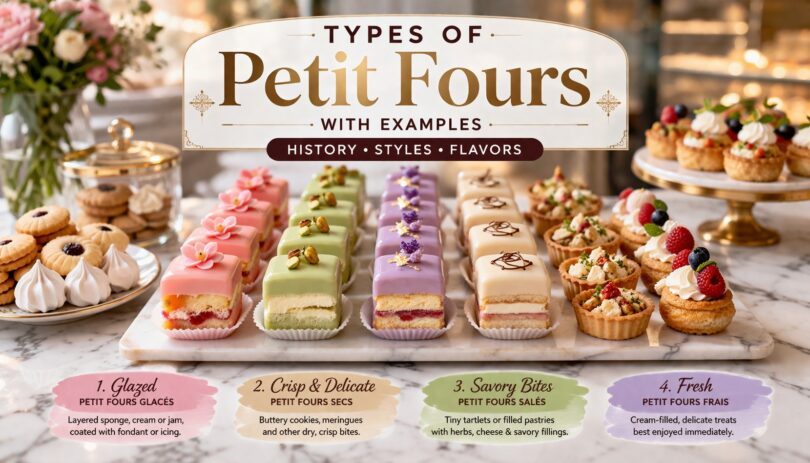
Petit fours may share a name, but they don’t follow a single template. In fact, their variety is part of their appeal. Each type offers you a different texture, flavor profile, and role within a meal. Take a look:
1. Glazed and decorative (petit fours glacés)
These are the most iconic. Small sponge cakes are layered with fillings like cream or jam. And then they’re coated in fondant or icing. Their smooth finish often acts as a canvas for intricate decoration, hence making them as visually appealing as they are flavorful.
2. Crisp and delicate (petit fours secs)
This category leans more towards dry pastries and biscuits. Think buttery cookies, meringues, and other crisp bites that are designed to accompany your tea or coffee. They’re simple in structure but rely on precision to get the texture just right.
3. Savory bites (petit fours salés)
Despite what you might think, not all petit fours are sweet. Some appear as miniature savoury pastries as well. They come in the form of tiny tarts or filled choux, and they’re often served as refined appetisers. They bridge the gap between patisserie and hors d’oeuvres.
4. Fresh, short-lived treats (petit fours frais)
These ones are special; they’re best enjoyed immediately. Most often filled with cream or made using delicate pastry, they depend on their freshness and don’t keep for too long.
Read More: Exploring The World Of Cream Chargers And Nangs
The Craft Behind the Tiny Treats
Despite their size, petit fours demand an exceptional level of skill. In many ways, they’re more challenging than larger desserts. Here’s why:
- No Errors: There’s little room for error as every layer must align. Plus, every coating must be smooth, and the decoration must feel intentional.
- Technique and Control: Pastry chefs often regard them as a measure of technique. Mainly because scaling down a dessert without losing balance requires careful control. Whether you’re managing moisture in a sponge or achieving a flawless glaze. Even slight inconsistencies stand out at this scale.
- Presentation: It plays an equally important role, since petit fours are rarely served alone. Typically, they’re arranged in assortments that highlight the contrast: be it color, texture, or form.
Final Words
Trends in food may come and go, yet petit fours remain appealing due to their adaptability. In today’s time, when people value variety and portion control, these bite-sized treats can feel perfectly aligned with our modern preferences.
They also invite a different kind of interaction. You get to sample, compare, and linger over different choices. There’s a sense of curiosity in selecting one, then reaching for another.


