Published on October 9th, 2026
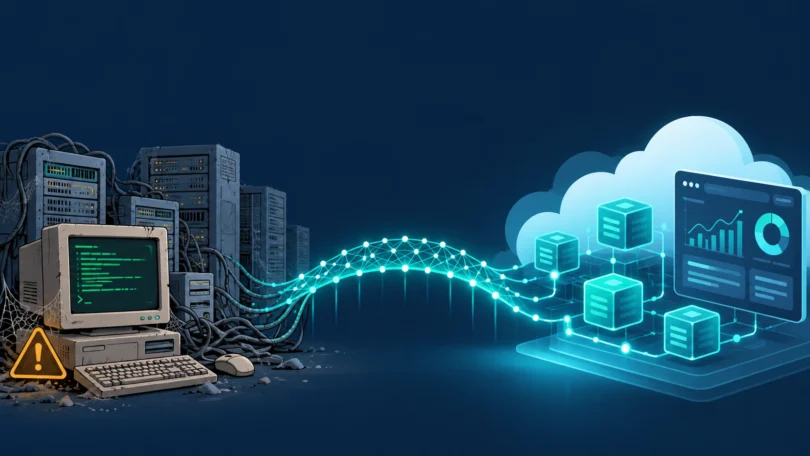
Most organizations know they have a legacy problem. The symptoms are obvious enough — slow releases, rising maintenance costs, integration workarounds that everyone’s embarrassed by. What’s less obvious is why previous modernization attempts didn’t stick.
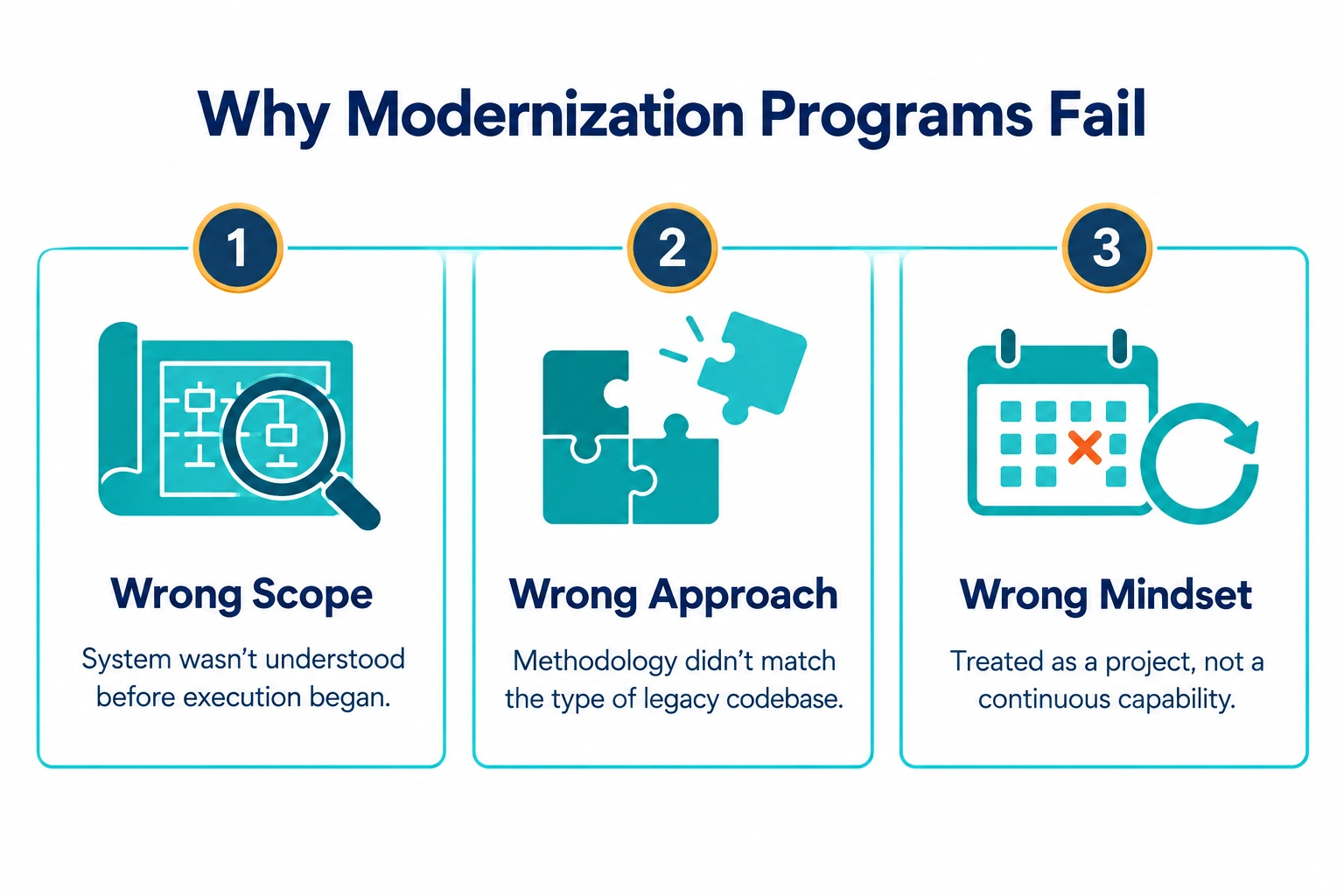
Usually it comes down to one of three things. The scope was wrong because the system wasn’t properly understood before execution started.
The approach didn’t fit the system — a methodology that works for one type of legacy codebase applied to a fundamentally different one. Or the program treated modernization as a project with an end date rather than a continuous capability the organization needs to build.
The companies on this list have worked through enough modernization programs to understand which of these failure modes they’re dealing with before proposing solutions.
Recode is worth checking before you start talking to vendors — a platform for finding and comparing companies across software modernization, application migration, and legacy transformation.
1. Corsac Technologies
Website: corsactech.com
Location: United States
Founded: 2007
Team size: 50-249
Legacy stacks: .NET Framework, AngularJS, ASP.NET Web Forms, Monolithic architecture, Delphi, ColdFusion, COBOL, FoxPro, VB.NET, Xamarin
Modern alternatives: .NET Core/.NET, Angular, Microservices, TypeScript, React/Vue, Flutter, Blazor/WebAssembly, Power BI/Tableau
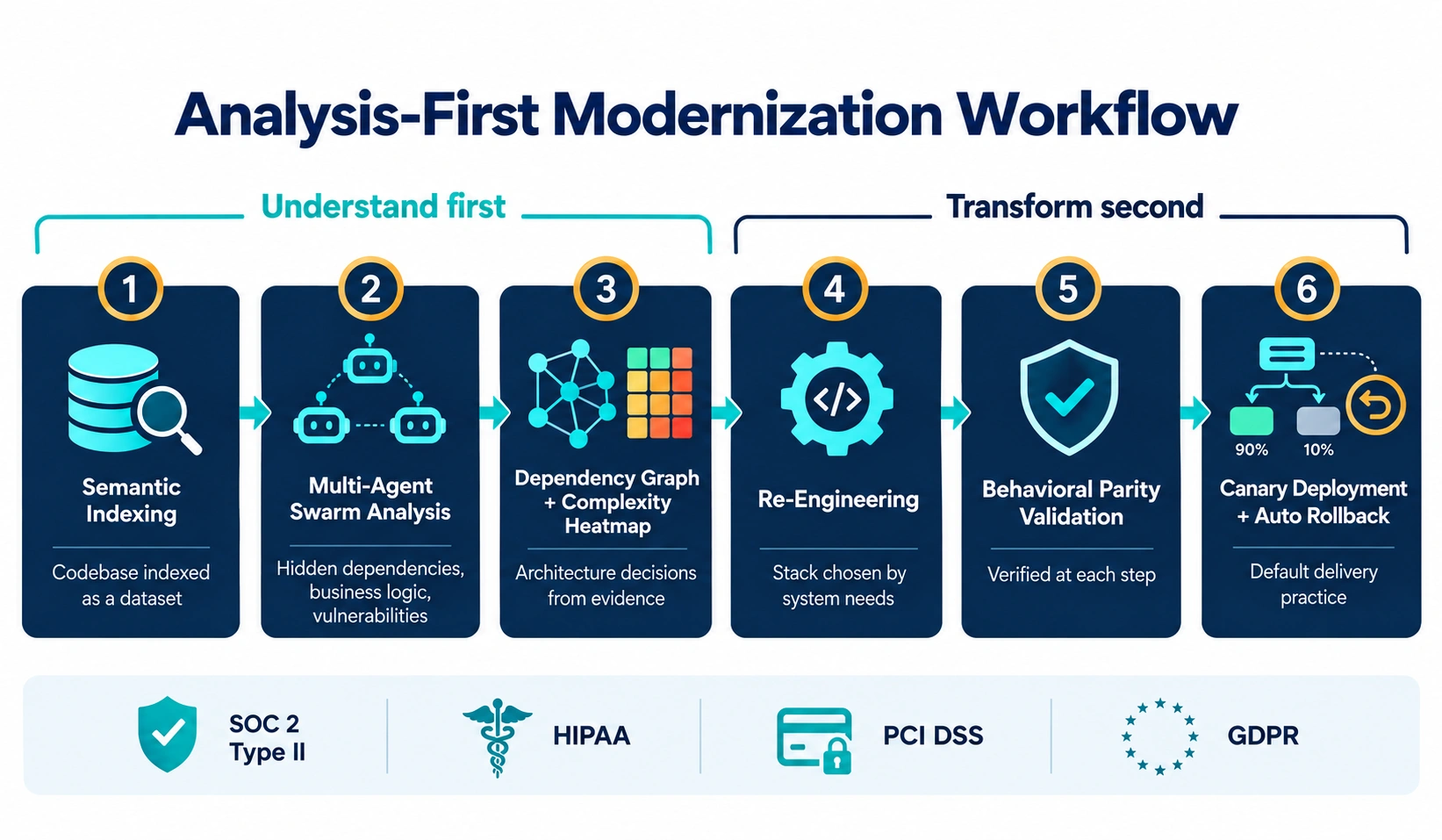
Corsac Technologies uses an AI-driven software modernization approach to accelerate legacy software and application analysis, dependency discovery, business logic extraction, and risk reduction. Their practice is built around a specific insight: most modernization programs fail not because the engineering is bad, but because the system wasn’t understood well enough before the engineering started.
Their RAG architecture treats legacy codebases as datasets to be semantically indexed rather than systems to be manually decoded by engineers who have to read every file.
Hidden dependencies, undocumented business logic, security vulnerabilities, complexity hotspots — all of it surfaces through the Multi-Agent Swarm analysis before a single line of new code gets written.
The dependency graph and complexity heatmap that result let modernization teams make architecture decisions based on what’s actually in the system rather than what they assume is there.
Re-engineering follows the analysis rather than preceding it. The modern stack gets selected based on what the system needs, not what the vendor prefers.
Behavioral parity validation at each transformation step. Canary deployments with automated rollback as default delivery practice rather than contingency plan. The full compliance stack — SOC 2 Type II, HIPAA, PCI DSS, GDPR — for regulated industries where modernization requires sign-off before work begins.
Key differentiator: Analysis-first approach where the system gets fully understood before transformation decisions get made — the root cause of most modernization failures addressed at the start
2. Reliqsy
Website: reliqsy.com
Location: United States
Founded: 2014
Team size: 50-249
Legacy stacks: .NET Framework, ASP.NET Web Forms, Java, JavaScript, jQuery, AngularJS, VB.NET, monolithic architectures
Modern alternatives: .NET Core/.NET, Java, React, Angular, TypeScript, Node.js, microservices
Reliqsy combines AI with the practical expertise of modernization and migration specialists — using an AI-powered approach to analyze legacy software and applications, extract business logic, and accelerate refactoring and modernization processes.
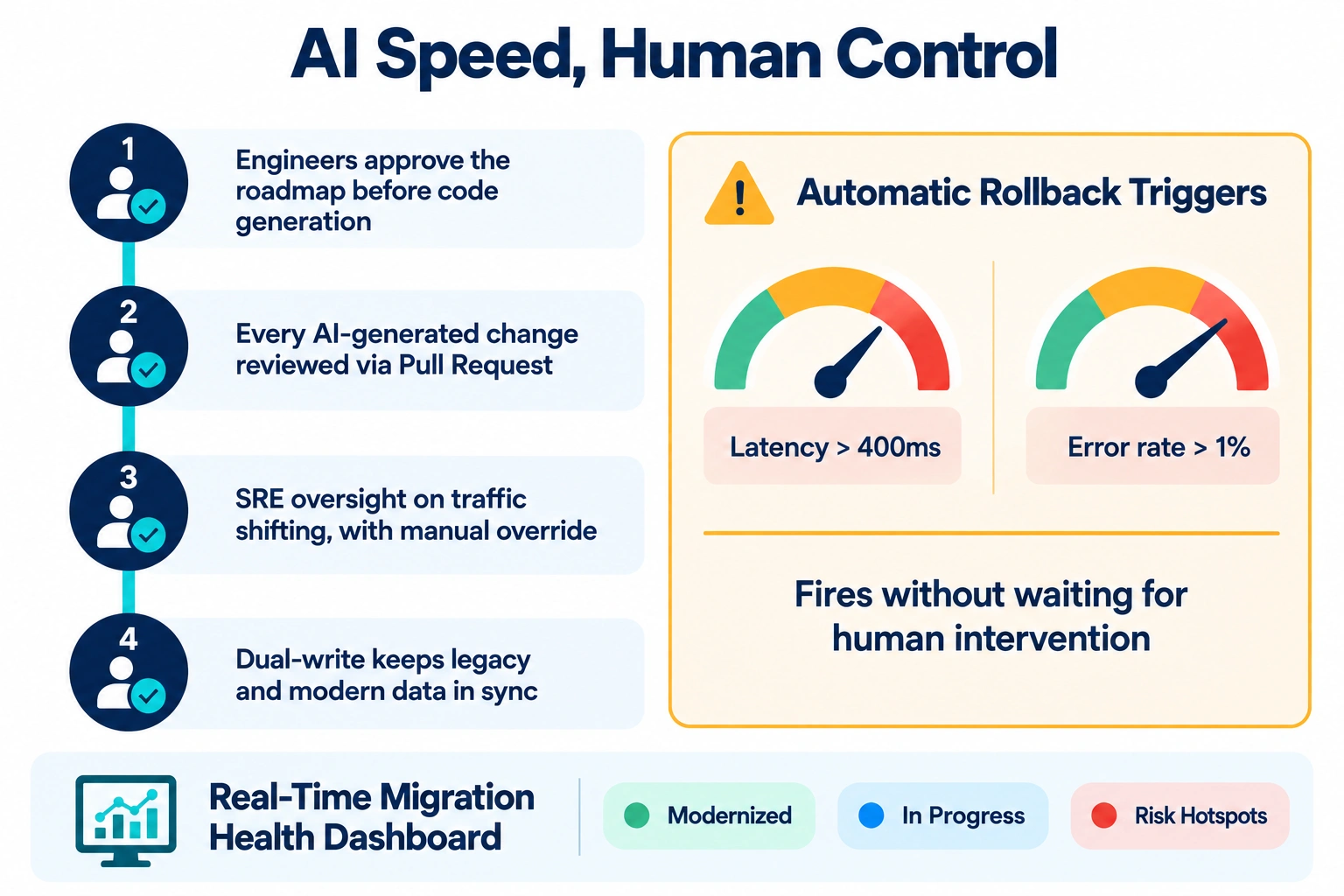
What distinguishes their framework is the governance model alongside the AI capability. Speed from AI analysis and code generation. Control from mandatory human decision points that can’t be bypassed.
Engineers approve the modernization roadmap before any code generation starts. Every AI-generated change goes through Pull Request review before touching production.
Traffic shifting during deployment requires SRE oversight with manual override. Dual-write keeps legacy and modern application data synchronized throughout migration.
Automated rollback at specific thresholds — 400ms latency, 1% error rates — fires without waiting for human intervention. A real-time Migration Health Dashboard gives stakeholders visibility into what’s been modernized, what’s in progress, where risks are concentrating.
Key differentiator: Structured governance at every AI decision point — the combination of AI acceleration and human control that regulated industries specifically require
3. Zoolatech
Website: zoolatech.com
Location: United States, Europe, Latin America, MENA
Founded: 2017
Team size: 600+
Hourly rate: $50-$99/hr
Legacy stacks: Ruby on Rails, Java monoliths, C++, Angular, JavaScript, ERB, tightly coupled architectures
Modern alternatives: AWS, Azure, Kubernetes, microservices, React, TypeScript, Spring Boot, Kafka, REST APIs
Zoolatech’s approach starts with what’s actually in the legacy system before selecting a modernization path — technical debt assessment, dependency mapping, system analysis. The path follows the assessment.
Targeted refactoring for systems where the architecture is sound but the code is dated. Full re-engineering for systems where the architecture itself is the problem.
Cloud migration where the primary constraint is infrastructure rather than application logic. Monolith-to-microservices where the scaling requirements demand it. Their experience spans retail, healthcare, fintech, telecom, logistics, energy, and enterprise software.
Key differentiator: Path selected after assessment rather than before it — modernization approach determined by what the system actually needs
4. DXC Technology
Website: dxc.com
Location: United States (global)
Founded: 2017
Team size: 10,000+
Legacy stacks: ASP.NET Web Forms, Monolithic architecture, JavaScript, jQuery, VB.NET
DXC works at the intersection of legacy software complexity and enterprise operational constraints — aerospace, defense, energy, financial services at the scale where modernization programs run for years and the organizational complexity rivals the technical complexity.
Their AI-backed methodology targets operational simplification and workflow modernization with the security posture that highly regulated industries require.
When a legacy software portfolio spans dozens of interconnected applications that nobody has a complete map of, DXC has the delivery infrastructure and domain depth to handle it.
Key differentiator: Enterprise delivery scale for industries where legacy software complexity is highest and operational disruption tolerance is lowest
5. Smartbridge
Website: smartbridge.com
Location: United States
Founded: 2003
Team size: 50-249
Hourly rate: $150-$199/hr
Modern alternatives: AWS, Azure, Docker, Python, Java, Node.js, .NET Core
Smartbridge treats legacy software modernization as part of a broader organizational capability rather than a standalone technical project.
Their practice spans data and analytics, intelligent automation, and AI implementation alongside modernization — which matters for organizations where the legacy application is the obstacle between current state and a strategic initiative that leadership has already funded.
The assessment of the existing application precedes the recommendation. No default to full rewrite when targeted modernization would accomplish the same goal at lower risk.
Key differentiator: Legacy software modernization positioned inside a broader data, automation, and AI practice — the constraint gets removed in the context of what it was constraining
6. The Smyth Group
Website: thesmythgroup.com
Location: United States
Founded: 2005
Team size: 10-49
Hourly rate: $150-$199/hr
Modern alternatives: AWS, Azure, Docker, Python, Java, Node.js, .NET Core, Microservices
The Smyth Group’s delivery model is structured around visibility rather than reporting. Defined deliverables at each phase — strategy, development, scaling — that clients can evaluate rather than status updates they have to trust.
They work with clients to surface the fundamental issues driving legacy software problems before proposing solutions, which produces recommendations that address root causes rather than symptoms.
Key differentiator: Client-visible progress at every phase — deliverables rather than status updates
7. Devox Software
Website: devoxsoftware.com
Location: USA, Poland, Ukraine
Founded: 2018
Team size: 50-249
Hourly rate: $50-$99/hr
Modern alternatives: Angular, .NET, Java, Python, React JS, Vue JS, Node JS
Devox addresses legacy software modernization through their proprietary AI Solution Accelerator™ — tooling built specifically for modernization programs rather than general development acceleration.
Security vulnerabilities, vendor dependencies, workflow bottlenecks that accumulate in legacy software over years — the Accelerator addresses these through automation rather than additional engineering headcount.
Their 95% customer satisfaction rate across a market where client disappointment is common is worth taking seriously.
Key differentiator: Proprietary AI Solution Accelerator™ purpose-built for legacy software modernization — automation that reduces program timeline without proportionally increasing team size
8. TSRI
Website: tsri.com
Location: United States
Founded: 1995
Team size: 50-249
Legacy stacks: 35+ languages including COBOL, PL/1, JCL, CA-IDEAL, Ada, Fortran
Modern alternatives: Java, C#, .NET Core, C++
TSRI’s 35+ legacy language coverage addresses a gap that matters more than it gets acknowledged in vendor selection: most modernization companies claim legacy software expertise but have genuine depth in only a handful of languages. COBOL, PL/1, JCL, Ada, Fortran — TSRI works with these from the inside rather than through tooling that approximates the behavior.
Their Composite AI combining deterministic and generative approaches minimizes errors and business disruption for legacy software transformations where precision matters more than speed.
Key differentiator: Genuine depth across 35+ legacy languages — accurate assessment of software stacks most vendors approximate
9. Innowise
Website: innowise.com
Location: Poland, Ukraine, Germany, Lithuania
Founded: 2007
Team size: 1,000-9,999
Hourly rate: $50-$99/hr
Modern alternatives: AWS, Microsoft Azure, Google Cloud, Kubernetes, Docker
Innowise’s full-cycle model keeps the same team across consulting, modernization delivery, and post-launch support — which prevents the institutional knowledge loss that happens when different teams handle different project phases.
For legacy software modernization programs where the system knowledge accumulated during analysis is as valuable as the technical delivery, that continuity changes the quality of decisions made throughout the program.
Key differentiator: Full-cycle team continuity — system knowledge built during analysis informs delivery and post-launch support
10. Simform
Website: simform.com
Location: United States, India, Canada, UAE
Founded: 2010
Team size: 1,000-9,999
Hourly rate: $25-$49/hr
Legacy stacks: .NET Framework, ASP.NET Web Forms, Monolithic, Delphi, ColdFusion, COBOL, FoxPro
Modern alternatives: Python, Node.js, Java, AWS, Azure, Google Cloud
Simform brings vertical expertise in fintech, healthcare, logistics, and retail to legacy software modernization — modernization recommendations informed by industry-specific constraints alongside technical ones.
Re-platforming with minimal disruption to production operations. Architectural upgrades that align aging applications with current engineering practices.
Key differentiator: Vertical domain expertise in fintech, healthcare, logistics, and retail — modernization decisions that account for industry constraints, not just technical best practice
How to Choose Companies for Modernizing Legacy Software and Applications
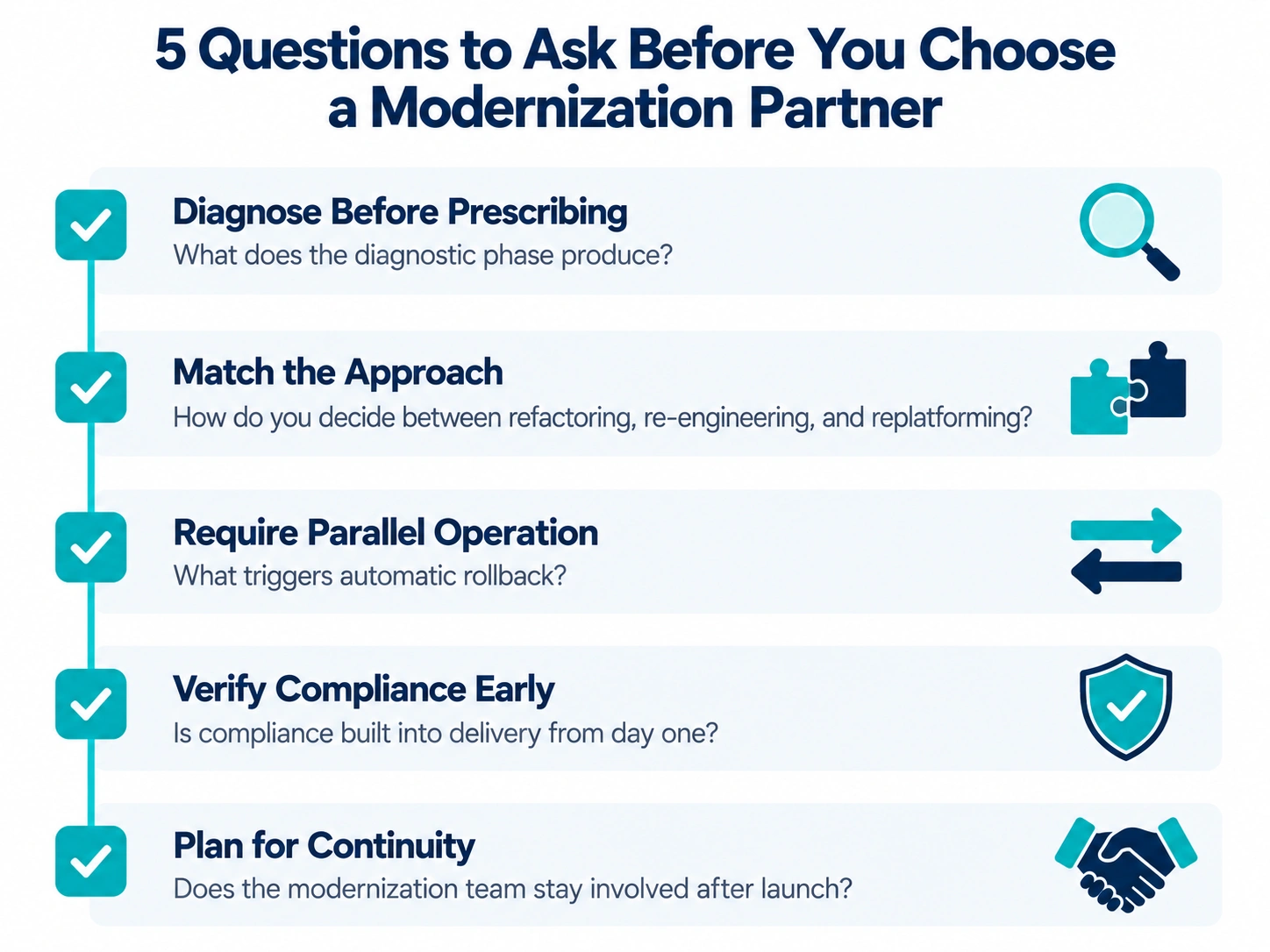
Diagnose before prescribing
The failure mode that derails most legacy software modernization programs is proposing solutions before the system is understood.
Ask specifically what the diagnostic phase produces — dependency maps, complexity scoring, business logic documentation — and how those outputs inform the modernization approach. Companies that move from initial call to proposal without serious analysis are telling you something about how they work.
Match the approach to the actual problem
Targeted refactoring, full re-engineering, cloud replatforming, microservices decomposition — these address different underlying problems in legacy software.
A company that recommends the same approach regardless of what’s in the system is optimizing for their delivery model, not for your problem. Ask how they determine which modernization approach fits which situation and what that determination is based on.
Require parallel operation capability
Full cutover from legacy to modern in a single phase is operationally risky for most production systems. Ask specifically how companies manage the parallel operation period — how long it runs, what validation happens before cutover, what triggers automatic rollback.
Companies with genuine modernization experience have worked through this repeatedly and have specific answers.
Verify compliance integration from the start
Legacy software in regulated industries carries compliance requirements that apply to the modernization process itself, not just the end state.
Discovering compliance gaps at final validation means expensive rework. Ask how compliance requirements are addressed throughout the program — embedded in delivery practice from day one rather than validated at program completion.
Evaluate post-modernization continuity
The team that modernizes the legacy software carries knowledge about how it was built and how it behaves that a separate support team has to reconstruct.
For complex legacy software where that knowledge is the most valuable output of the modernization program, losing it in a post-launch handoff undermines the investment. Ask specifically about post-launch support models and whether the modernization team maintains involvement.
For a broader comparison of companies for modernizing legacy software and applications, Recode lets you search and compare vendors across software modernization, application migration, and legacy transformation.