July 18th, 2025 | Updated on July 28th, 2025
Picture this: you’ve just created the perfect Instagram post. The photo is crisp, your caption tells a compelling story, and you’re ready to hit publish. But then you stare at that blank hashtag section, wondering which tags will actually help people discover your content.
You spend twenty minutes scrolling through hashtag suggestion tools, copying random tags, and hoping for the best.
Sound familiar? You’re not alone. The average content creator spends more time researching hashtags than actually creating content, yet most still struggle to reach their ideal audience.
The problem isn’t that hashtag research is complicated—it’s that most people are doing it wrong.
What if I told you there’s a proven method to find high-performing Instagram hashtags in just five minutes? A strategy that doesn’t require expensive tools, complicated spreadsheets, or hours of analysis.
This quick hashtag research method has helped thousands of creators, small business owners, and digital marketers boost their Instagram reach without the guesswork.
In this comprehensive guide, you’ll discover the exact five-minute framework that transforms hashtag research from a time-consuming chore into a strategic advantage.
Whether you’re a seasoned Instagram marketer or just starting your social media journey, this method will become your go-to system for consistent content discovery.
Why Traditional Hashtag Research Methods Fall Short
Before diving into the five-minute method, let’s address why most hashtag strategies fail. Traditional approaches often rely on outdated hashtag generators, generic industry lists, or copying what competitors use.
These methods ignore Instagram’s constantly evolving algorithm and the nuanced relationship between hashtag performance and audience behavior.
The Instagram algorithm prioritizes content that generates immediate engagement from relevant users.
When you use irrelevant or oversaturated hashtags, your content gets buried among millions of posts competing for the same audience.
Conversely, when you use highly specific, moderately competitive hashtags that align with your content and audience interests, Instagram rewards your posts with increased visibility.
The key is finding that sweet spot between hashtags that are popular enough to have active audiences but specific enough to avoid overwhelming competition.
This balance requires a strategic approach that considers real-time performance data, audience intent, and competitive analysis—all within a time-efficient framework.
Read More: How to optimize your Instagram bio for conversions
The 5-Minute Instagram Hashtag Research Method
Step 1: Define Your Content Core (60 seconds)
Start by identifying three key elements about your specific post: your main topic, target audience, and content goal.
For example, if you’re sharing a vegan breakfast recipe, your core elements might be “plant-based breakfast,” “health-conscious food lovers,” and “inspire healthy morning routines.”
This foundation step prevents you from selecting hashtags that might be popular but irrelevant to your content.
Write down 2-3 primary keywords that describe your post’s essence. These become your hashtag research starting points and ensure every tag you select serves a strategic purpose.
Consider your audience’s search behavior during this step. Are they looking for quick breakfast ideas, detailed recipes, or meal prep inspiration? Understanding their intent helps you choose hashtags that connect with users most likely to engage with your content meaningfully.
Step 2: Use Instagram’s Native Search Function (90 seconds)
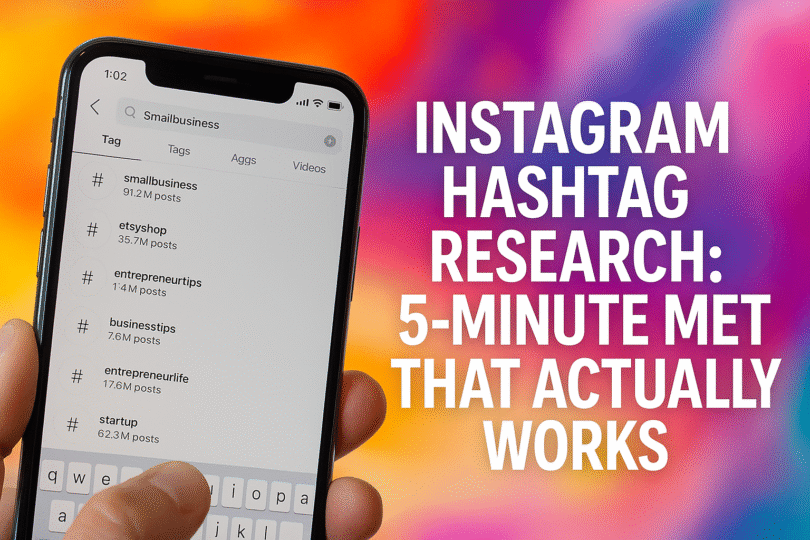
Instagram’s search function is your most powerful hashtag research tool, and it’s completely free. Navigate to the search bar and type your primary keyword. Instagram immediately shows you related hashtags, displaying the number of posts using each tag.
Look for hashtags with post counts between 100,000 and 1 million. These represent the optimal competition level—active enough to have engaged audiences but not so saturated that your content disappears instantly.
Take note of hashtags with recent, high-quality posts in the top results, as this indicates active community engagement.
Pay attention to Instagram’s suggested hashtags as you type. The platform’s algorithm suggests tags based on current trends and user behavior, giving you real-time insights into what’s performing well.
Screenshot or quickly jot down 8-10 hashtags that fit your content and fall within the ideal competition range.
Step 3: Analyze Top-Performing Posts (90 seconds)
Click on each hashtag you’ve identified and examine the “Top” posts section. This reveals which content types perform best for each tag and helps you understand the community’s preferences. Look for patterns in posting times, content styles, and engagement rates.
If most top posts for a hashtag are from accounts with millions of followers, that tag might be too competitive for smaller accounts.
Conversely, if top posts have low engagement despite high follower counts, the hashtag might be losing momentum or facing algorithm issues.
Focus on hashtags where top posts come from accounts similar to yours in size and niche. This indicates you have a realistic chance of ranking well and reaching engaged users who are genuinely interested in your content type.
Step 4: Create Your Hashtag Mix (60 seconds)
Organize your selected hashtags into three categories: high-competition (500K+ posts), medium-competition (100K-500K posts), and low-competition (under 100K posts).
Your final hashtag set should include 2-3 high-competition tags, 4-5 medium-competition tags, and 3-4 low-competition tags.
This strategic mix maximizes your content’s discoverability across different audience segments.
High-competition hashtags expose your content to large audiences, medium-competition tags target engaged niche communities, and low-competition hashtags help you rank prominently in smaller, highly-relevant searches.
Avoid using all your hashtags from a single competition level. A balanced approach ensures consistent performance regardless of algorithm changes or shifting hashtag popularity. Document your final selection in a notes app or hashtag management tool for easy access.
Step 5: Final Quality Check (60 seconds)
Before publishing, verify that none of your selected hashtags are banned or restricted by Instagram.
Search each hashtag individually and check if recent posts appear in the results. If you only see old posts or receive a “recent posts are currently hidden” message, remove that hashtag immediately.
Also, ensure your hashtags align with your content authentically. Even if a hashtag has perfect competition metrics, using it inappropriately can hurt your account’s credibility and algorithm performance.
Your audience should understand why you’ve used each hashtag based on your content.
Review your hashtag set for diversity in terms of specificity and audience type.
Include a mix of broad industry tags, specific niche tags, and descriptive content tags. This variety increases your chances of reaching different user segments within your target audience.
Read More: Try Instagram Marketing Hashtags Course
Advanced Strategies for Maximum Impact
Timing Your Hashtag Strategy
The timing of your hashtag research can significantly impact your results. Conduct your research as close to posting time as possible, ideally within 24 hours.
Hashtag performance fluctuates based on current events, trending topics, and seasonal factors. Fresh research ensures you’re using tags that are performing well at the moment you publish.
Consider your audience’s time zone and typical Instagram usage patterns when finalizing your hashtag selection.
If your audience is most active on weekday evenings, research hashtags during that timeframe to capture current trending topics and community conversations.
Monitor your hashtag performance across different posting times and days. Some hashtags perform better on weekends when users have more time to explore content, while others thrive during weekday lunch breaks when people scroll quickly through their feeds.
Building Hashtag Banks for Efficiency
Create themed hashtag collections for different content types you regularly share.
Develop separate banks for product posts, behind-the-scenes content, educational posts, and promotional material. This preparation reduces future research time while maintaining hashtag relevance and variety.
Update your hashtag banks monthly by removing underperforming tags and adding newly discovered ones.
Track which hashtags consistently generate engagement and which ones fail to deliver results. This ongoing optimization ensures your hashtag strategy evolves with platform changes and audience preferences.
Store your hashtag banks in easily accessible locations like your phone’s notes app, a dedicated hashtag management tool, or a simple spreadsheet. Include notes about when and why certain hashtags work best to inform future content decisions.
Avoiding Common Hashtag Mistakes
Never use the same hashtag set for every post, even if they performed well previously. Instagram’s algorithm favors accounts that demonstrate variety and authenticity in their hashtag usage.
Rotate your hashtags regularly while maintaining strategic consistency in your overall approach.
Avoid extremely popular hashtags like #love, #instagood, or #photooftheday unless they directly relate to your content.
These mega-hashtags have millions of posts and make it nearly impossible for your content to gain visibility. Focus on hashtags that accurately describe your specific content and audience.
Don’t ignore hashtag placement in your overall content strategy. While hashtags in captions can drive immediate discovery, hashtags in comments often perform better for long-term reach.
Experiment with both approaches and monitor which method generates better results for your specific audience and content type.
Read More: What are Instagram trial reels and how to use them
Measuring and Optimizing Your Results
Tracking Hashtag Performance
Instagram’s native analytics provide valuable insights into your hashtag performance through the “Discovery” section of your insights.
Track which hashtags drive the most profile visits, website clicks, and follower growth. This data helps you identify your highest-performing tags and understand what resonates with your audience.
Create a simple tracking system to monitor your hashtag success over time. Note which hashtag combinations generate the most engagement, reach, and meaningful interactions.
Look for patterns in successful posts to inform your future hashtag selections and content strategy.
Pay attention to the types of comments and direct messages you receive from hashtag-driven traffic.
High-quality engagement from relevant users indicates successful hashtag targeting, while irrelevant comments might suggest your hashtags are too broad or misaligned with your content.
Adapting to Algorithm Changes
Instagram’s algorithm continuously evolves, affecting hashtag performance and content discovery.
Stay informed about platform updates and adjust your hashtag strategy accordingly. Follow Instagram’s official communications and trusted social media marketing resources for the latest best practices.
Test new hashtag approaches regularly to stay ahead of algorithm changes. Experiment with different competition levels, hashtag quantities, and placement strategies.
What works today might not work tomorrow, so maintaining flexibility in your approach ensures continued success.
Monitor your overall account performance alongside hashtag changes. If your reach or engagement suddenly drops, evaluate whether recent hashtag modifications might be contributing to the decline.
Sometimes, returning to previously successful hashtag strategies can restore your account’s momentum.
Read Also: Full List of Viral Pinterest Keywords by Niche
Conclusion: Transform Your Instagram Strategy in Just 5 Minutes
The five-minute hashtag research method isn’t just about speed—it’s about strategic efficiency that delivers consistent results.
By focusing on Instagram’s native tools, understanding competition levels, and maintaining authentic relevance to your content, you can dramatically improve your post discovery without spending hours on research.
This method works because it prioritizes quality over quantity, relevance over popularity, and strategic thinking over random selection.
The framework adapts to any niche, account size, or content type, making it a versatile tool for sustainable Instagram growth.
The beauty of this approach lies in its simplicity and effectiveness. You don’t need expensive tools, complex spreadsheets, or deep technical knowledge.
Just five focused minutes of strategic research can transform your Instagram reach and help you connect with your ideal audience more effectively than ever before.
Start implementing this method with your next post. Time yourself through each step, document your results, and refine your approach based on what you discover.
Within a few weeks, you’ll have developed an intuitive understanding of your audience’s hashtag preferences and built a sustainable system for consistent content discovery.
Your Instagram success isn’t about finding the perfect hashtags—it’s about developing a smart, efficient process that consistently connects your content with the right people.
This five-minute method gives you that process, transforming hashtag research from a time-consuming obstacle into a strategic advantage that drives real results for your brand.