Published on February 5th, 2026
Most startup founders face a frustrating gap between what traditional education offers and what building a company actually requires.
Business school teaches frameworks and case studies, but rarely covers how to validate an idea with 100 dollars, negotiate a first enterprise deal, or decide between bootstrapping and raising capital.
Online courses promise startup success but often recycle generic advice that doesn’t translate to real decision-making.
YouTube has quietly become one of the most practical learning platforms for early-stage founders.
Unlike structured courses, the platform offers unfiltered access to founders who share their actual experiences, failures, and frameworks in real time.
The learning happens through watching someone break down their pitch deck, explain why their initial product failed, or walk through the exact steps that led to their first paying customers.
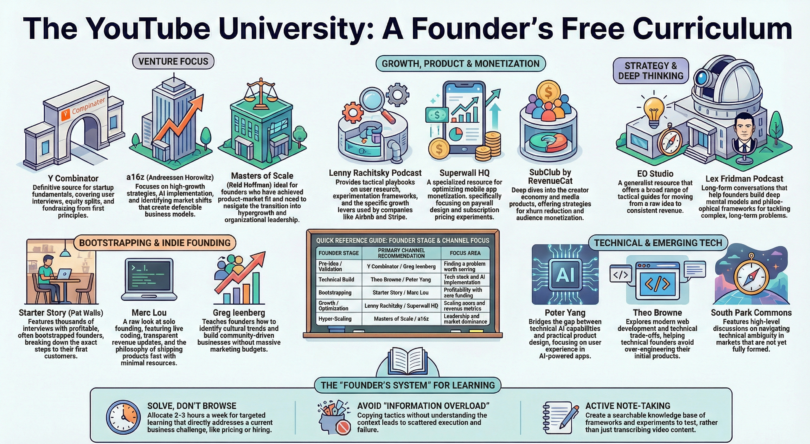
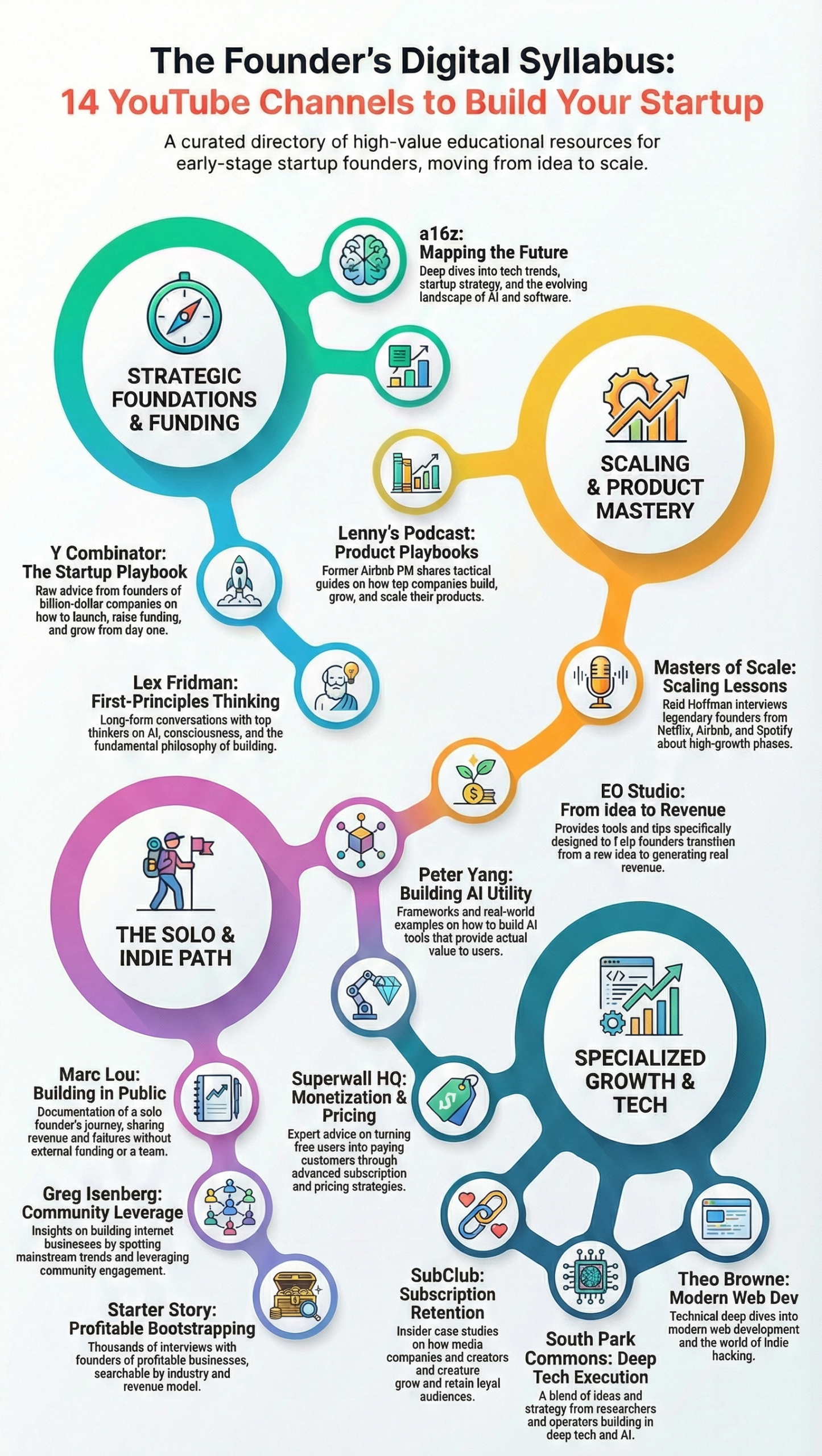
This article breaks down 14 YouTube channels that provide actionable startup education across idea validation, product development, fundraising, growth, and monetization.
Each channel offers different perspectives, from venture-backed scaling strategies to bootstrapped profitability playbooks. The goal is to help founders build a personalized curriculum based on their specific stage and business model.
Why YouTube Works as a Learning Platform for Founders
YouTube solves a specific problem for startup founders: the need for practical, experience-based knowledge that can be applied immediately.
Traditional startup education often feels disconnected from the messy reality of building a company.
YouTube channels run by actual founders and operators provide context that textbooks cannot—what worked, what failed, and why certain decisions were made under specific constraints.
The platform allows founders to learn across multiple dimensions simultaneously.
A founder working on product-market fit can watch validation frameworks from Y Combinator, study community-building strategies from Greg Isenberg, and see how solo founders like Marc Lou execute without external funding.
This multi-angle approach mirrors how real startup problems are solved: by synthesizing insights from different domains and adapting them to unique circumstances.
Another advantage is the speed at which knowledge gets shared. When a new growth tactic works, a pricing model shifts, or a fundraising environment changes, founders document and share these insights within weeks.
This creates a feedback loop where startup education evolves alongside the market, rather than lagging behind by months or years.
The transparency also matters. Founders on YouTube often share revenue numbers, failed experiments, and decision-making processes that would never appear in polished case studies.
This raw documentation helps early-stage founders understand not just what to do, but how to think through problems when there’s no obvious playbook.
The 14 Best YouTube Channels for Early-Stage Startup Founders
a16z
The channel focuses on how emerging technologies, market shifts, and strategic decisions shape startup outcomes.
Content ranges from AI implementation strategies to distribution tactics, typically featuring investors and operators who work directly with high-growth companies.
Topics cover both technical execution and business model evolution across different sectors.
Founders building in tech-heavy spaces should follow this channel, especially those exploring AI, software infrastructure, or enterprise tools.
The insights help bridge the gap between understanding a technology trend and figuring out how to build a viable business around it.
The content assumes some baseline knowledge of startup mechanics and tech ecosystems.
Key lessons include identifying when a technology shift creates real business opportunities versus hype, understanding how successful companies position themselves during platform transitions, and recognizing patterns in what makes certain business models defensible.
The channel provides frameworks for thinking about market timing and competitive dynamics in fast-moving sectors.
Y Combinator
This channel compiles advice from founders who have built companies worth billions, covering every stage from initial idea validation to scaling operations.
The format includes office hours, founder stories, and tactical guides on specific startup challenges. Much of the content comes from the accelerator’s internal curriculum, making it one of the most concentrated sources of startup execution advice available.
Early-stage founders working on their first company should prioritize this channel.
The advice is particularly valuable for founders who need to understand the fundamentals: how to run user interviews, structure equity splits, prepare for investor meetings, or decide what to build first. The content assumes no prior startup experience and builds from first principles.
Founders can expect to learn how to validate ideas before writing code, structure early team dynamics, create pitch materials that communicate value clearly, and avoid common mistakes that kill companies before they reach product-market fit.
The channel also covers psychological aspects of founding, like handling rejection and maintaining momentum during slow periods.
Greg Isenberg
Greg Isenberg explores how to build internet businesses by identifying cultural trends, leveraging communities, and creating products people actually want to pay for.
His content focuses on spotting opportunities in emerging niches, understanding how audiences form around specific interests, and monetizing attention without traditional advertising models. The approach centers on observing behavior shifts before they become saturated markets.
Founders interested in community-driven businesses, content platforms, or consumer products should follow this channel.
The insights work particularly well for bootstrappers and indie founders who need to build traction without large marketing budgets.
The content suits founders who think about distribution and audience-building as core to their product strategy.
Key lessons include how to validate business ideas by studying existing communities, techniques for building products that people voluntarily share, and frameworks for deciding which trends have commercial potential versus which are just noise.
The channel emphasizes starting small, testing quickly, and scaling what works rather than launching with a complete vision.
Starter Story by Pat Walls
Starter Story features detailed interviews with founders who built profitable businesses, often bootstrapped or with minimal outside funding.
Each interview breaks down the specific steps taken to launch, the challenges encountered, and the revenue generated over time. The channel organizes content by business model, industry, and revenue level, making it easy to find relevant case studies.
Founders who want to see concrete examples of how others built businesses in their space should use this channel as a research tool.
The content works especially well for bootstrappers or founders exploring business ideas before committing fully. Watching multiple interviews in a specific category helps identify patterns in what works for different types of businesses.
Founders can learn practical tactics for getting initial customers, choosing pricing models, managing early growth without external funding, and deciding when to hire.
The interviews also reveal how founders handled specific obstacles like manufacturing delays, customer acquisition challenges, or product pivots.
The value comes from seeing the full picture of a business journey rather than just the highlights.
South Park Commons
South Park Commons shares conversations with founders, researchers, and operators building across different sectors, from deep tech to AI applications.
The content balances strategic thinking with execution details, covering both the conceptual work of defining a company’s direction and the tactical decisions required to build it.
Guests often discuss problems they’re actively working through rather than retrospectives on past success.
Founders working on technical products or exploring emerging categories should follow this channel for perspective on how to think about problem spaces before solutions crystallize.
The content suits founders comfortable with ambiguity who need to understand how others are navigating similar uncertainties.
The discussions assume familiarity with startup fundamentals and focus more on nuanced decision-making.
Key lessons include how to approach building when the market isn’t fully formed, ways to validate technical assumptions before investing heavily in development, and frameworks for deciding between different strategic paths when data is limited.
The channel helps founders think through long-term positioning while managing near-term execution constraints.
Lenny Rachitsky Podcast
Lenny Rachitsky breaks down exactly how top product-led companies acquire users, drive engagement, and convert free users into paying customers.
The podcast features deep dives with product leaders from companies like Airbnb, Stripe, and Notion, focusing on the specific tactics and frameworks they used to solve growth challenges.
Content covers everything from onboarding flows to pricing experiments to retention mechanics.
Founders building product-led businesses or struggling with growth should prioritize this channel.
The insights are particularly valuable for founders who have initial traction but need to understand how to systematically improve their product’s growth metrics.
The content assumes basic understanding of product development and focuses on optimization and scaling strategies.
Founders can expect tactical playbooks on running user research, structuring experimentation frameworks, improving activation rates, and building features that drive retention.
The conversations reveal how successful teams prioritize work, measure success, and make trade-offs between different growth levers.
The channel provides a foundation in modern product growth practices.
Masters of Scale by Reid Hoffman
Reid Hoffman interviews founders who scaled companies to significant size, exploring the specific decisions and mindset shifts required at different growth stages.
Episodes examine how companies like Netflix, Airbnb, and Spotify navigated transitions from early traction to massive scale.
The format focuses on extracting lessons about timing, culture, strategy, and leadership during hypergrowth phases.
Founders who have achieved product-market fit and are entering scaling phases should follow this channel.
The content is less relevant for founders still validating ideas or building their first version.
The insights help founders anticipate challenges that come with rapid growth and understand how others structured their teams and operations to handle expansion.
Key lessons include recognizing when to shift from scrappy execution to building systems, understanding how company culture evolves as teams grow, and identifying the right moments to make major strategic bets.
The channel helps founders think several steps ahead about the organizational and operational challenges that accompany scaling revenue.
Marc Lou
Marc Lou documents his journey as a solo founder building and launching multiple products, sharing exact revenue numbers, failed experiments, and daily workflows.
The channel shows the reality of indie founding: shipping quickly, iterating based on user feedback, and managing all aspects of a business alone.
Content includes live coding sessions, revenue updates, and transparent discussions about what worked and what didn’t.
Solo founders and indie hackers who want to build products without raising funding should follow this channel for unfiltered insight into the process.
The content is particularly useful for technical founders who handle both development and business responsibilities.
The approach emphasizes speed, learning, and adaptation over perfect execution.
Founders can learn how to validate ideas quickly with minimal resources, techniques for shipping products fast, strategies for getting initial users without marketing budgets, and honest assessments of what different tactics actually produce in terms of revenue and growth.
The channel provides a realistic view of bootstrapped founding that balances optimism with practical constraints.
Peter Yang
Peter Yang explains how to build AI products that people actually use, drawing from his experience in product management at companies like TikTok.
The channel breaks down product strategy, user behavior patterns, and implementation frameworks specific to AI applications.
Content focuses on translating technical capabilities into user value and avoiding common pitfalls in AI product development.
Founders building AI-powered products or integrating AI features into existing applications should follow this channel.
The insights help bridge the gap between what’s technically possible and what users actually need.
The content suits founders who understand basic AI concepts but need guidance on product positioning and user experience design.
Key lessons include frameworks for identifying valuable AI use cases, techniques for designing interfaces that make AI features accessible, and strategies for managing user expectations around AI capabilities.
The channel emphasizes practical product decisions over technical complexity, helping founders focus on delivering real value rather than chasing technological novelty.
EO Studio
EO Studio shares founder stories, startup tools, and tactical advice for moving from idea to revenue.
The channel covers a broad range of startup topics, from initial validation to customer acquisition to operational setup.
Content includes both founder interviews and tactical guides on specific aspects of starting and running a company.
Early-stage founders who need guidance across multiple aspects of building a business should use this channel as a general resource.
The content works well for founders at the very beginning of their journey who need to understand the full landscape of startup building. The advice is accessible and practical rather than theoretical.
Founders can learn about different startup tools and how to use them effectively, validation techniques for testing ideas before building, approaches to getting early customers, and operational basics for running a sustainable business.
The channel provides a well-rounded introduction to the startup process from multiple angles.
Theo Browne
Theo Browne covers modern web development, technical decisions in startups, and the indie hacking space.
Content includes deep technical dives into frameworks and tools, discussions about startup engineering culture, and perspectives on building products as a technical founder.
The channel bridges the gap between pure development content and startup strategy.
Technical founders and developers building their own products should follow this channel for perspective on technology choices, development practices, and the technical side of indie founding.
The content assumes strong technical knowledge and focuses on helping developers make better decisions when building products or companies.
Key lessons include understanding trade-offs between different technology stacks, recognizing when to choose simplicity over cutting-edge tools, and thinking about technical decisions through the lens of business outcomes rather than just engineering preferences.
The channel helps technical founders avoid over-engineering while staying informed about modern development practices.
Superwall HQ
Superwall HQ focuses entirely on subscription business models, covering pricing strategies, monetization tactics, and conversion optimization for apps that rely on recurring revenue.
Content breaks down how successful apps structure their paywalls, run pricing experiments, and convert free users into subscribers.
The channel provides detailed analysis of what works in subscription monetization.
Founders building subscription-based apps or exploring recurring revenue models should follow this channel for specialized knowledge in monetization.
The insights are particularly valuable for mobile app founders who need to optimize their conversion funnels and maximize lifetime value.
The content assumes basic understanding of app development and focuses specifically on revenue optimization.
Founders can learn how to structure pricing tiers, design effective paywalls that convert without frustrating users, run experiments to test different monetization approaches, and understand the psychology behind subscription purchases.
The channel provides frameworks for thinking about long-term revenue growth rather than just initial conversion rates.
Lex Fridman Podcast
Lex Fridman conducts long-form conversations with leading thinkers, researchers, and founders across technology, science, and philosophy.
Episodes explore fundamental questions about AI, consciousness, society, and human potential, often through the lens of building ambitious projects.
The format allows for deep exploration of ideas that shape how founders think about their work’s broader context.
Founders who want to develop deeper mental models about technology’s trajectory and human behavior should follow this channel for perspective beyond immediate tactics.
The content works well as complementary material to more execution-focused channels, providing the conceptual frameworks that inform long-term thinking.
The conversations require patience but offer insights that persist beyond specific trends.
Key lessons include first-principles thinking about complex problems, understanding how technological capabilities might reshape industries over decades, and developing philosophical frameworks for navigating uncertainty.
The channel helps founders think about their work in broader context and consider second-order effects of the systems they’re building.
SubClub by RevenueCat
SubClub features detailed interviews and case studies on subscription businesses, particularly in media and creator economies.
Content explores how companies and creators build, grow, and retain paying subscriber bases.
Episodes break down specific strategies for audience development, pricing, and churn reduction in subscription models.
Founders building media products, creator platforms, or content-based subscription businesses should follow this channel for specialized insights into audience monetization.
The content is valuable for anyone exploring recurring revenue models where the product is content or community rather than software.
The discussions focus on sustainable growth and retention rather than just acquisition.
Founders can learn strategies for converting audiences into paying subscribers, tactics for reducing churn and increasing lifetime value, approaches to pricing content appropriately, and frameworks for balancing free and paid content.
The channel provides practical guidance on building subscription businesses that can scale sustainably over time.
How Founders Can Use These Channels Effectively
Passive consumption of startup content rarely translates into actual progress. The difference between watching hundreds of hours of founder interviews and building a successful company comes down to how the information gets applied.
Founders who benefit most from YouTube treat it as a reference library rather than entertainment, actively seeking specific answers to current problems rather than browsing randomly.
A practical approach involves maintaining a learning system tied to current startup challenges.
When facing a specific decision—like choosing a pricing model, structuring a first fundraising conversation, or deciding which features to prioritize—search these channels for relevant content.
Take notes on frameworks, specific tactics, and reasoning processes rather than trying to remember everything. The goal is to extract applicable insights that inform immediate decisions.
Experimentation is where learning becomes valuable. After watching how another founder approached user interviews, actually conduct interviews using their framework and observe what happens.
When a channel explains a growth tactic, test a small version in the current business and measure results.
This cycle of learning, applying, and measuring creates real knowledge that generic consumption never will.
The most effective founders also develop critical thinking about what they watch. Not every tactic works in every context, and what drove success for a venture-backed SaaS company might not apply to a bootstrapped consumer product.
Evaluate advice based on how closely the speaker’s context matches the current situation, and adapt frameworks rather than copying them directly.
Common Mistakes Founders Make When Learning from YouTube
Information overload destroys more startup progress than lack of information. Watching dozens of channels simultaneously and trying to implement every new framework leads to scattered execution and constant strategy shifts.
Founders caught in this pattern never build momentum because they’re always chasing the next compelling idea instead of focusing on what their specific business needs.
Another common mistake is copying tactics without understanding the underlying principles or context.
A growth strategy that worked for a company with product-market fit and venture funding might fail completely for a pre-revenue bootstrapped startup.
The surface-level tactics get attention, but the context—market position, resources, timing, team capabilities—often determines success more than the tactic itself.
Chasing trends based on YouTube content can pull founders away from their core business.
Just because AI agents are discussed everywhere doesn’t mean every startup needs to pivot toward them. The most valuable learning focuses on solving the actual problems in front of the business, not on what seems exciting in the broader ecosystem.
Frequently Asked Questions
What makes YouTube better than paid startup courses for founders?
YouTube provides access to real founder experiences and unfiltered lessons that paid courses often lack.
Most structured courses teach generalized frameworks, while YouTube channels show actual decision-making processes, failed experiments, and context-specific solutions.
The platform also updates continuously as the startup landscape evolves, unlike static course materials that become outdated.
Founders can learn from multiple perspectives simultaneously and customize their education based on current challenges rather than following a predetermined curriculum.
How much time should founders spend learning on YouTube versus building?
Learning should support building, not replace it. A practical approach involves spending 2-3 hours per week on targeted learning tied to specific problems the business is facing.
When encountering a new challenge like pricing strategy or fundraising preparation, allocating focused time to study relevant content makes sense.
The key is treating YouTube as a reference tool for solving active problems rather than as passive entertainment or a way to delay making decisions.
Can bootstrapped founders benefit from venture-focused channels like a16z?
Bootstrapped founders can extract valuable insights from venture-focused content by filtering for applicable principles rather than adopting everything.
Understanding how venture-backed companies think about market sizing, competitive positioning, or product development helps even if the funding model differs.
The key is recognizing which concepts translate across contexts and which depend specifically on having external capital. Many strategic frameworks apply regardless of funding approach.
Which channels should complete beginners start with?
Y Combinator and Starter Story provide the most accessible entry points for founders with no prior startup experience.
Y Combinator covers fundamental concepts from first principles, while Starter Story shows concrete examples of how others built businesses from scratch.
These channels establish baseline knowledge about validation, customer acquisition, and basic operations that makes other content more valuable.
After building foundational understanding, founders can branch into more specialized channels based on their specific business model.
How can founders avoid analysis paralysis from too much content?
Setting clear learning objectives before watching content prevents aimless consumption. When facing a specific decision or challenge, search for targeted advice on that exact topic rather than browsing generally.
Take action-oriented notes that capture specific next steps rather than trying to absorb everything.
Limiting consumption to 2-3 channels at a time based on current business stage also helps maintain focus and prevents contradictory advice from creating confusion.
Do these channels work for non-tech startups?
Many channels listed provide value beyond tech startups, particularly those focused on business fundamentals, customer acquisition, and monetization.
Starter Story features businesses across industries including physical products, services, and local businesses. Lenny Rachitsky’s product insights apply to any customer-facing business.
Channels heavily focused on AI or software development like Theo Browne or Peter Yang are less relevant for non-tech founders, but business model and growth content translates across sectors.
How often do these channels release new content?
Release schedules vary significantly by channel. Y Combinator and a16z publish multiple videos weekly, while channels like Masters of Scale or Lex Fridman release episodes less frequently but in longer formats.
Most active channels publish at least bi-weekly. Founders should subscribe to channels relevant to their current stage and rely on notifications for new content rather than checking manually.
The back catalog on each channel also contains substantial evergreen content worth exploring.
Should founders watch entire episodes or skip to relevant sections?
This depends on the content format and current needs. For long-form podcasts like Lex Fridman, using timestamps to jump to relevant sections makes sense when seeking specific information.
For tactical content from Y Combinator or Lenny Rachitsky, watching full episodes often provides necessary context for understanding why certain approaches work.
When researching a specific topic, watching multiple shorter segments across channels can be more efficient than consuming full episodes sequentially.
Can founders learn fundraising effectively from YouTube?
YouTube provides substantial fundraising education including pitch preparation, investor psychology, term sheet navigation, and meeting strategies.
Y Combinator offers detailed guidance on the fundraising process, while channels like a16z provide investor perspectives.
However, YouTube content works best when combined with actual practice pitching, networking with founders who have raised capital, and potentially working with advisors.
The platform teaches concepts and frameworks, but execution requires real-world application and feedback.
What if the advice from different channels contradicts?
Contradictory advice often reflects different contexts rather than one approach being wrong.
A venture-backed founder and a bootstrapped founder will give different advice about growth speed, hiring, and resource allocation because they’re optimizing for different outcomes.
When encountering contradictions, consider which speaker’s situation most closely matches the current business context.
Many startup decisions don’t have universal right answers—the best choice depends on specific constraints, goals, and market conditions.
Are these channels suitable for experienced founders or just beginners?
Experienced founders find value in these channels but use them differently than beginners.
While beginners need foundational concepts, experienced founders extract nuanced insights about scaling challenges, market timing, or specific tactical problems.
Channels like South Park Commons, Lenny Rachitsky, and Masters of Scale offer depth that becomes more relevant after achieving initial traction.
Even experienced founders encounter new problems as their companies grow, making continuous learning valuable regardless of experience level.
How can founders take effective notes while watching?
Create a simple note-taking system focused on actionable insights rather than transcription. Capture specific frameworks, tactics worth testing, and questions the content raises about the current business.
Organize notes by topic or business area so they become searchable references when facing related challenges later. Many founders maintain a running document where they log key takeaways with timestamps for easy reference.
The goal is creating a personal knowledge base that supports decision-making, not comprehensive documentation of everything watched.
Final Takeaway and Long-Term Value
YouTube works as a long-term learning companion precisely because startup building is a continuous process of encountering new problems.
The channels listed here provide different lenses for examining those problems, from technical implementation to business model design to psychological resilience.
The value comes from returning to these resources as needs evolve rather than trying to absorb everything at once.
Effective founders build their own curriculum over time, identifying which channels and perspectives align with their specific journey.
A technical founder bootstrapping a developer tool will benefit from different content than a non-technical founder raising venture capital for a consumer app. The platform’s flexibility allows for this personalization in ways traditional education cannot.
The ultimate goal is developing judgment—the ability to evaluate situations, weigh options, and make decisions under uncertainty.
YouTube channels accelerate this development by providing access to how experienced founders think through problems.
But the judgment itself comes from applying those thinking patterns to real situations and observing the results. These channels provide the raw material; building the company provides the refinement.