Published on February 5th, 2026
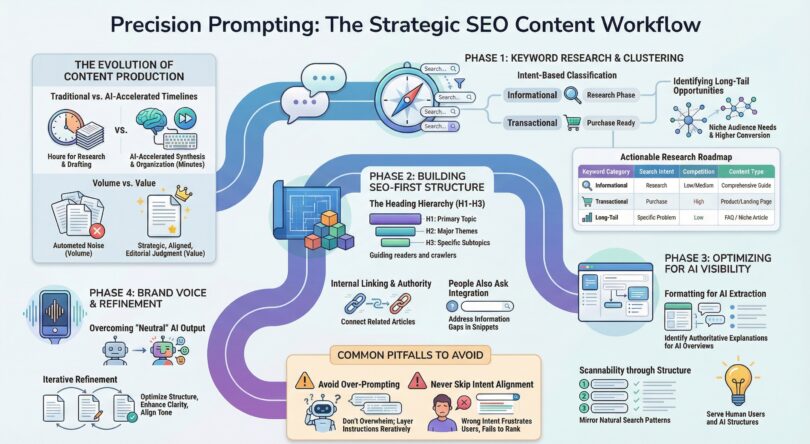
Traditional content creation timelines stretched across multiple hours per article. Research consumed time.
Drafting demanded focus. Editing required revision after revision. The process worked, but speed remained limited by human capacity alone.
Modern workflows compress these timelines dramatically. AI assistance accelerates research, structure, and optimization phases without replacing strategic thinking.
The difference lies in treating AI as a specialized tool rather than a replacement for expertise.
Results depend entirely on how ChatGPT receives instructions. Generic prompts produce generic content.
Structured prompting creates content that ranks, converts, and serves readers effectively. Training the AI to understand search intent, content hierarchy, and brand voice transforms output quality.
This guide demonstrates how to use ChatGPT for SEO content creation through systematic prompting. The chatgpt seo content workflow covers keyword clustering, structural optimization, AI search visibility, and voice consistency.
Each phase builds on strategic frameworks rather than random generation.
Why Content Is the First Area Disrupted by AI
Content creation involves pattern recognition, information synthesis, and structural organization. These tasks align precisely with AI strengths.
Language models excel at processing vast information sets and generating coherent output based on learned patterns.
Low-quality AI content floods search results because barriers to entry disappeared. Anyone can generate thousands of words within minutes. Quality content requires strategic direction, intent alignment, and editorial judgment.
The difference between volume and value becomes clear through implementation. Expert-guided AI produces content that serves search intent and reader needs.
Volume-focused approaches create content that fills space without delivering substance. Strategic thinking separates professional workflows from automated noise.
The Difference Between Good AI Content and Great AI Content
Casual AI usage generates surface-level content. Users input basic requests and accept whatever output emerges.
Professional workflows treat ChatGPT as a specialized assistant that requires clear instructions and context.
Treating ChatGPT as an SEO content manager means providing comprehensive briefs.
Context includes target keywords, search intent classification, competitor analysis, and structural requirements. Each instruction layer improves output relevance and usability.
Great AI content emerges from iterative refinement. Initial outputs provide foundation material.
Subsequent prompts optimize structure, enhance clarity, and align tone. Multiple refinement passes transform generic content into polished deliverables.
Keyword Research and Clustering With ChatGPT
Keyword research establishes content direction. ChatGPT generates keyword variations based on business context, audience characteristics, and product offerings.
Prompts should specify industry, target audience, and main offerings to receive relevant suggestions.
Search intent classification separates informational queries from transactional ones. Informational keywords indicate research phases where users seek knowledge.
Transactional keywords signal purchase readiness. Understanding this distinction shapes content strategy and conversion optimization.
Long-tail opportunities emerge through systematic exploration. These specific, lower-competition phrases often convert better than broad terms.
ChatGPT identifies variations that capture niche audience needs and specific problem statements.
Practical outcomes include organized keyword clusters grouped by intent and competition level.
Tables showing keyword, search intent, competition assessment, and recommended content type provide actionable roadmaps. This organization prevents scattered efforts and focuses resources on high-value opportunities.
Building SEO-First Content Structure
Content hierarchy begins with H1, H2, and H3 heading structures.
H1 tags establish primary topics.
H2 sections break content into major themes.
H3 headings address specific subtopics within broader sections.
This hierarchy guides both readers and search engines through logical information flow.
Internal linking connects related content across sites. Links to product pages drive conversions.
Connections between informational articles build topical authority. Strategic anchor text reinforces target keywords while maintaining natural language.
Structured outlines reduce editing time dramatically. Clear frameworks eliminate organizational decisions during drafting.
Writers focus on content quality rather than structural choices. Revisions address refinement rather than reconstruction.
People Also Ask sections address common questions directly. These queries represent real search behavior and information gaps.
Incorporating them demonstrates content comprehensiveness and increases snippet opportunities.
Optimizing Content for AI SEO and AI Overviews
Structured content enables AI engines to extract precise answers. Clear definitions, organized lists, and explicit formatting signal information hierarchy. AI systems prioritize content that presents answers in extractable formats.
Clear definitions provide immediate value. Box formats, callouts, and direct statements help AI identify authoritative explanations.
Question-and-answer formats mirror natural search patterns and AI response structures.
Bullet points and numbered lists enhance scannability. Sequential processes benefit from numbered steps. Feature comparisons work well in bulleted formats. Tables organize comparison data effectively.
FAQ-style sections directly match search query patterns.
Users ask questions, AI engines seek answers. Content structured as question-answer pairs serves both audiences simultaneously.
Step-by-step formatting guides users through processes clearly. Numbered sequences establish order and prevent confusion. This structure also helps AI engines understand procedural content and provide accurate guidance.
Polishing Content With a Consistent Brand Voice
Raw AI output lacks distinctive character. Generic phrasing, neutral tone, and standard vocabulary create forgettable content. Brand voice differentiates content and builds recognition.
Tone, sentence length, and vocabulary establish identity. Energetic brands use shorter sentences and action verbs.
Professional services maintain formal vocabulary and measured pacing. Technical audiences expect precise terminology and detailed explanations.
Voice refinement improves trust and readability. Consistent personality creates familiarity across content.
Readers recognize brand characteristics and develop preferences based on delivery style. This consistency transforms content from information delivery into relationship building.
A Repeatable SEO Content Workflow Using ChatGPT
Systematic workflows maintain quality while increasing speed. Research establishes direction through keyword analysis and intent classification.
Structure creates frameworks through heading hierarchies and internal linking maps.
Optimization refines content for AI extraction and search visibility. Structured formatting, clear definitions, and FAQ sections enhance discoverability. Brand voice application ensures consistency and personality.
Publishing represents deployment rather than completion. Performance monitoring informs future optimization.
Analytics reveal which structures, topics, and formats resonate with audiences. Speed improvements emerge from standardized processes rather than corner-cutting.
Common Mistakes When Using AI for SEO Content
Over-prompting without strategy creates confusion rather than clarity. Excessive detail in initial prompts overwhelms AI processing. Better approaches layer instructions across multiple iterations.
Publishing without structure wastes AI capabilities. Unorganized content confuses readers and search engines. Structural frameworks should precede content generation.
Ignoring search intent misaligns content with user needs. Transactional content addressing informational queries frustrates readers. Intent classification must guide content approach.
Treating AI as a shortcut instead of a system undermines results. Professional workflows require strategic planning, iterative refinement, and quality control. Speed comes from systematic processes, not elimination of essential steps.

Conclusion
AI rewards strategic guidance over random requests. Training ChatGPT through structured prompting produces professional content consistently.
The investment in developing systematic workflows compounds through improved output quality and reduced revision time.
Structured prompting represents a competitive advantage in content creation.
Organizations mastering ai content optimization for search capture visibility while competitors struggle with generic output.
The gap between strategic and casual AI usage continues widening.
Content creation fundamentals remain constant while tools evolve.
Understanding audience needs, delivering value, and maintaining quality never become obsolete. AI amplifies these capabilities for those who approach it systematically.
Frequently Asked Questions
How can ChatGPT be used for SEO content writing?
ChatGPT functions as an SEO content assistant through structured prompting and workflow integration.
Effective usage involves providing business context, target keywords, search intent classification, and structural requirements.
Keyword research prompts generate organized clusters grouped by intent and competition level.
Content structure prompts create heading hierarchies, internal linking strategies, and FAQ sections.
Optimization prompts refine content for AI extraction and search visibility. Brand voice prompts ensure consistency across deliverables.
Is ChatGPT content safe for Google Search?
Content quality, originality, and usefulness determine search performance regardless of creation method.
Google evaluates content based on expertise, authority, and trustworthiness rather than production tools.
AI-generated content requires human oversight for accuracy verification, strategic alignment, and brand voice consistency.
Structured content that serves search intent, provides comprehensive information, and demonstrates expertise performs well. The tool matters less than execution quality and value delivery.
How does prompting improve AI-generated content quality?
Better prompting produces clearer structure, stronger intent alignment, and improved relevance.
Comprehensive instructions provide context that shapes AI output direction. Specifying target audiences, search intent categories, and desired formats focuses generation toward specific outcomes.
Multi-stage prompting allows iterative refinement where initial outputs establish foundations and subsequent prompts optimize details.
Strategic prompting transforms generic content into purposeful deliverables that serve defined objectives.
What is AI SEO and how is it different from traditional SEO?
Traditional SEO focuses on ranking content within search engine results pages through keyword optimization, link building, and page authority.
AI SEO prioritizes answer extraction and direct response generation for AI-powered search interfaces. Content structure becomes critical for machine readability and information extraction.
Clear definitions, FAQ formats, and organized lists help AI systems identify authoritative answers.
Both approaches value quality content, but AI SEO emphasizes extractable formats and semantic clarity alongside traditional ranking factors.
Can ChatGPT replace human SEO writers?
ChatGPT accelerates content production but requires human strategy, editing, and brand voice application.
Strategic decisions about keyword targeting, content angles, and audience messaging demand business understanding and market knowledge.
AI executes instructions effectively but lacks business context and strategic judgment. Human oversight ensures accuracy, maintains brand consistency, and optimizes for specific business objectives.
The combination of AI efficiency and human expertise produces superior results compared to either approach alone.
How long does it take to create SEO content using ChatGPT?
Structured workflows reduce content creation time from multiple hours to approximately 40-60 minutes per article.
Keyword research through AI prompting takes 5-10 minutes.
Outline generation requires 5-10 minutes.
Content drafting and optimization consume 20-30 minutes.
Brand voice refinement adds 5-10 minutes.
These timeframes assume established workflows and practiced prompting skills. Initial learning periods require more time as creators develop systematic approaches and refine their prompt libraries.
What types of keywords work best with AI-written content?
Long-tail keywords, intent-driven phrases, and low-competition terms perform well with AI-assisted content.
Specific queries allow focused content creation addressing precise user needs.
Question-based keywords align naturally with FAQ formats and structured answers. Informational keywords benefit from comprehensive guides and explanatory content.
Low-competition opportunities provide visibility windows where quality content captures rankings quickly. AI excels at generating comprehensive coverage of specific topics when guided through strategic prompting.
Does AI-written content need editing before publishing?
Human review improves clarity, accuracy, and trust in AI-generated content. Fact-checking ensures information accuracy and prevents outdated or incorrect claims.
Strategic alignment confirms content serves business objectives and audience needs.
Brand voice application maintains consistency and personality across deliverables. Structural review optimizes formatting, internal linking, and call-to-action placement.
Editorial oversight transforms acceptable AI output into polished professional content that builds authority and drives results.